

Featured
Augustine Idiagbon
LAGOS, Nigeria’s commercial nerve centre and a city of more than 20 million people, is growing at a pace that continues to test the limits of its infrastructure.
Among the most visible consequences of this growth is the mounting challenge of managing the mountains of waste generated every day.
The Lagos Waste Management Authority, LAWMA, estimates that the state generates between 13,000 and 15,000 tonnes of waste daily.
In May 2026 alone, LAWMA and its licensed Private Sector Participation, PSP, operators evacuated 418,500 tonnes, an average of about 13,200 tonnes daily.
Yet, despite this scale of evacuation, refuse continues to appear on roadsides, in drainage channels, waterways and other unauthorised locations across parts of the metropolis.
For residents, the sight of overflowing waste points to a system under severe pressure.
For LAWMA, however, the problem is more complicated than the inability to collect refuse.
The authority says Lagos is undergoing a fundamental transformation of its waste-management system, involving new infrastructure, landfill rehabilitation, waste diversion, recycling, material recovery and eventual waste-to-energy initiatives.
The debate, therefore, is no longer simply about whether Lagos has enough trucks to evacuate its waste.
It is about whether the city can transform its entire waste-management chain quickly enough to keep pace with the population growth and consumption.
A city under pressure
LAWMA Managing Director, Muyiwa Gbadegesin, recently acknowledged operational challenges affecting waste evacuation, attributing some of the pressure to restricted access to disposal facilities, heavy rainfall and aging infrastructure.
He said that the state was implementing immediate, medium and long-term interventions to restore efficient service delivery.
In July, LAWMA said that its rehabilitation of Road E at the Olusosun Disposal Facility was critical to improving access for compactor trucks and reducing turnaround time.
The rehabilitation, undertaken by Zoomlion Nigeria as part of its corporate social responsibility initiative, followed damage to access roads caused by heavy rainfall.
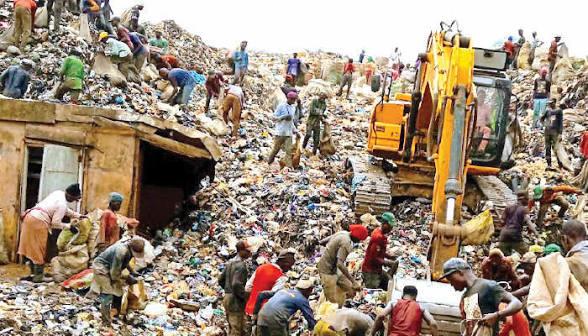
Gbadegesin stated that Olusosun receives about 10,000 tonnes of municipal solid waste daily, underscoring the enormous consequences of any disruption at the facility.
The challenge is therefore partly logistical.
When a facility handling thousands of tonnes daily experiences access problems, trucks spend longer waiting, collection cycles slow down and waste can begin to accumulate in the communities.
Beyond the landfill
Lagos is also attempting to move away from a system that relies heavily on dumping waste in landfills.
The state says it plans to develop material recovery and waste-to-energy facilities that would recover useful materials from refuse instead of sending everything to disposal sites.
At Olusosun and Solous III, two new Transfer Loading Stations are under construction.
According to LAWMA, each is designed to process about 2,500 tonnes of waste daily, while the facilities are expected to divert significant volumes towards recycling and treatment.
LAWMA has also assured that the government remains committed to eventually decommissioning Olusosun, but that this would be gradual and dependent on the availability of alternative infrastructure.
That caution is significant.
Olusosun’s enormous daily throughput means that shutting it prematurely without sufficient alternatives could create a far larger crisis.
The proposed transition towards material recovery and refuse-derived fuel, RDF, also represents a different philosophy: waste becomes a resource rather than merely something to bury.
For a city generating up to 15,000 tonnes daily, such a transition could reduce pressure on landfills while creating opportunities in recycling, energy recovery and the circular economy.
But infrastructure must first be built and made operational at the required scale.
The cart-pusher dilemma
Perhaps no aspect of Lagos’ waste problem illustrates the complexity of the crisis more vividly than the proliferation of illegal cart pushers.
Some residents patronise cart pushers because they offer quick and sometimes cheaper alternatives when PSP services are perceived as irregular, unavailable or unaffordable.
The critical question, however, remains: where does the waste go?
When refuse is collected outside the formal system, there is no guarantee that it will reach an authorised disposal or transfer facility.
This can simply move the problem from a household to a roadside, canal, vacant plot or another illegal dumpsite.
The Lagos State Government has repeatedly urged residents to pay approved PSP operators and avoid cart pushers.
The Commissioner for the Environment and Water Resources, Tokunbo Wahab, previously said that the government had identified syndicates behind cart-pushing operations and illegal dumpsites.
He warned that enforcement against cart pushing would be intensified.
LAWMA has also established a coordinated “waste police” initiative involving stakeholders, including transport unions and community groups to strengthen enforcement against illegal dumping.
The authority said that it was simultaneously expanding infrastructure and supporting additional collection capacity.
The dilemma, however, is that enforcement alone may not eliminate the demand for informal collectors.
If residents cannot obtain reliable, affordable and timely collection through the formal system, an informal market will continue to find customers.
The Badagry corridor controversy
The tension between environmental enforcement and livelihoods was again exposed during the recent clearance of illegal structures along the Lagos-Badagry Expressway.
The state government ordered the removal of shanties and illegal structures occupying the median between Orile-Iganmu and Okokomaiko, describing the occupation as an abuse of public infrastructure and a threat to the corridor’s development.
Wahab subsequently said that the enforcement would be sustained and followed by continuous surveillance to prevent reoccupation.
During the operation, however, reports emerged of officials burning wooden debris after the structures were removed.
The incident generated questions about how government enforcement should deal with informal recycling and waste-recovery activities that have developed around such settlements.
While the government has a legitimate responsibility to protect public infrastructure and enforce environmental laws, environmentalists argue that informal recyclers should not simply be treated as environmental offenders.
They form part of a broader informal recycling economy that recovers materials which might otherwise end up in landfills.
The challenge for policymakers is therefore to regulate and formalise useful activities without allowing them to become sources of illegal dumping, obstruction or environmental degradation.
The resident’s responsibility
Government infrastructure cannot solve the problem if residents continue to dump waste indiscriminately.
Waste thrown into drains can obstruct water flow, while refuse deposited along roads and waterways can worsen flooding during heavy rainfall.
The Lagos State Government has consequently linked sanitation enforcement with its broader flood-management strategy.
Wahab has repeatedly stressed the importance of making proper sanitation a daily habit, while urging residents to use approved waste-collection channels.
The government’s position is that keeping Lagos clean is a shared responsibility involving government, service providers, businesses and residents.
That argument is difficult to dispute.
But responsibility must also be matched by reliable service.
A resident who pays for waste collection reasonably expects the service to be regular, predictable and efficient.
Can Lagos outrun its waste crisis?
The evidence suggests that Lagos is not standing still.
The state is investing in additional compactor trucks, transfer-loading infrastructure, landfill rehabilitation, recycling, material recovery and longer-term waste-to-energy projects.
In March, the state announced plans for a major waste-to-energy facility in Epe capable of processing about 3,000 tonnes daily.
LAWMA also reported that its facilities and PSP network evacuated 418,500 tonnes in May, demonstrating that enormous quantities are being moved through the system.
Yet the persistence of waste blackspots tells another story.
A system can evacuate thousands of tonnes and still fail to keep every neighbourhood clean if waste generation continues to grow faster than collection, transportation, treatment and disposal capacity.
The real test of Lagos’ reforms, therefore, will not be the number of tonnes evacuated from landfills.
It will be whether residents see fewer waste heaps, cleaner streets, functioning drains, reduced illegal dumping and reliable collection.
Lagos has the population, economic activity and waste volume to make waste management one of its defining urban challenges.
It also has the opportunity to turn that burden into an economic resource.
But achieving that transformation will require more than trucks, enforcement or new landfills.
It will require infrastructure that matches the city’s growth, effective regulation of PSP operators, integration of informal recyclers, responsible behaviour by residents and sustained investment in recycling and waste-to-resource technologies.
Until those pieces work together, Lagos may continue to experience the paradox of a city that is evacuating thousands of tonnes of waste every day while refuse remains one of the most visible signs of its rapid urbanisation.
The question, ultimately, is not whether Lagos produces too much waste.
It is whether the city can build a system capable of keeping pace with the Lagos that is emerging every day.
M.P
Tags: lagos LAWMA