

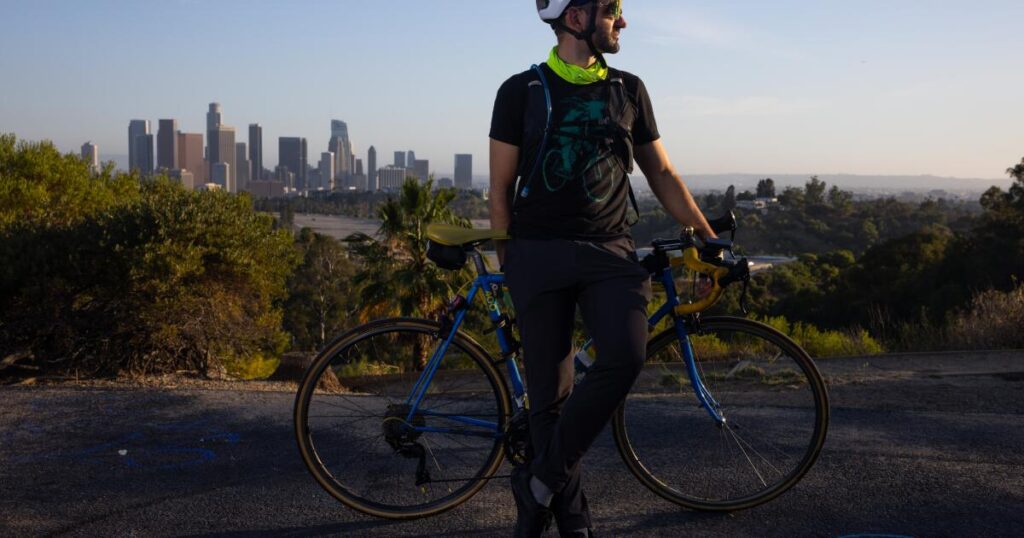
It’s a few minutes after 10 a.m. on a recent morning and the thermometer is closing in on 95 degrees, but Marc Papas isn’t fazed. “The heat doesn’t bother me much,” he said, unloading his bicycle — a blue and yellow 1989 Trek 400 — from the trunk of his car on a side street in Reseda. “I just keep going.”
Papas adjusted the heart monitor underneath his T-shirt, checked the bike computer attached to his handlebars, then set off on the day’s ride; he’s taken it upon himself to bike every public street in Los Angeles. The Phoenix native has completed over 78% (about 5,840 miles) after two years. He calls it “The Project,” and says there’s about 7,516.07 miles in total, when you include various enclaves and adjacent cities like Beverly Hills or Burbank. Today he’s headed toward the longest continuous bike lane in Southern California — a stretch of Reseda Boulevard. It’s an unexpected amenity in a part of the city that seems otherwise hostile to pedestrians and cyclists, but one Papas wants incorporated around more of Los Angeles.
“Somebody once asked me on a Reddit Ask Me Anything what is one street you think needs a bike lane,” he said. “I wrote him a whole essay in response, because I can’t just say one street.”
After a few blocks on Reseda, Papas turned back into the neighborhood centered around Etiwanda and started tracing loops across the blocks. It’s his standard pattern for covering any area he rides for the Project. “I base my routes on a math theory called the Eulerian Path,” said Papas, a mechanical engineer by training. Each new segment of the city he rides is generally a rectangle bound by major streets. “Then, I start with loops around the edges and work my way in,” he continued. “It’s the most efficient way to cover an area without overlapping.”
Today’s ride would yield eight new miles for Papas. “So, I’ll be about 12 miles away from 80%,” he calculated.
Papas started his biking project almost by accident. He moved to Los Angeles in late 2020 after finishing his PhD at Georgia Tech. He had taken up biking around Atlanta as part of triathlon training and worried he wouldn’t be able to continue once arriving in L.A.
“I remember having a sort of fear around it,” said Papas. “I’d heard it’s just so car-filled and dangerous to be on the roads.” But riding along the beach and around much of the Westside quickly changed his mind. With perfect weather year-round and a mostly flat topography, why wasn’t everyone in L.A. riding bikes?
He was soon cycling to work in Monrovia from his apartment in Pasadena, and biking more than he ever had in his life. “Sometimes friends would be surprised to learn I have a car,” he said. “They thought I bike everywhere because I don’t drive.”
Then, on Dec. 31, 2023, Papas decided to get in one last bike ride for the year. He rode a section of San Marino that he and friends refer to as “The Mitochondria” for the shape the streets make when viewed in the tracking app Strava. After riding the Mitochondria, he decided to keep going — making a path up each street and block — until he was satisfied. It gave him the idea to ride every mile of street in San Marino. “It’s only 60 miles total,” said Papas. “That seemed doable.”
Finishing the 60 miles of San Marino led to completing the 400 miles of Pasadena. He next found himself taking detours to cover new streets in Northeast Los Angeles as he’d ride to and from Koreatown Run Club meet-ups at Los Angeles Community College. But it wasn’t clear to himself, or anyone else, what he was doing. “Friends were seeing my Strava activities and texting me like, ‘What the heck are you doing, man?,’” Papas recalled. One friend jokingly asked if he was drawing the Nazca lines across the city, but Papas wrote it off as just trying to clock extra mileage. “There’s a level of self-deception, because riding the whole city of Los Angeles seemed impossible to do,” he said. Still, his treks around Northeast L.A., East Hollywood and Los Feliz were starting to build up mileage — he had completed about 18% of the city.
When Papas drove out to North Hollywood in November 2024 specifically to track new mileage, he realized he had crossed the Rubicon. “At that point, I can’t lie to myself anymore about what I’m doing,” he said. “I’m driving out to these places to get miles more efficiently. When that happened, I was like, all right, I’m in it for the long haul.”
As Papas covered more and more of the city, he began growing an appreciation for various architecturally-significant neighborhoods as well as the many murals across large swaths of South and East L.A. “There are beautiful pieces of art on the walls that you wouldn’t imagine,” he said. “I want to take people to these places and do a mural tour.” He was especially moved when he was riding in Pacoima and saw a Buddy Holly and Ritchie Valens mural that memorializes the tragic plane crash that killed both Holly and Valens. “So many of these murals are commemorating people and events that are culturally important to those specific areas,” he added.
The bike rides were connecting him to his city in ways he never expected. “I’m not necessarily saying that everybody needs to go out and ride their bikes,” said Papas, though he’d certainly love it if more Angelenos did. Instead, he hopes his biking project is showing people what’s possible — in the most extreme way. Yes, you can bike in Los Angeles, as many Angelenos often do out of necessity. It’s even enjoyable. And yes, you can do it across every single mile of the city, even if the cycling infrastructure isn’t perfect yet. “I think to me, success would be if people just go out and explore their own neighborhood,” he said. He views cycling as a form of civic engagement and a way to see things otherwise invisible when speeding by in a car. For beginners, Papas recommends sticking to bike paths and joining cycling groups. More experienced riders should venture out into new areas, said Papas. “Biking is like a superpower to gain familiarity with your neighborhood, but it just needs to be unleashed.”
Last September, Papas passed the 50% mark of his project and estimates he’s been covering an additional 1% (or about 75 new, unique miles) every week since. That puts him on pace to finish sometime around mid-December — should everything go smoothly — nearly three years after he first began. Does he know what his final mile will be? “Eldred Street in Mount Washington,” he said. He notes it’s one of the steepest streets in the entire country.
“It’’s a fitting end, like a final boss [in a video game], just one last all-out hard effort to completely finish things off,” Papas said. “It gives me goosebumps to think that would be the time and place that this years-long project would be done.” Of course, there’s always the rest of Los Angeles County to conquer.