

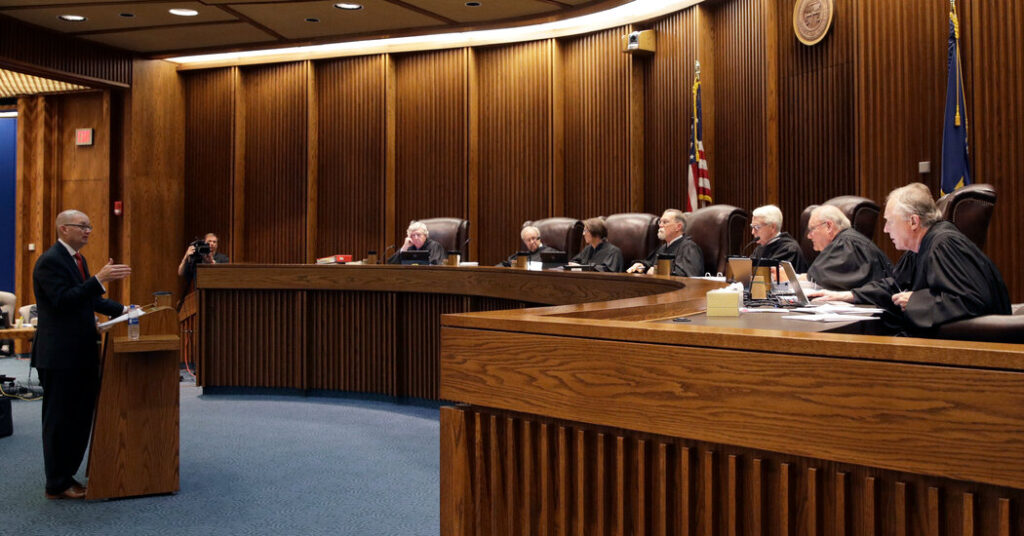
Kansas voters on Tuesday rejected a ballot measure that would have required state Supreme Court justices to be popularly elected rather than appointed by the governor, dealing another setback to Republican lawmakers trying to overturn a decision that established a constitutional right to abortion.
That ruling in 2019 has preserved Kansas as a significant abortion provider for women in a wide swath of middle-American states that banned abortion after the U.S. Supreme Court overturned Roe v. Wade.
The Republican-controlled Legislature put the amendment on Tuesday’s ballot, arguing that the court had repeatedly failed to represent the will of the state’s voters. Lawmakers disagreed with other court rulings, including one requiring the Legislature to spend more on public schools.
But Republican leaders made clear to anti-abortion groups that the measure was mainly aimed at abortion.
The Legislature had tried and failed before to get voters to reverse the court ruling, putting an amendment on the ballot in August 2022 that would have amended the constitution to say there was no right to abortion. The vote came six weeks after the reversal of Roe, and 59 percent of Kansas voters rejected the amendment.
That vote inspired abortion rights supporters in a dozen other states to pass ballot measures establishing or affirming a constitutional right to abortion.
Both opponents and supporters of the ballot measure defeated on Tuesday had argued that its passage would inspire Republican-controlled legislatures in other states to remake appointed courts that have blocked bans on abortion and gender care, and upheld nonpartisan redistricting commissions.
With conservatives dominating the U.S. Supreme Court, groups that support abortion and L.G.B.T.Q. rights in particular have turned to state supreme courts to establish those rights in their constitutions.
Kansas is one of 21 states with an assisted appointment system. The governor — since 2019, a Democrat and a supporter of abortion — selects justices from a list put forward by a nine-member nominating commission. The governor appoints four members of the commission and the state’s lawyers elect five. New justices face a retention election after their first year and every six years after that.