


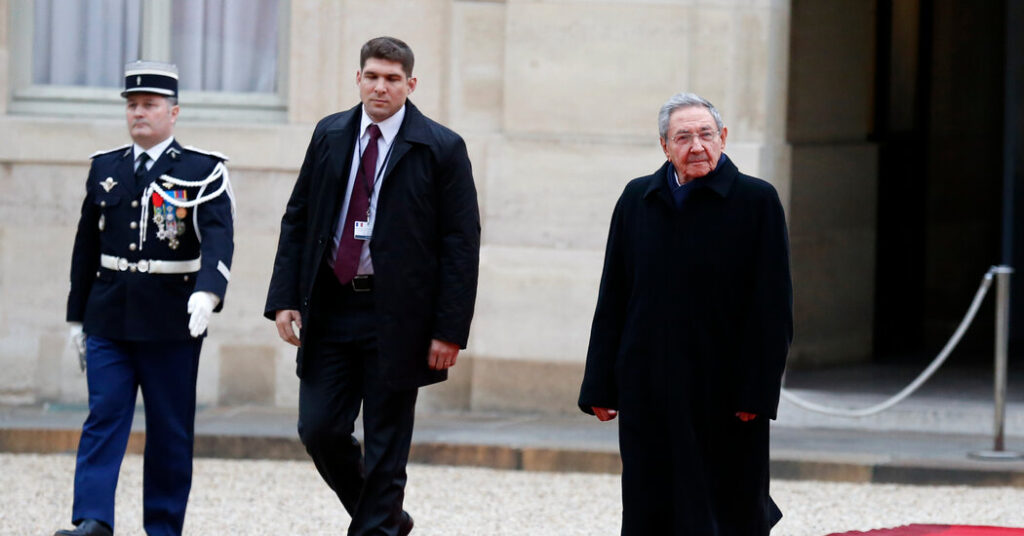
Raúl Castro was on an official state visit in Paris a decade ago as Cuba’s president when a hulky bodyguard in his entourage stood out.
The man kept so close to Mr. Castro while they walked the red carpet at the Élysée Palace that a member of the French honor guard tried pulling him back.
Even François Hollande, France’s president at the time, waved him back.
The security escort who kept inserting himself in official photos was none other than Mr. Castro’s grandson, Raúl G. Rodríguez Castro, a colonel in the interior ministry.
Today, the once largely unknown bodyguard has become a key figure in Cuba’s talks with the United States, even though he has never held public office. His name has even come up as someone the Trump administration might find acceptable to become Cuba’s next leader.
“He exemplifies how that government operates,” said Tim Rieser, a foreign policy aide to former Senator Patrick Leahy, a Democrat from Vermont, who met Mr. Rodríguez Castro several times. “It’s a lot like a family business, and so someone who was described to us a decade ago as President Castro’s bodyguard has for whatever reason, by whatever means, become something much more than that.”
But Mr. Rodríguez Castro, who has met with some of the most senior people in the Trump administration, may have also used his considerable influence to protect a large-scale smuggling operation that moved people out of Cuba and brought illicit goods into the country, according to interviews and court records.
Mr. Rodríguez Castro, 42, was accused of helping funnel goods purchased with stolen credit cards into the country, receiving luxury items as bribes and allowing wanted criminals to roam free on the island, the interviews and court records show.
The scheme was the target of a federal investigation that resulted in the convictions of at least 21 people and decades-long sentences. Mr. Rodríguez Castro has not been charged.
This article is based on court documents and interviews with nearly a dozen people who either know Mr. Rodríguez Castro personally, including one person close to the U.S. negotiations, or are familiar with the criminal investigation in which his name surfaced.
Mr. Rodríguez Castro did not respond to requests for an interview sent through formal diplomatic channels and a mutual acquaintance. A top Cuban official called the accusations slanderous.
Mr. Rodríguez Castro’s prominent role in the discussions with the Trump administration seemed to astound some Cuban officials who viewed him as merely a caretaker for his grandfather.
Still, an official with the Central Committee of the Communist Party of Cuba took to social media last month to say Mr. Rodríguez Castro had been the subject of “character assassination” in the U.S. media, which was aimed at making the Cuban government appear divided.
As he helps Cuba’s government try to survive and navigate its standoff with the United States, those who have spoken to Mr. Rodríguez Castro say he has made no secret of his ultimate ambition to be his country’s next president — though it is unclear whether he has the internal support to do so.
The Cuban Smugglers
The human smuggling network was known as the Cuban Mafia in Quintana Roo; its name came from the state in eastern Mexico where it was based.
The ring used boats stolen from Florida to sneak people out of Cuba who wanted to reach the United States, according to the Justice Department and members of the criminal gang who cooperated with prosecutors.
The Cuban migrants would be taken to Mexico, where they were held in safe houses until they paid smuggling fees, and were tortured if they didn’t, according to court testimony.
Two defendants in the case implicated Mr. Rodríguez Castro as a collaborator in the organization, according to court records and interviews with several people familiar with the investigation. Both defendants, José Miguel González Vidal and Reynaldo Crespo Márquez, pleaded guilty and were sentenced to long prison terms for their roles in the scheme.
Mr. Rodríguez Castro arranged safe passage for the group into and out of Cuba, a leader of the group told U.S. prosecutors, several people familiar with the case said. Mr. Rodríguez Castro’s name came up in a U.S. Department of Justice case in 2020 against the group, according to evidence gathered by prosecutors and one of the people familiar with the investigation.
The people who know Mr. Rodríguez Castro spoke on the condition of anonymity to preserve relationships with Cuban government officials, and those familiar with the criminal case did so to discuss sensitive legal matters they were not authorized to disclose.
It is unclear whether Mr. Rodríguez Castro is a target of the ongoing investigation. The Justice Department declined to comment.
The smuggling ring stole vessels from South Florida to bribe foreign officials, according to an admission statement filed in federal court as part of a guilty plea signed by Mr. González Vidal, who was sentenced to 25 years in prison.
The statement does not name Mr. Rodríguez Castro.
But Mr. González Vidal and another defendant told U.S. authorities that Mr. Rodríguez Castro was among the foreign officials who received a stolen boat, court records show.
The issue was also discussed in open court.
During a September 2023 trial in Miami, a defense lawyer asked Mr. Crespo, who was a cooperating witness, about a meeting in which he told prosecutors that Mr. González Vidal and Mr. Rodríguez Castro had discussed sending him a boat in Cuba. Mr. Crespo is serving 20 years in prison for his role in the smuggling operation.
Mr. González-Vidal said the men who smuggled migrants and goods bribed Mr. Rodríguez Castro to keep the Cuban Coast Guard and Customs away, three of the people said.
In exchange for allowing merchandise that the smuggling network bought in Mexico with stolen credit cards to clear Cuban customs, Mr. Rodríguez Castro was given a Fountain 38 high-performance boat and various other gifts, including a Rolex watch, Suzuki motorbike and Louis Vuitton clothes, Mr. González Vidal claimed.
The products were later sold in Cuban government stores, he said.
Mr. González Vidal’s account was supported by text and voice mail messages that the F.B.I. extracted from the cellphones of members of the smuggling ring, the people familiar with the case said.
Mr. González Vidal’s lawyer, Juan D. Berrios, declined to comment.
Mr. Rodríguez Castro, in a recent interview with USA Today, which some critics took to be self-promotional, he said he had no wealth of his own. “Wealthy friends and admirers” had paid for fashionable clothes, luxury foreign vehicles and expensive overseas trips, he said.
A Slanderous Accusation
Cuba’s deputy foreign minister, Carlos R. Fernández de Cossío, in an interview with The Times in Havana, called the accusations against Mr. Rodríguez Castro involving the smuggling ring “slander.”
He said that for several years during migration talks with the United States, Cuban officials had repeatedly raised concerns about widespread smuggling of Cubans through Central America and Mexico.
They received no response, he said.
“We alerted them. Meeting after meeting: ‘Have you taken action? What have you done?’” Mr. Fernández de Cossío said. “I cannot doubt whatsoever that there are organizations in Mexico, in Central America and in other parts of Latin America, which involve Cubans that have been making money and had a business of smuggling aliens to the United States.
“But I can assure you,” he added, “there’s no link with the Cuban government.”
The State Department did not respond to a request for comment.
One American close to the U.S.-Cuba discussions said that, despite the allegations of smuggling, Mr. Rodríguez Castro was considered a worthy representative to interact with the Trump administration because his fondness for material goods suggested he was open to capitalist ideas.
Mr. Rodríguez Castro is not apologetic about his lifestyle.
“It pains me that many people can’t live the way I do,” Mr. Rodríguez Castro told USA Today. “And I’m working every day to change that situation.”
A Golden Boy of Cuba’s Elite
Mr. Rodríguez Castro is the son of Raúl Castro’s eldest daughter, Déborah Castro Espín, and the late Gen. Luis Alberto Rodríguez López-Calleja, a powerful figure who helped establish Cuba’s military conglomerate, known as GAESA, which manages much of Cuba’s ailing economy.
His parents had a troubled marriage, so Mr. Rodríguez Castro, who is also known as “Raulito,” spent much of his youth at his grandparents’ house, several people who knew him in his youth said. His nickname, which is how he is commonly known, is “el Cangrejo,” meaning “the crab,” and was given to him because he was born with an extra finger on one hand.
Despite his revolutionary roots, he is descended from an upper-class family — his grandmother was an heir to the Bacardi rum fortune. He enjoyed extreme sports, music with racy lyrics and was less polished than other members of Cuba’s revolutionary elite.
He studied economics at the University of Havana, where he received credit for traveling with his grandfather, said Juan Juan Almeida, the exiled son of a hero of the 1959 Cuban revolution who was close to the Castro family for many years.
He described Mr. Rodríguez Castro as affectionate and friendly.
“He is better known outside Cuba than inside,” he said. “Cangrejo and all the Castros know that their power only lasts until the day his grandfather dies.”
Mr. Rodríguez Castro, who is often photographed wearing expensive designer clothes, was widely known during his younger years for being spotted in videos partying at concerts, hanging out with the reggaeton duo Gente de Zona and on boats.
One family member said he sometimes traveled around Havana in one of his grandfather’s BMWs, which irked some who thought it projected a bad image in a country where people suffer severe food, medicine and power shortages.
Mr. Rodríguez Castro has enjoyed extraordinary access, attending virtually every one of his grandfather’s meetings, including with the late Pope Francis.
After serving as a bodyguard, he became more of a personal assistant for Mr. Castro, 95, who was vice president for decades and became president in 2006 when his brother Fidel fell ill. While he no longer holds any official government post, Mr. Castro is widely considered the most powerful person in Cuba.
After Cuba began secret meetings with the United States this year seeking to end sanctions imposed by the Trump administration, Mr. Rodríguez Castro met separately with C.I.A. Director John Ratcliffe and Secretary of State Marco Rubio. (The C.I.A. has covertly created a task force as part of the U.S. campaign to pressure Cuba into political, economic and leadership change, The Times reported.)
Arturo Lopez-Levy, a research associate at the University of Denver who is a second cousin to Mr. Rodríguez Castro, said much of the criticism of his relative is based on videos of rowdy behavior that circulated more than a decade ago.
He has not spoken to his cousin in about seven or eight years, he said, but his public persona appears to have changed considerably.
“The relationship with his grandfather has changed from a young man who was quite immature to someone with political knowledge and connection to his grandfather — not only for the protection of his life, but politically,” said Mr. Lopez-Levy, a former analyst at Cuba’s Ministry of Interior. “He has not been outside the door; he has been inside every meeting.”
Reporting was contributed by David Ovalle and Jack Nicas. Seamus Hughes and Kristen Noyes contributed research.