

Jonathan Earle is the author of “He Has the People: Abraham Lincoln and the Election of 1860,” from which this article is adapted.
When the abolitionist John Brown raided the sleeping Virginia town of Harpers Ferry in October 1859, he intended to arm the region’s enslaved people and start an insurrectionary war in the South. The raid was a catastrophic failure. It ended barely 36 hours after it began and left 10 of the 21 men who joined Brown dead, including two of his own sons. Another six — and Brown himself — were tried and executed by the state of Virginia.
The raid also seismically altered the presidential election that was on the horizon in 1860. Indeed, it helped get Abraham Lincoln elected.
Before the raid, Republicans were confident, bordering on cocky, about their fortunes in 1860. True, the party had only existed for five years, but already it stood poised to take control of the House of Representatives by appealing to Northerners hostile to slavery and its expansion. The party also reflected an expanding electorate by advocating for pro-growth economic measures such as more railroads and free homesteads.
But could the new Republican Party win the ultimate political prize? In its first presidential election, 1856, it had come close. Its neophyte candidate, John C. Frémont, won all of the upper North and almost captured Illinois and Indiana. Four years later, leading Republican candidates — such as Sen. William Henry Seward of New York, the presumed standard-bearer; Ohio Gov. Salmon P. Chase; and Lincoln, a lawyer and former one-term congressman who was at the time considered vice-presidential material — felt confident of a Republican victory in November.
The likeliest Democratic candidate, Sen. Stephen A. Douglas of Illinois, had staked his political future on the concept of “popular sovereignty”: letting a new territory’s residents choose whether to allow slavery. But this moderate-sounding idea opened millions of acres of land, previously closed to slavery, to settlement by enslavers and their human property. The stance was enough to help Douglas eke out a narrow victory against Lincoln for a U.S. Senate seat in 1858, but it left him vulnerable nationally, both to committed antislavery voters and to Southern Democrats who wanted slavery in every state.
Brown’s attack on Harpers Ferry made Southerners question whether the popular sovereignty espoused by Douglas was a strong enough position to guarantee slavery’s existence in hostile places. At the same time, the specter of slave insurrection, disunion and even race war made moderate Republicans doubt whether antislavery candidates like Seward and Chase could be successful in the lower North and Midwest, where opposition to the institution was weaker — and where the party needed to improve on its 1856 totals. The compromise politics of the previous decade had crumbled.
“The old idiot,” wrote one Republican newspaper editor of Brown. “The quicker they hang him and get him out of the way, the better … we are damnably exercised here about the effect of Old Brown’s retched fiasco … upon the moral health of the Republican Party!” The Baltimore Sun, heretofore the voice of border state moderation, wrote that the South could not afford to “live under a government, the majority of whose subjects or citizens regard John Brown as a martyr and a Christian hero, rather than a murderer and a robber.”
In the Deep South, newspapers declared that Brown’s actions were the logical outcome of Republican agitation over slavery restriction. Seward rapidly — and unfairly — became the face of Brown’s Republican defenders. “Brown may be insane,” wrote the Richmond Enquirer, “but there are other criminals, guilty wretches — who instigated the crime perpetrated at Harpers Ferry.” The writer meant Seward.
Meanwhile, Northern pro-slavery Democrats worked to persuade the public of a link between Brown and the Republican Party. In November 1859, one group held a convention where speakers vied with one another to make the strongest claims about Brown’s supposed Republicanism. (In fact, Brown was critical of organized political parties and barely voted.) “The principle on which John Brown and his allies acted is the same which has been proclaimed by the leaders of the Republican Party,” said one speaker. Brown’s actions were “the misguided, guilty tools of more subtle and dangerous men.”
What could Seward do? He repeatedly distanced himself from Brown and denounced the raid. He and his allies made speeches and wrote editorials bending over backward to reassure the South.
But even before Brown was executed in Charles Town, Virginia, on Dec. 2, it was becoming clear that the candidates who had seemed best positioned to win their parties’ nominations before the raid — the Northeastern Seward wing of the Republican Party and Douglas’s popular sovereignty Democrats — were in line to pay the steepest political price for Brown’s actions.
One observer recalled that he “had a very strong belief” in Seward’s nomination “till since Mr. Brown visited Virginia. That little incident has thrown a new cloud over the presidential talk.”
The biggest beneficiary of Brown’s raid proved to be Lincoln, whose origins in a border state — Kentucky — and more moderate professed views on slavery reassured voters who worried about Seward’s supposed radicalism.
Lincoln, an ambitious politician, chose a savvy way to capitalize on Seward’s misfortune: He decided to clothe himself in the founders’ views on slavery and its expansion. He spent the winter of 1859-60 researching and writing an address to deliver at New York’s Cooper Union in February, in which he argued that the men who crafted the U.S. Constitution and the 1787 Northwest Ordinance — which forbade slavery in the territory that eventually became Illinois, Indiana, Michigan, Ohio and Wisconsin — would have approved barring slavery from federal territories.
The speech satisfied moderate Republican demands for no new slave states, while the clever use of history helped Lincoln avoid being seen as radical. That day, he established himself as a national political figure and a contender for the top spot on the party’s ticket. Lincoln biographer David Donald notes that the Cooper Union address, delivered in Seward’s home state and in a city abundant with newspapers, transformed Lincoln’s reputation from that of a “crude frontiersman” to the new face of a rising Republican Party.
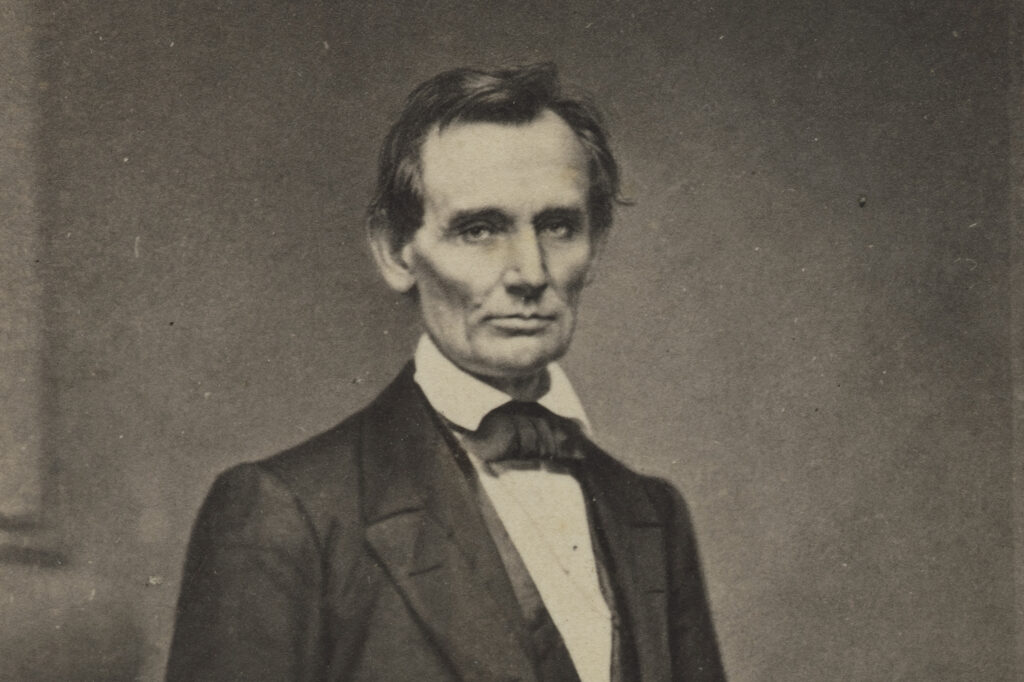
Brown’s failed insurrection heralded a new majority, based in the North, with enough electoral votes to win the White House. This majority demanded a stop to slavery’s advance but also sought out a new face to manage the crisis of Brown’s raid. On the day of the Cooper Union address, photographer Mathew Brady captured that face in a now-famous image: It was Abraham Lincoln.