

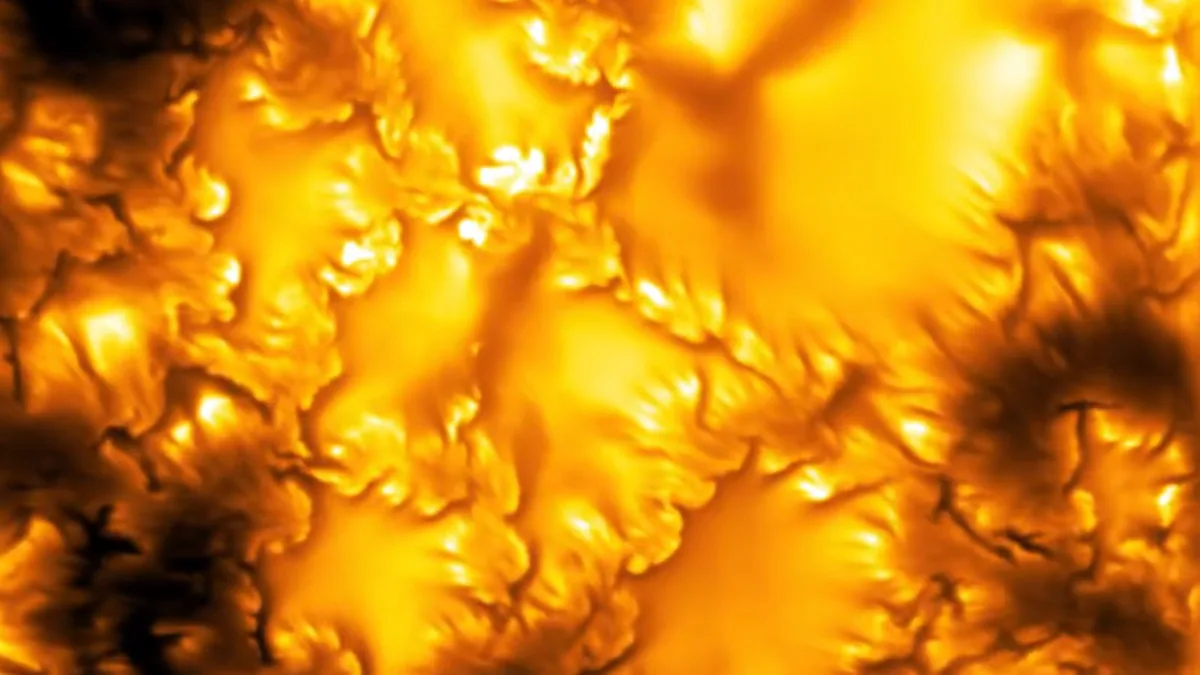
The observations have revealed tiny magnetic whirlpools known as Kelvin-Helmholtz Instability (KHI), which researchers say could help explain explosive solar activity and why the Sun’s outer atmosphere is much hotter than its surface.
The breakthrough was made using the National Science Foundation’s Daniel K. Inouye Solar Telescope in Maui, Hawaii.
ALSO READ | Sun unleashes powerful solar flares, ISRO warns of radio blackout
By combining detailed imagery with computer simulations, an international team of researchers identified Kelvin-Helmholtz Instability (KHI) in the form of small, swirling, whirlpool-like patterns on the Sun’s surface. The observations provide the first confirmation of a phenomenon that had long been predicted by theory.
☀️ Scientists using the @NSF Inouye Solar Telescope have made a major breakthrough in solar physics, discovering Kelvin-Helmholtz instability on the Sun’s surface—a finding that could help explain explosive solar activity and other solar phenomena: https://t.co/GHDS3B7UXT pic.twitter.com/yJhD4KecVY
— National Solar Observatory (@NatSolarObs) August 5, 2026
Published in the journal Nature, the findings offer fresh insight into the complex magnetic processes taking place on the Sun. Researchers say the newly discovered whirlpools could help build up and transport magnetic energy on the Sun, powering solar flares, coronal mass ejections and other explosive solar activity.
What are these solar whirlpools?
Kelvin-Helmholtz Instability occurs when two fluids move past each other at different speeds, creating swirling, wave-like vortices. The phenomenon has previously been observed in ocean waves, Earth’s clouds and the atmospheres of planets like Jupiter and Saturn. This is the first time it has been detected on the Sun.
Researchers observed whirlpool-like structures along the edges of magnetic regions on the Sun’s surface. The observations also revealed ultra-fine dark stripes that closely matched advanced computer simulations, providing the first experimental confirmation of Kelvin-Helmholtz instability.
ALSO READ | X-class solar flare marks most intense Sun activity in years: What is it and why it matters
Why the discovery matters
Scientists say the newly discovered vortices could help explain one of solar physics’ longstanding mysteries: why the Sun’s outer atmosphere, or corona, is much hotter than its surface. The whirlpools are also believed to twist the Sun’s magnetic field lines, contributing to the buildup of magnetic energy that powers solar flares and coronal mass ejections.
When directed towards Earth, these solar eruptions can disrupt satellites, GPS navigation, power grids and global communications, highlighting the importance of better understanding solar activity.
(Edited by : Sudarsanan Mani)