

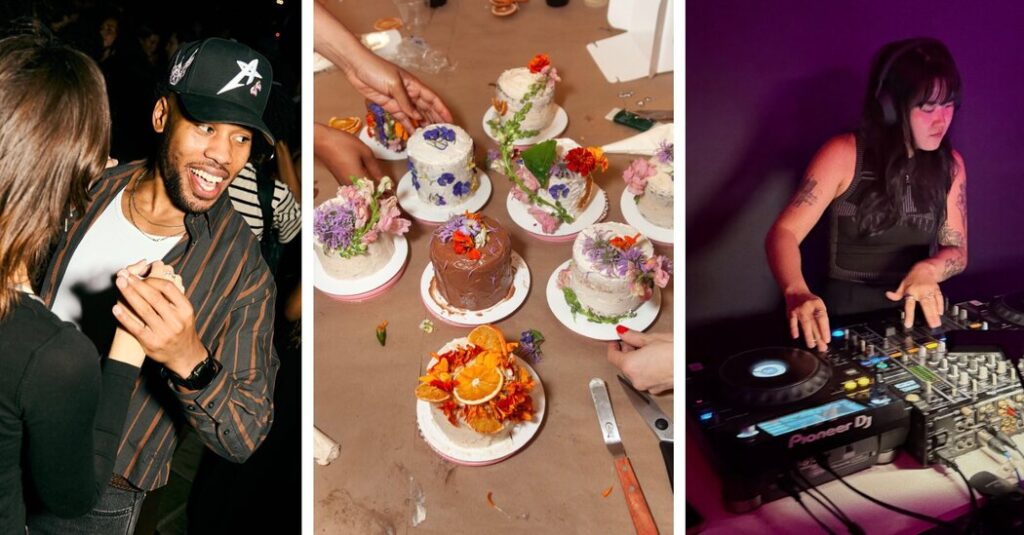
Salsa class after work on Monday. Chess club on Tuesday. Boxing on Wednesday.
That was only the first half of Tylo Laidlaw’s week. So when the conversation turns to dating, the answer is simple: Lately, he’s making more time for hobbies than dates.
After his last relationship ended in 2024, Laidlaw realized he’d become stagnant and robotic. Even though he followed the trajectory of graduating from college, getting a job and saving money, “something was missing,” he said. He wasn’t feeling connected to himself.
Laidlaw, 30, started trying different hobbies. For him, it was about staying curious and putting himself in environments he wouldn’t otherwise be in. And now, he feels more well-rounded. Chess, for example, introduced him to new people and taught him life lessons around strategy and accountability.
“I’m so fulfilled in my life that I know the right person will come,” said Laidlaw, a freelancer in creative direction who lives in London. “But I’m not out searching for it.” Even though he’s a relationship kind of guy — “I want to do the boom box outside the house,” he said, referencing a scene from the 1989 classic film, “Say Anything” — he’s finding he’s less concerned with dating because he’s enriched in other ways.
“I’m so good with where I’m at,” he said, that “the energy becomes infectious.”
You could call it “hobbyamory”: Laidlaw is among a growing number of singles emphasizing multiple hobbies over dating. Rather than spending hours swiping and messaging on apps, these singles are investing their time, energy and disposable income in passions like rock climbing, cake decorating and cyanotype printmaking. They say their social calendars are packed, their friend groups are expanding and their lives feel rich, with or without a romantic partner.
Young people are prioritizing their well-being and happiness in a way that other generations have not, said Alexandra Solomon, a clinical psychologist and adjunct professor at Northwestern University. “Lots of people in this generation are asking important questions about this capitalist model of working from nine to five,” Dr. Solomon said. “They’re trying to create lives that have some more flexibility and adaptability and that really value the experiences in life that are beyond just earning money.”
They are also a generation feeling disenfranchised by A.I. and disinclined toward drinking, making wholesome, creative and tactile activities all the more appealing. Online, terms like “hobbymaxxing,” the pursuit of as many hobbies as possible, have taken off. According to TikTok, #hobbies has seen an almost 15 percent increase in posts in the U.S. so far in 2026 compared to last year, and #grandmahobbies has grown by more than 400 percent.
“Side quest,” a term originally used in gaming, has taken on a new life online: It describes the activities and adventures in which people partake outside their routines to add whimsy to their lives. According to TikTok, U.S. posts using the term “side quest” increased over 210 percent this year compared to the same time period last year.
Lisa Kimura, a 31-year-old user experience designer in Brooklyn, has mastered the art of the side quest. Early last year, she learned to D.J., inspired by a flourishing music scene in her Bushwick neighborhood that she felt needed more women.
She also took a genealogy class last year and began building her family tree, then picked up Japanese calligraphy. Her most enduring passion, though, is fiber arts. She knits and dabbles in just about every fiber craft she can get her hands on, she said, including crochet, tapestry weaving, rug tufting, embroidery and cross-stitch.
Kimura moved to New York in 2023, excited for the dating scene. But as an introvert, she found the experience draining. She hasn’t been on a date since last summer.
“I realized that it’s really difficult for me to hear my inner voice when I’m in a relationship,” or sometimes just in the presence of a man, she said. “I grew up in a very traditional, very immigrant household where the patriarchy was alive and well.”
Hobbies have helped Kimura feel more secure and find her voice, partly because many of her hobbies end with a finished product, giving her a feeling of accomplishment. Unlike the women in previous generations in her family, whose lives were centered on marriage and raising children, she feels empowered to pursue the activities that bring her happiness.
“I feel like I can design my future,” she said. As for romantic relationships, Kimura said she’s not closed off to dating indefinitely. “I just don’t feel like I’m in such a rush anymore.”
Natalie Mora, a 21-year-old student in Berlin said, “I’m the single friend who’s always doing everything.” In addition to scuba diving, indoor cycling, bouldering and boxing, “you’ll catch me skydiving, you’ll catch me traveling anywhere, camel riding, horse riding.”
She continued, “I’m young, I don’t have a husband, I don’t have kids. I’m the happiest I’ve ever been: single.”
According to Amy Chan, a dating coach and author of a book called “Unsingle: How to Date Smarter and Create Love That Lasts,” “People have dating fatigue. They are just so disappointed with the apps that some of them are not dating at all.”
For clients who tend to lose themselves in relationships, Chan advises shifting focus away from finding dates and toward building a rich personal life first. “It’s really, let’s build a full life so that you’re not coming from a place of scarcity and you’re not dating like you’re starving,” she said, adding that establishing independence creates a positive ripple effect when they do return to dating.
“There is a collective course correction around dating apps, which have been the centerpiece of dating in the last 10 years,” added Dr. Solomon, the psychologist, and the solution is investing in real-world experiences.
This isn’t necessarily a bad thing, so long as it is not coming from a place of emotional retreat or avoidance, she said: “Putting yourself out in the world with actual humans and actual art projects or creative endeavors or community endeavors — that’s a really healthy adaptation.” And those endeavors could even lead to new romantic prospects who have common interests.
When a relationship ended five years ago, Laura Geaves, who works in marketing in London, hated being single. Over time, as she saw friends go through different stages in their relationships, she thought, “I have so much freedom. I have all my own money to spend, I can go on whatever holidays I want.”
Once she reframed her perspective, she felt lucky. Now, Geaves, 44, said she is thriving in her solo era.
After finishing work at 5 p.m., instead of spending her evening wallowing in bed, as she had sometimes done, she began lighting candles, putting on a movie and crocheting, water coloring, doing puzzles or making pottery. She began looking forward to her activities after work and realized that relationships are not the goal.
“The goal is actually to enjoy your own company, and the best way to do this is to find a hobby that you absolutely love, and you can lose yourself in and get in that flow state,” Geaves said.
Jenneh Kaikai, the owner of Pelah Kitchen, hosts cake decorating classes in New York that are popular for singles. “So many folks join for solo dates and things to do as an alternative to dating apps,” she said. “I think right now, there’s kind of a boom in people wanting to do those sorts of activities — something that’s creative, tactile and also not focused on drinking.”
For Michael Fasulo, who lives in Cambridge, England, and works in marketing, that has included paddle boarding, open water swimming and baking. He took on these activities in January after splitting with a long-term partner. He has two teenage children who have become more independent and developed their own social circles. Those two factors combined left Fasulo, 42, to do a lot of soul searching.
It started with baby steps, he said: “I’m just trying to do things to get my spark back, to lift my mood, to give me something to do.”
“I think where I maybe have gone wrong in the past is I’ve kind of defined happiness by a successful relationship,” Fasulo said. His definition has since changed, though.
“The more confident, the more fulfilled, the more I expand my social network,” he said, “the better partner I will be in the future and the more likely I am to find the right partner as well.”