

Norma Desmond would have approved.
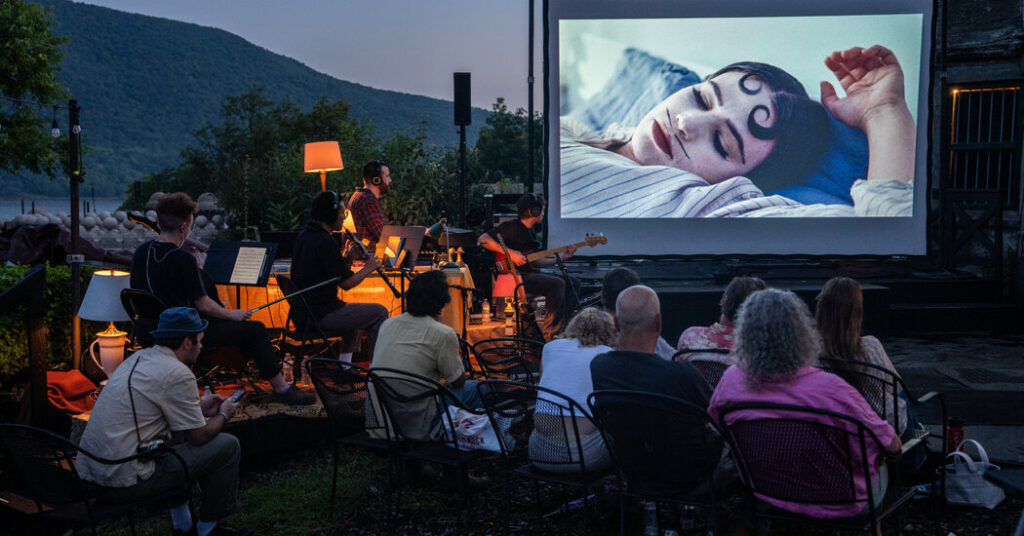
A sold-out silent film festival took place the other night on the grounds of a forbidding castle on a rocky, uninhabited island in the Hudson River. Crowds munched popcorn as they watched seven new shorts that paid tribute to the kind of entertainment that was all the rage before talkies arrived.
The moviegoers rode a ferry from Beacon, N.Y., to reach Bannerman Castle on Pollepel Island (commonly called Bannerman Island). They sat under tree canopies in the buggy heat as silent films were projected onto a big screen.
But they hadn’t gathered to watch the kinds of movies that Desmond, Charlie Chaplin or Rudolph Valentino would have appeared in. The occasion was the Modern Silent Shorts festival, a roving revue and production company devoted to contemporary silent cinema. Since its founding three years ago, it has commissioned select filmmakers to make silent films, which are presented at its screenings.
While the films pay homage to classic silent cinema — a slapstick comedy, “The Weird Guy,” directed by Sandy Honig, included Chaplinesque walks and a swelling iris shot — their story lines are centered on contemporary life.
“Clarities,” directed by Daniel Jaffe and Michelle Uranowitz, begins with a woman sending out an ominous chain text message. “I’m Really Scared I’m Dying TBH,” directed by Lindsay Calleran, follows a young man who seeks advice from strangers on an adult webcam site after he suffers a panic attack.
“The silent medium was wonderful because of the inherent silence of anxiety,” Calleran said, standing by a crumbling ruin. “I was able to create dramatic tension that I just wouldn’t have been able to in a normal film.”
A four-piece ensemble, led by the composer Kevin Donald, played beside the screen. Think of the musicians who once accompanied Buster Keaton flicks, and then imagine if they had grown up on Radiohead, and that approximates the band’s sound.
Roi Cydulkin, a young filmmaker who journeyed to the island from Brooklyn, said the evening gave him newfound appreciation for an obsolete medium.
“Movies like ‘The Odyssey’ and the new ‘Spiderman’ are the biggest films in the world right now, but those films feel almost like rides,” he said. “There’s this thing now where if a movie isn’t shaking all of your senses, then it isn’t working. That creates an underreliance of pure storytelling. Seeing these films makes a case for silent cinema.”
As a storm brewed earlier that evening, the festival’s founders and film producers, Lily Weisberg and Michael Bloom, rode out the rain in a grotto. Both 27, they met as production assistants on the set of a Sofia Coppola movie, and they enjoy watching Lillian Gish films together. Weisberg recounted the festival’s origins, which began on the farm of the actress Isabella Rossellini, who is known for hosting screenings on her Long Island property.
When a family friend of Weisberg, the financier Boykin Curry, attended one of Rossellini’s screenings of old silent films, he was moved by the experience. He then approached Weisberg with the idea of starting an initiative devoted to contemporary silent shorts. Through Curry’s funding, Modern Silent Shorts grants filmmakers budgets of up to $25,000.
“Boykin’s idea was, what if people were still making silent films today — what would they be making them about?” Weisberg, a filmmaker who began directing shorts as an undergraduate at Yale, said. “The way we think about silent films is that we were able to progress out of them, but are there things that can still work better in a silent film?”
Bloom had finally come around to the genre, he said, after being a little bored by it in his college years. “When I was falling asleep at Wesleyan to silent films in my morning class, I was totally fine with that,” Bloom said. “But now I have extreme affinity for the genre. I’ve gotten into early Lubitsch movies because I find them so intelligent and economical in their storytelling.”
As night fell, the moviegoers sat in darkness. Alongside the more intense shorts, the audience was treated to lighter fare, like Brendan McHugh’s “Head Over Heels,” a romance set in Paris, and a stop-motion animation, “Flock,” by Lucas Ansel, about a lonesome street pamphleteer who befriends pigeons. While the movies played, the chugging of Amtrak trains could be heard in the distance.
After the final film’s credits rolled, people made their way back down rocky trails to the pier. Among them was Sarah McNally, the owner of McNally Jackson bookstores.
“What I found interesting in these movies is the way they made me realize how much silence I’m actually surrounded by, even in loud spaces,” she said. “Our lives are punctuated by silence. Even as I walk away now, before I join someone else, there’s going to be a moment of silence where everything we just talked about is spinning in my head. It’s nice to have movies where that silence becomes the main event.”
Sean Breen, a musician who lives in Beacon, admired the castle’s old ruins as he boarded the ferry.
“I think it’s very strange, this thing that always happens, where technology makes us move on,” Breen said. “Technology always promises to improve our lives, but I only feel more isolated and alone. These older technologies and their truths, like silent movies, I think they kept us a little more human.”