

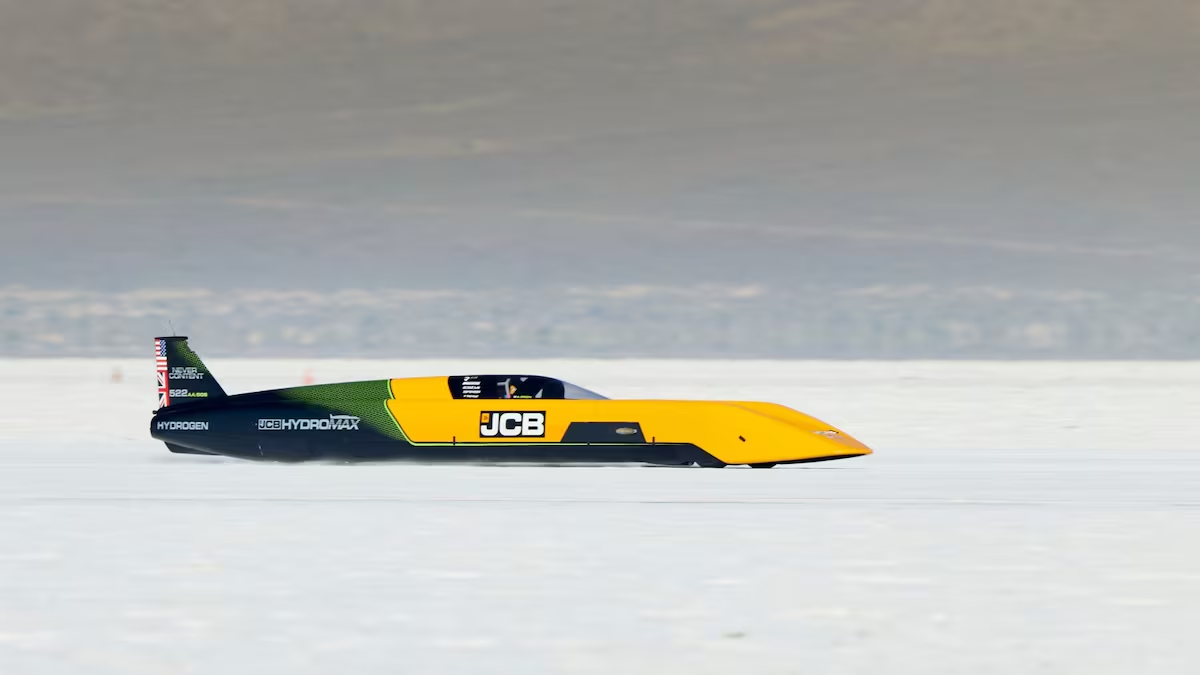
Green harnessed two production-based digger engines to post a combined average of 406.320 mph (653.909 kph) across two runs at Utah’s Bonneville Salt Flats.
Under FIA rules, a driver must run once in each direction within an hour, with the average of the two runs setting the record. His first run hit 400.623 mph, the second 412.135 mph.
The Hydromax is a twin-engine, 32-foot (9.75-metre) car built by JCB. Its two engines deliver a combined 1,600 horsepower by mixing pressurised hydrogen gas with air and igniting it. Made at JCB’s Foston plant in Derbyshire, they are the same basic units fitted to its diggers.
The JCB team celebrates at Bonneville Salt Flats after the Hydromax set a new hydrogen car world speed record.
Green, 63, called Bonneville the spiritual home of the World Land Speed Record and said Hydromax had “written itself into that history,” praising the car as stable, strong and fast.
Not Quite Supersonic
Tuesday’s run fell well short of the outright land-speed record, which Green set with jet power in 1997, hitting 763.035 mph (1,227.985 kph) in the Thrust SSC in Nevada’s Black Rock Desert—breaking the sound barrier and shaking the nearby town of Gerlach with sonic booms. No one has matched it since.
In 2006, Green set the diesel land-speed record at Bonneville, driving the JCB Dieselmax to 350.092 mph (563.4 kph).
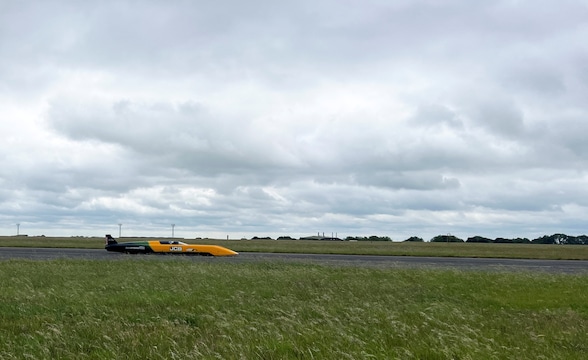
The JCB Hydromax hydrogen car during a record run at Bonneville Salt Flats, Utah.
Tuesday’s run beat that mark, topped the previous hydrogen combustion record of 185.5 mph set by BMW’s H2R in 2004, and exceeded the 303 mph mark held by hydrogen fuel-cell vehicles—making Hydromax the fastest hydrogen-powered vehicle built so far.
Cockpit Turns Furnace
Green said the cockpit was probably hotter than in his 1997 jet car, with temperatures routinely above 122°F (50°C). He trained for four months, combining gym work with hot baths to cope.
Bonneville, a remnant of a prehistoric lake bed about 100 miles (160 kilometres) west of Salt Lake City, sits atop a shallow aquifer that helps cool tyres.
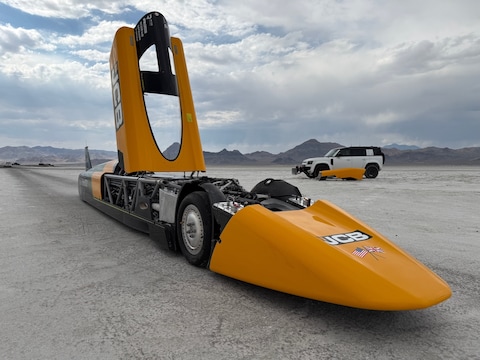
The JCB Hydromax with its canopy raised, exposing the twin hydrogen combustion engines, at Bonneville Salt Flats.
Its low-friction surface and dry air have drawn speed-record attempts since 1914; Green described it as looking and behaving like packed snow, though surprisingly slippery.
Hydrogen’s Big Bet
JCB began the Hydromax project in June 2025 with partners Prodrive, Ricardo and Xtrac, investing £100 million ($135.03 million) in hydrogen engine development as part of a wider $130 million programme.
The attempt promotes JCB’s hydrogen-powered diggers, now in production, and comes just ahead of a new $500 million JCB factory opening in San Antonio, Texas, for the US market. JCB’s fastest tractor tops 135 mph, and the firm also partners the Aston Martin F1 team.
Chairman Anthony Bamford, who led the hydrogen project and proposed the record attempt last year, said JCB had shown what British engineering could do with diesel at Bonneville 20 years ago and had now done it again with hydrogen—using production engines identical to those in its diggers, proof, he said, that hydrogen works at the highest level with zero emissions.
Cost Remains The Hurdle
Hydrogen is only as clean as its source, and most global supply still comes from fossil fuels. JCB has separately signed a deal to buy green hydrogen, made from renewable energy, though this remains a small share of total production.
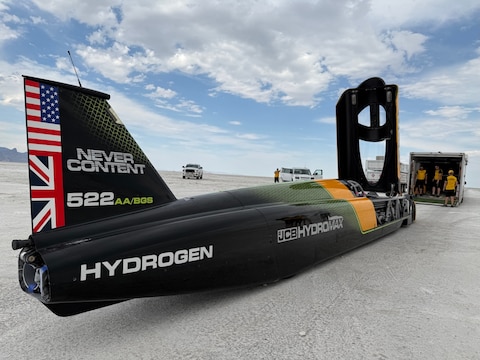
The JCB Hydromax, marked “522 AA/BGS” and flying UK and US flags, ahead of its record attempt at Bonneville.
Greg Keoleian of the University of Michigan’s MI Hydrogen initiative said the technology has existed for decades but has seen renewed interest lately. Several automakers have developed hydrogen combustion or fuel-cell tech, he noted, but higher production costs versus petrol and diesel remain a barrier.
Hydrogen could help decarbonise parts of the economy, though adoption hinges on cost—he pointed to growing interest in extracting it from natural deposits rather than water, which could cut costs significantly.