

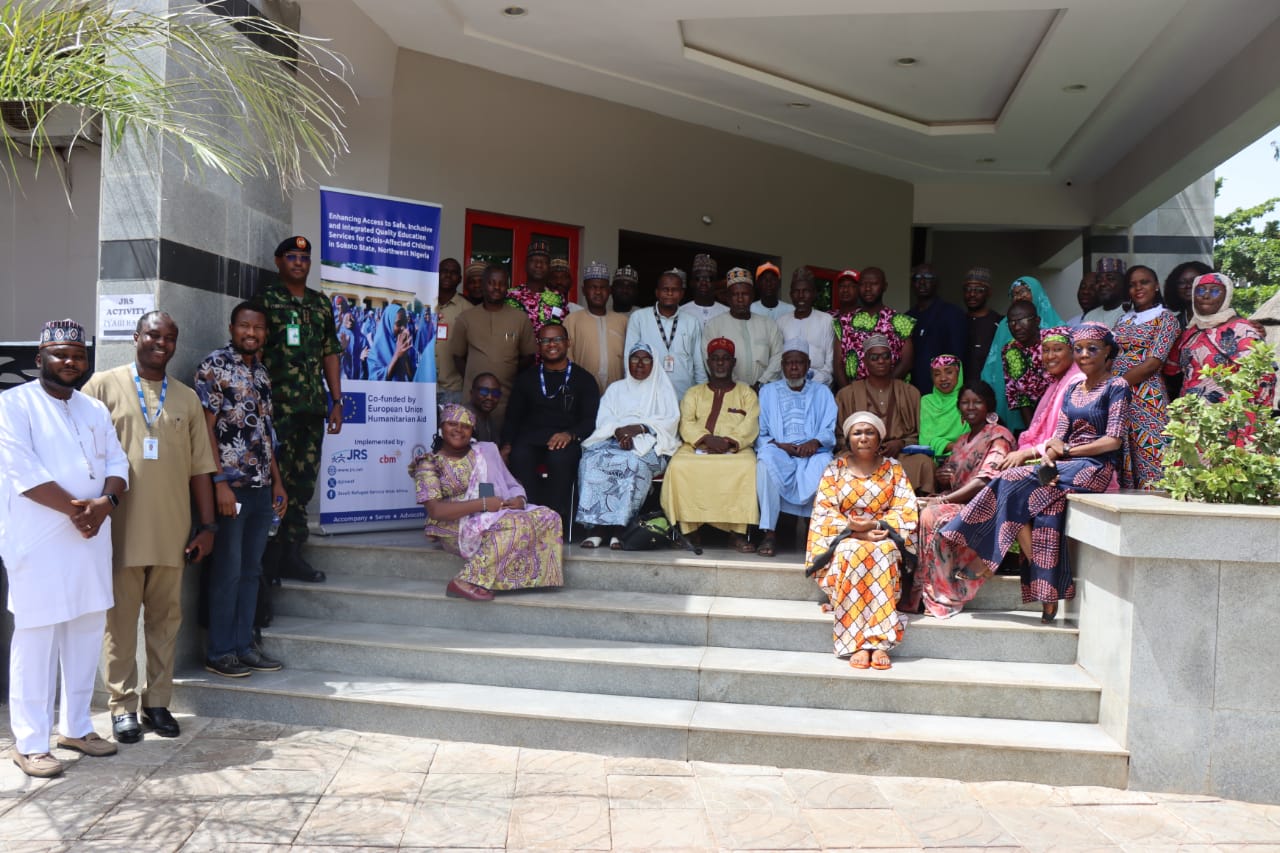
The Jesuit Refugee Service (JRS), in partnership with Christian Blind Mission (CBM) and Hikima Community Mobilisation and Development Initiative (HCOMDI), has launched an educational intervention for communities devastated by insecurity in Sokoto State.
The project, co-funded by the European Union (EU), aims to ensure safe access to quality and inclusive education for crisis-affected children across the state.
Sokoto, the seat of the Caliphate and home to the Sultan of Sokoto, His Eminence Muhammad Sa’ad Abubakar, President-General of the Nigeria Supreme Council for Islamic Affairs (NSCIA), is widely regarded as the epicentre of Islam in Nigeria.
Justifying the intervention, JRS submitted that years of instability and insecurity have inflicted severe damage on children’s education, potentially curtailing their future opportunities.
Country Director of JRS, Fr. Temple Anuforo, emphasised: “North West Nigeria, and Sokoto State in particular, carries a weight the humanitarian community has been slow to recognise. In Sabon Birni, Isa and Kware, we found children who have been out of school for years, others forced to drop out, and classrooms that have collapsed rather than merely deteriorated.
“Girls and boys are kept at home not because they lack the desire to learn, but because there is no latrine, no safe route to school, and no functioning borehole or reliable water source.”
He stressed that the partnership between JRS, CBM, and HCOMDI would address these challenges and create effective learning opportunities for 25,000 children across the three implementing local government areas—Sabon Birni, Isa, and Kware.
JRS disclosed that the intervention would give 60 per cent priority to girls, targeting more than 9,000 out-of-school children for re-enrolment. Priority will be given to internally displaced persons, returnees, and host communities, with particular attention to Almajiri children and those with disabilities.
The organisation expressed satisfaction that the EU-funded project places inclusion at the heart of its approach.