
End of an era?: How Nigeria’s Super Falcons went from African champions to missing the World Cup

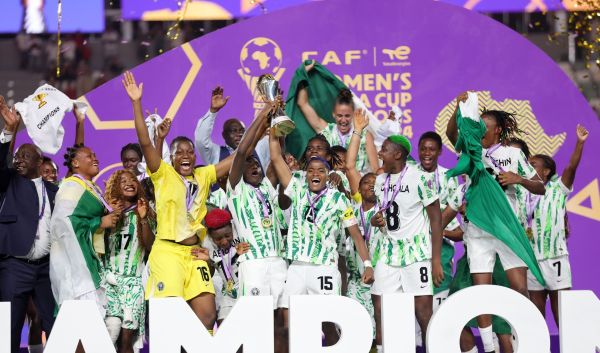
Nigeria’s Super Falcons have suffered one of the most dramatic setbacks in their history, missing out on the FIFA Women’s World Cup for the first time after an unexpected quarter-final exit at the 2026 Women’s Africa Cup of Nations (WAFCON) in Morocco.
The 10-time African champions entered the tournament as defending champions and among the leading contenders for the title. Instead, a turbulent campaign ended with Nigeria failing to reach the semi-finals and subsequently losing its final route to qualification for the 2027 FIFA Women’s World Cup.
The setback marks a major departure from Nigeria’s long-standing dominance of women’s football on the continent. The Super Falcons had appeared at every previous Women’s World Cup since the competition began in 1991.
The warning signs emerged from Nigeria’s opening match when the defending champions suffered a stunning 3-2 defeat to Malawi, a tournament debutant.
Temwa Chawinga scored twice while Tabitha Chawinga added another as Malawi secured a historic victory over one of Africa’s most decorated women’s teams. Nigeria’s late goals from Rasheedat Ajibade and Uchenna Kanu were not enough to prevent the upset.
The Falcons recovered with a narrow 1-0 victory over Zambia, despite playing much of the second half with 10 players following Blessing Demehin’s red card. Asisat Oshoala scored the decisive goal early in the encounter.
Nigeria then produced its strongest performance of the group stage, defeating Egypt 6-2 to secure a place in the quarter-finals.
Despite the commanding victory, Nigeria finished behind Malawi in Group C after all three teams ended on six points and CAF’s head-to-head tiebreaking system was applied.
Nigeria’s recovery ultimately proved insufficient.
The Falcons were eliminated in the quarter-finals by Cameroon, ending their hopes of defending their continental title and putting their World Cup qualification campaign in serious danger.
The 2026 WAFCON was also serving as Africa’s qualification tournament for the expanded 2027 Women’s World Cup, making every knockout-stage result particularly significant.
With Nigeria unable to reach the required stage for automatic qualification, the team was left without a route to Brazil 2027.
For decades, the Super Falcons had been the benchmark for women’s football in Africa. Nigeria has won the WAFCON 10 times, far more than any other country, and remained a regular presence at every Women’s World Cup since 1991.
But the balance of power in African women’s football has increasingly begun to shift.
South Africa have emerged as continental champions, Morocco have invested heavily in women’s football and reached successive WAFCON finals, while Cameroon and emerging teams such as Malawi have demonstrated that the gap between Nigeria and the rest of the continent is narrowing.
The 2026 tournament provided perhaps the clearest evidence yet of that changing landscape. Cameroon went on to win their first WAFCON title, while debutants Malawi reached the final and secured their first-ever World Cup qualification.
Nigeria’s failure is therefore bigger than one disappointing tournament.
The result has raised questions about coaching, preparation, player development and the country’s ability to keep pace with rapidly improving women’s football programmes across Africa.
The Super Falcons were forced to recover from an early defeat before eventually reaching the knockout stage, highlighting the narrow margins separating success from failure in an increasingly competitive continental game.
For Nigerian football authorities, the challenge now goes beyond appointing a new coach. The country must examine how its women’s national teams are prepared, how young players are developed and whether domestic structures are producing enough elite talent to sustain Nigeria’s traditional dominance.
The failure to qualify for the 2027 World Cup leaves Nigerian women’s football facing a period of difficult reflection.
The immediate priority will be rebuilding the national team and ensuring that the setback does not become the beginning of a prolonged decline.
Nigeria still possesses a deep pool of experienced international players and a strong football culture. But the 2026 WAFCON has demonstrated that reputation alone is no longer enough.
For the Super Falcons, missing the World Cup is not simply the end of a remarkable qualification streak. It is a warning that African women’s football has changed and Nigeria must change with it.