

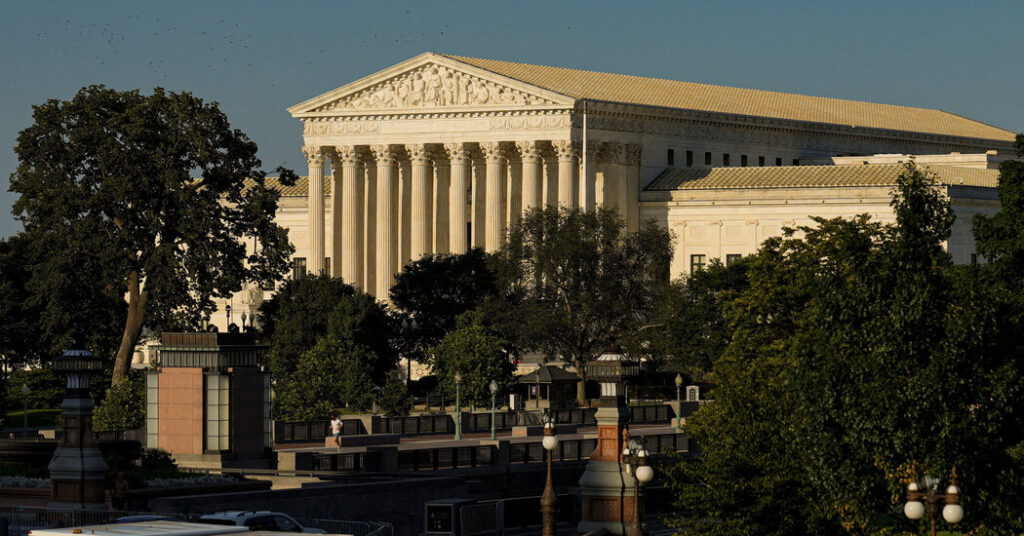
The next great First Amendment battleground is just six inches high and is attached to about a million motor vehicles in Virginia alone. It is the vanity license plate, and courts are splintered over whether and how states can censor the messages the plates convey.
The latest decision landed Friday. It involved Curtis Whateley, who paid Virginia $10 in 2023 for a personalized license plate. He had seven characters to work with, and he sought to convey a statement “expressing my opinion on the current state of policing in this country,” as he would later put it in a lawsuit.
He settled on FTP & ATF. No one disputes what those letters stand for. “TP” is the police. “ATF” is the Bureau of Alcohol, Tobacco, Firearms and Explosives. “F” is what you think it is.
The state issued the plate, and he used it for about a year, until authorities received an anonymous complaint that caused them to cancel it. Representing himself, Whateley sued, saying the cancellation violated the First Amendment.
Virginia responded by saying that the plate is government property and contains a unique combination of characters that serves to identify vehicles. All of that means, the state said, that Whateley’s vanity plate is government speech.
If that is correct — a big if — the First Amendment does not figure in the analysis. The government, the Supreme Court has ruled, can say whatever it wants when it is speaking. And it can refuse to endorse messages with which it disagrees.
Indeed, the Supreme Court has said so in a case involving another kind of license plate.
In 2015, the court ruled that Texas, which had issued hundreds of specialty designs for license plates with messages like “Choose Life,” “God Bless Texas,” “Fight Terrorism” and “Rather Be Golfing,” could refuse to allow one bearing the Confederate battle flag.
The vote in the case, Walker v. Sons of Confederate Veterans, was 5 to 4. Justice Stephen G. Breyer wrote the majority opinion, joined by the court’s other three liberal members and Justice Clarence Thomas.
Drivers use specialty plates to suggest that the government endorses the messages they bear, Justice Breyer wrote. Otherwise, he said, people “could simply display the message in question in larger letters on a bumper sticker right next to the plate.”
Justice Breyer stressed that the decision was limited to specialty plates, which let drivers choose from a large but finite set of designs including graphics and a slogan. Individuals and groups could propose designs to a state board. The board rejected the proposed plate including the Confederate flag, concluding that many members of the public would find it offensive.
Justice Breyer said he was not addressing the status of vanity plates, where vehicle owners choose numbers and letters that appear only on their own plate.
In dissent, Justice Samuel Alito was incredulous.
“If a car with a plate that says ‘Rather Be Golfing’ passed by at 8:30 a.m. on a Monday morning,” he wrote, “would you think: ‘This is the official policy of the state — better to golf than to work?’”
Nor could specialty plates bearing the name of, say, the University of Oklahoma plausibly convey a government message, Justice Alito wrote. During football season in Texas, he said, that would border on treason.
In Whateley’s case, Judge Norman Moon of the Federal District Court in Lynchburg, Va., ruled for Virginia, saying that the plate was government speech.
The American Civil Liberties Union of Virginia stepped in to handle Whateley’s appeal. Eden Heilman, its legal director, said the state is known for its vanity plates, which are displayed on about 10 percent of the state’s cars.
“The idea that somehow over a million of those contain government speech was sort of a silly, preposterous reading in our in our estimation,” she said.
On Friday, Judge Pamela Harris, writing for a unanimous three-judge panel of the U.S. Court of Appeals for the Fourth Circuit, sided with Whateley and the A.C.L.U., ruling vanity plates are private speech subject to First Amendment protections.
But that is only the first step. Even private speech is sometimes subject to government regulation.
The appeals court returned the case to Judge Moon to consider whether Virginia’s cancellation of Whateley’s plate can survive First Amendment scrutiny, which often turns on whether the challenged policy discriminates based on the speaker’s viewpoint.
Virginia, for its part, announced on Wednesday night that it would seek Supreme Court review.
“The commonwealth has a responsibility to ensure that state-issued license plates are not profane and do not promote dangerous hate speech or incite harm,” said RaeAnn Pickett, a spokeswoman for Jay Jones, the state’s attorney general.
Tell me about your vanity plates or ones you have liked or hated — and whether the government ought to be allowed to censor them at [email protected].
Other Things Worth Knowing About
Don’t miss a long and riveting look from Mike Schmidt and Jessica Silver-Greenberg at the capitulation of Paul Weiss, once a fearless liberal law firm, to the Trump administration. It’s a master class in investigative reporting and narrative journalism. Fun fact: Justices Ruth Bader Ginsburg, Sonia Sotomayor and Elena Kagan were all summer associates at the firm.
By an 8-to-5 vote, the 11th Circuit rejected a challenge from Hamburger Mary’s, an Orlando restaurant that features drag shows, including “family friendly” ones, to a Florida law that bars lewd conduct when children are present.
An intriguing post on the legal blog Balkinization by Jeffrey Gordon, a law professor at Columbia, argues that the 22d Amendment, which limited presidents to two terms, undermines one of the Supreme Court’s rationales for expansive executive power. As Chief Justice Roberts put it, such power is warranted because the president is “directly accountable to the people through regular elections.” But that rationale, Gordon writes, “collapses in the face of the 22nd Amendment, approved in 1947, ratified in 1951, which not only imposes term limits but also embraces prior efforts to limit presidential power.”
A new poll from Marquette Law School has some intriguing findings. Most Republicans think the Supreme Court rarely or never sides with President Trump, while most Democrats believe it often or fairly often does. Overall, though, a majority of the public agreed with 11 of 13 major rulings from the court last term. The exceptions were on the president’s power to fire agency heads and looser campaign finance limits.
Mailbag
Sending Migrants to the Ends of the Earth
What standards, if any, must the federal government adhere to when deciding what countries they can deport unauthorized immigrants to? — Catherine West
Federal law generally requires the government to deport people only to countries with which they have a meaningful connection. A statute sets out a sort of checklist, meant to be worked through in order. The sequence varies a little based on whether the immigrant is arrested while entering the country or is later ordered removed.
Among the places law requires the government to consider first are the country from which the immigrants arrived, ones they designate, ones they are citizens of and ones they have lived in.
Under the law, “third-country removal” — deportation to a place with which the immigrants have no connection — is meant to be a last resort. The Trump administration has been accused of ignoring the required sequence, of relying on untested “diplomatic assurances” that immigrants will not be tortured or persecuted when they are sent to such third countries and of failing to provide immigrants with a meaningful opportunity to object.
The administration has justified its approach by saying that the president has enormous discretion over immigration and foreign affairs. Those contentions have been questioned by federal trial judges but have been tentatively endorsed by the Supreme Court, which has, for now, allowed the administration wide latitude to conduct “third-country” deportations while their legality is being challenged.
I’d love to hear your questions on the law, the courts or whatever is on your mind. Send them my way at [email protected].
Closing Argument
A Curse Word and Me
The vulgar Virginia license plate reminded me of a misstep I made in a 2019 column about a case then before the Supreme Court. The question was whether the government could refuse to register a trademark for a line of clothing sold under the brand name FUCT.
In explaining the government’s reasoning, I wrote, thinking myself clever, that “the term sounded like the past tense of the most versatile Anglo-Saxon curse word.”
That elicited a correction request from a reader that an editor called “ludicrous, charming and very plausibly correct.”
The reader, listing colorful examples, wrote that “some of today’s swear words did indeed originate in Old English.” The word in question, he wrote, did not.
I couldn’t take his word for it, so I consulted Jesse Sheidlower, a lexicographer who had worked on the relevant entry in the Oxford English Dictionary and is the editor of “The F-Word,” a magnificent and elaborate historical dictionary.
He said the core of the reader’s argument was correct. “‘Anglo-Saxon’ and ‘Old English’ are the same thing,” he wrote, “referring to the earliest period of the English language, before 1150 or so.” The curse word in question, he said, “is not found in English at this time, period.”
“Whether it merits a correction is up to you, but ‘Anglo-Saxon curse word’ isn’t right,” he wrote. “‘Most versatile’ probably is, however.”
Naturally, we ran a correction: “A previous version of this article referred incorrectly to the etymology of the ‘most versatile’ curse word. It is of Middle English origin, not Anglo-Saxon.”
In drafting the vanity plates item, I thought to check up on things. Imagine my delight on reading that the fourth edition of “The F-Word,” published in 2024, included, along with 150 new entries and 2,500 new quotations, “major new discoveries” that “push back the known history of” the word “by almost 200 years.”
Might that mean that the new information now demonstrated that the word appeared in Old English? Perhaps, I thought, we could un-correct.
But Sheidlower threw cold water on the idea. “The recent discoveries, while extremely important, don’t change the fact that the earliest examples of” the word “are still solidly in the Middle English period, and are thus not Old English or Anglo-Saxon,” he wrote in an email.
“Previously, the earliest known example of the word was from some point in the later 15th century,” he wrote. “We now have two examples from the 14th century.” They could not be more amusing — or unprintable.
The correction stands.
And there was more bad news. In 2008, I reported that the euphemism “the F-word” had first appeared in 1973, in The New York Times.
That represented the best available information in 2008. But Sheidlower has not been idle in the last 18 years, and here, too, he has made some new discoveries.
“The earliest example now known is from a language journal from Sweden (written in English) in 1956, and there are also examples from 1964 and 1970,” he wrote.
The Times still clings to one distinction, he told me. Its 1973 use remains the earliest one that deployed “the F-word” to represent a verb.
Please send me your comments on license plates, deportations, curse words or anything else at [email protected]. See you next week. — Adam