

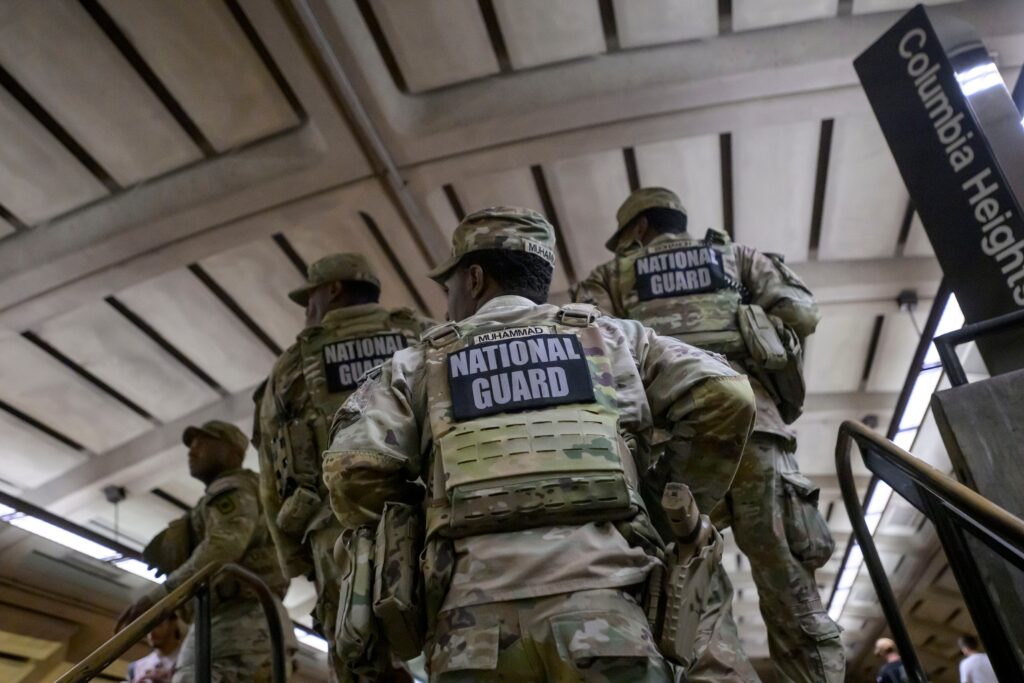
The Justice Department is accusing the D.C. Council of showing “callousness” and feigning “ignorance” for asking state governors to withdraw their National Guard troops from the city.
“Your council has no power to demand that governors remove their brave men and women from serving in uniform in our Nation’s capital,” wrote Colin M. McDonald, a top official in the deputy attorney general’s office, in a letter to the council members dated Wednesday. “Your politically-motivated letter is impotent theatrics not worth the paper it’s written on, and D.C. is a much safer place no matter what you say.”
All 13 members of the council signed letters in July addressed to 20 state and territory governors with National Guard troops deployed in D.C. as part of the administration’s “Safe and Beautiful” campaign, requesting their withdrawal by Sept. 1. In them, they thanked Guard members for their help with events such as the America 250 celebrations, calling that assistance “fundamentally different from open-ended military patrols in District neighborhoods.”
“Continuing this deployment despite the absence of a demonstrated violent-crime benefit would misuse both taxpayer dollars — in the billions, if maintained for years at its expanded scale — and the service of the Guard members themselves,” read the letters.
President Donald Trump’s administration first deployed out-of-state National Guard members to D.C. last August, alongside federal law enforcement agents, marking the start of a federal surge that has now lasted more than a year. Guard troops will remain in the city until January 2029, at an expected cost of an additional $1.4 billion, Brig. Gen. Leland Blanchard II, the interim commanding general of the D.C. National Guard, said this month.
The council members wrote in their letters that “extending the deployment raises serious concerns about mission creep, the militarization of civilian spaces, the erosion of local democratic control, and potential interference in the peaceful transfer of power following upcoming elections.”
In a statement marking a year since the federal surge began, Mayor Muriel E. Bowser (D) called the out-of-state National Guard troops “problematic.” She characterized the federal intervention as happening in the midst of D.C. driving down crime, rather than as the cause of the decrease.
The big dispute at play here is whether Guard troops have helped stem violent crime. Armed members have become a visible presence in the District, patrolling neighborhoods and Metro stations across the city.
Trump has claimed that his administration has “stopped crime in Washington,” and McDonald’s letter credits the National Guard as playing a pivotal role as part of the federal law enforcement task force by “increasing officer visibility, supporting life-saving law enforcement operations, protecting critical infrastructure and providing reassurance to all law-abiding people.”
McDonald wrote that Guard troops have “personally intervened in numerous assaults and provided medical aid on innumerable occasions.” National Guard members do not have law enforcement powers.
The D.C. Council contended in its letters to the governors that “analysis of the deployment has found only a modest decrease in property crime and no measurable reduction in violent crime attributable to the Guard’s presence since August 2025.”
That analysis comes from the Niskanen Center, a nonprofit organization that explored National Guard deployment in D.C. and determined that it “produced a significant reduction in property crime, and it did so quickly. … But it was an expensive tool deployed in the wrong places for the wrong types of crime, at a daily cost per person 60 percent higher than [a D.C. police] officer, with a hidden productivity cost to the civilian economy.”
D.C. Council Chairman Phil Mendelson (D) said by text message Wednesday that “the facts speak for themselves” regarding the National Guard’s effectiveness in keeping D.C. safe, in response to McDonald’s letter. “The city is in court trying to get the non-D.C. Guard removed.”
In September, D.C. Attorney General Brian Schwalb (D) sued the Trump administration over its deployment of the Guard, contending that it amounted to an “involuntary military occupation.” As litigation continues, an appeals court ruled in December that troops could remain in the city.
In addition to his letter to members of the D.C. Council, McDonald wrote to state governors to thank them for deploying their Guard troops to the District.
“Washington D.C. is Safe and Beautiful today because of your leadership and the courage of the men and women of your National Guard,” he wrote. “They have saved lives and changed the trajectory of the city.”
Perry Stein contributed to this report.