

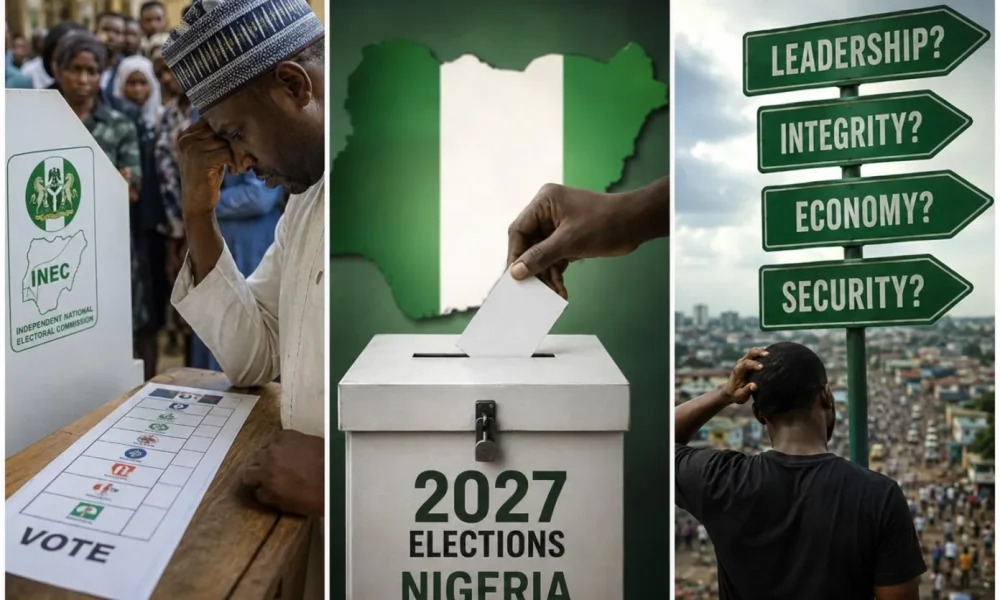
On June 2, 2026, the Independent National Electoral Commission (INEC) confirmed that its personnel had improperly accessed and exposed the voter registration data of Nollywood actor Emeka Ike.
INEC, however, said there had been no external breach of its voter database.
The commission said it launched an investigation after allegations surfaced on social media that information from its Continuous Voter Registration (CVR) system had been accessed without authorisation and subsequently published online.
In a statement made available to the media, Mohammed Haruna, INEC’s National Commissioner and Chairman of the Information and Voter Education Committee, said:
“The attention of the Independent National Electoral Commission (INEC) has been drawn to allegations currently circulating on social media and in some sections of the media regarding the alleged unauthorised access to the Commission’s Continuous Voter Registration (CVR) database and the subsequent publication of information on a candidate in the recent primaries of a political party in the Federal Capital Territory.
“The Commission takes this allegation seriously and has immediately commenced a thorough investigation to establish the facts surrounding the incident.”
INEC explained that access to the CVR system is strictly controlled and limited to authorised officials carrying out registration-related duties.
“As part of the ongoing Continuous Voter Registration (CVR) exercise nationwide, authorised INEC Registration Officers were granted controlled access to specific components of the CVR system to enable them to register new applicants, process requests for transfer of registration and update voter records where necessary. Such access is restricted to official duties only and is withdrawn at the conclusion of the exercise,” it said.
A preliminary audit identified the user account involved in the access, Haruna said.
“The audit trail from the preliminary investigation has enabled the Commission to identify the user account through which the information was accessed. Accordingly, relevant personnel have been questioned, and all units connected with the incident are cooperating fully with the investigation.”
According to the electoral umpire, it is examining possible breaches of internal controls and determining individual responsibility.
“The Commission is also examining all technical, administrative and operational factors associated with the matter in order to establish individual responsibility, determine the circumstances surrounding the use of those credentials, and identify any breach of internal access-control protocols before taking appropriate action against anyone involved,” it added.
“Preliminary findings from the Commission’s audit trail so far, however, indicate that there was no external breach of the CVR database, no hacking incident, and no unauthorised external access to the Commission’s ICT infrastructure. Rather, the information in question was accessed through valid user credentials assigned to personnel participating in the ongoing CVR exercise but released without authority.
“The incident under investigation relates to the retrieval of a specific voter record and does not indicate any compromise of the Commission’s broader voter registration infrastructure or the personal data of over 90 million registered voters.”
INEC reaffirmed its commitment to data protection and accountability, adding that security agencies, including the Department of State Services (DSS), were investigating the matter.
“The Commission will continue to cooperate fully with all relevant security agencies and will not hesitate to refer any person found culpable for appropriate legal action,” Haruna stated.
“Members of the public and the media are therefore urged to disregard unfounded speculations while investigations remain ongoing. The Commission will continue to keep the public informed of its final findings and any measures taken in response to the incident in due course.”
The actor’s voter registration data was posted on social media by Lere Olayinka, the media aide to the Minister of the Federal Capital Territory, Nyesom Wike.
Emeka Ike, whose digital rights are protected under Nigeria’s data protection laws, has since filed a suit seeking redress for what he describes as an egregious breach of his fundamental right to data protection and privacy.
The litigation has already commenced, with the Federal High Court in Abuja on Thursday, July 2, adjourning for further mention the ₦10 billion fundamental rights enforcement suit filed by Nollywood actor Emeka Ike against the Independent National Electoral Commission and Lere Olayinka, media aide to the Minister of the Federal Capital Territory, Nyesom Wike.
The suit stems from allegations that Ike’s personal voter registration details were unlawfully disclosed on Olayinka’s official X account after screenshots showing the transfer of his voter registration from Imo State to the Federal Capital Territory surfaced on social media.
The renowned actor, Mr Emeka Ike, contends that the information was published by Olayinka without his consent, allegedly after it was accessed from a restricted INEC administrative portal.
In the suit, the actor is seeking ₦10 billion in damages for the alleged breach of his right to privacy, as well as orders directing the removal of the social media post and the issuance of a public apology.
Meanwhile, Adeh said he believed that INEC “has no defence in the matter,” prompting what he described as its repeated attempts to shy away from the case.
He expressed confidence in his client’s claim, noting that the case would serve as a precedent to prevent future breaches of voters’ data. He added that Ike was magnanimous to have demanded only ₦10 billion.
“It is very possible that whoever accessed this thing must have also been able to access other records. So it is not just Emeka Ike. But we want to use Emeka Ike’s issue and also ensure that this kind of thing is put in check. I think this is going to be a very interesting case, and we hope that the court will do justice,” he stated.
The admission by INEC that the data of a registered voter was accessed and leaked to a top public office holder working as an aide to FCT Minister Nyesom Wike, who is openly partisan and has made it abundantly clear that he will do everything possible, alongside the minister, to deliver electoral victory to his preferred candidate, President Bola Ahmed Tinubu, who is seeking re-election in the January 16, 2027 presidential poll, has particularly sparked apprehension among registered voters in Abuja.
Many are now questioning whether they can trust the Independent National Electoral Commission, whose chairman has allegedly been associated with partisan loyalty to President Tinubu, who appointed him, to protect the digital rights and personal data of registered voters held within INEC’s systems.
Imminent Digital Manipulation of Nigeria’s 2027 Election
As fears spread over the alleged imminent leakage of protected voter data, possibly to satisfy the political ambitions of the incumbent president ahead of the January 2027 election, it is important that we examine what our digital rights are.
In this examination of our digital rights and other ancillary issues surrounding the broader concept of digital rights, this writer will extensively draw from a piece titled What Are Your Digital Rights?, compiled by Rosamund Hutt, a senior writer with Agenda.
Digital rights are essentially human rights in the internet age. The rights to online privacy and freedom of expression, for example, are extensions of the equal and inalienable rights enshrined in the United Nations’ Universal Declaration of Human Rights. According to the UN, disconnecting people from the internet violates these rights and goes against international law.
It is true that, as Nigerians and people around the world increasingly conduct our lives online—shopping, socialising and sharing information—our digital rights, particularly the rights to privacy and freedom of expression, are becoming increasingly important.
We need to understand how our data is being used by companies, governments and internet giants such as Facebook and Google. Is it being handled fairly and scrupulously, or is it being sold or shared without our consent?
Aside from the concern about INEC potentially leaking our digital data to the ruling All Progressives Congress (APC), there is also the issue of the inclusion of the Director-General of the data protection agency as a member of the presidential campaign council of the All Progressives Congress presidential candidate, President Bola Ahmed Tinubu, who, in the first instance, appointed the current chief custodian of our national data, including our electoral data.
What guarantee do Nigerians have that their data and digital information will be protected when the chief custodian of Nigeria’s national data has been enlisted by President Bola Ahmed Tinubu as a key member of the campaign council for his re-election?
This brings us to the next question addressed in Rosamund Hutt’s essay on digital rights:
How Do We Know If Our Digital Rights Are Being Respected?
We are told that if any of us has ever clicked “agree” without reading the terms of service of internet companies, we are far from alone.
As Hutt observed in her essay, the universal reality is that many of us do not bother to read the reams of small print when we first use an online service. However, a non-profit research initiative called Ranking Digital Rights has done the hard work for us and found that internet and telecommunications companies, to varying degrees, are failing to respect their users’ rights to digital privacy and freedom of expression.
Ranking Digital Rights, which is based at the New America Open Technology Institute think tank, assessed the user-agreement policies of 16 of the world’s biggest internet and telecommunications companies for its 2015 Corporate Accountability Index. The index allows users, investors, activists and policymakers to compare how—and whether—companies are making efforts to respect our digital rights.
Rebecca MacKinnon, director of Ranking Digital Rights, said: “Our hope is that the index will lead to greater corporate transparency, which can empower users to make more informed decisions about how they use technology.”
What this means is that even global owners of social media platforms can potentially be influenced or approached by governments seeking access to protected data that citizens have provided while using their platforms.
Who Is Looking at My Data in Nigeria?
The most notorious offenders in the alleged breach of citizens’ data in Nigeria include the Nigerian Government at both the federal and state levels, companies and cybercriminals. All of these actors can potentially collect personal data and track people’s movements and communications.
In 2014, Facebook, Microsoft, Yahoo and Google reportedly began publishing details about how many times governments requested data. Facebook said that, around the world, government requests jumped in the first half of 2015 to 41,214, up from 35,051 in the second half of 2014.
Hutt stated that, in the United States, most of the requests came from US law-enforcement agencies demanding information about Facebook users’ IP addresses and account details.
Should Nigerians Trust Governments With Our Data?
To answer this question, I would say categorically: no.
Nigeria is a country in which some holders of public office appear to believe that they are bigger than the law and that violations of the law can be committed for partisan or selfish interests. Since they are often the appointing authorities for the heads of law-enforcement agencies, they may appear to be immune from prosecution.
The appointment of the head of Nigeria’s data protection agency as a member of President Tinubu’s presidential campaign council provides, in my view, further reason why millions of citizens may question whether the government can be trusted to protect their data with integrity.
Even in the developed Western world, governments have been accused of violating the digital rights of citizens.
In 2013, Edward Snowden’s revelations about the extent of US government surveillance sent shockwaves around the world. The fallout continues, with civil-society organisations and foreign governments complaining that the relationship between American security agencies and internet giants is too close.
Earlier, the UN appointed its first Special Rapporteur on the Right to Privacy. Joseph Cannataci, an expert in privacy, data protection and information technology, was tasked with reporting on how the erosion of online privacy undermines fundamental freedoms and democracy.
I can therefore conclusively state that, if action is not taken to guarantee the protection of citizens’ digital rights in Nigeria, it is increasingly possible that the 2027 presidential election could be compromised through the misuse of stolen or leaked data.
INEC must come clean on the major breach that is the subject of the court proceedings described above. The protection of citizens’ personal and electoral data must not be treated as a peripheral issue. In an increasingly digital electoral environment, the integrity of voter information is fundamental to public confidence in the electoral process.
We will keep our fingers crossed.
Emmanuel Nnadozie Onwubiko is the founder of the Human Rights Writers Association of Nigeria (HURIWA) and was a Federal Commissioner of the National Human Rights Commission of Nigeria.