

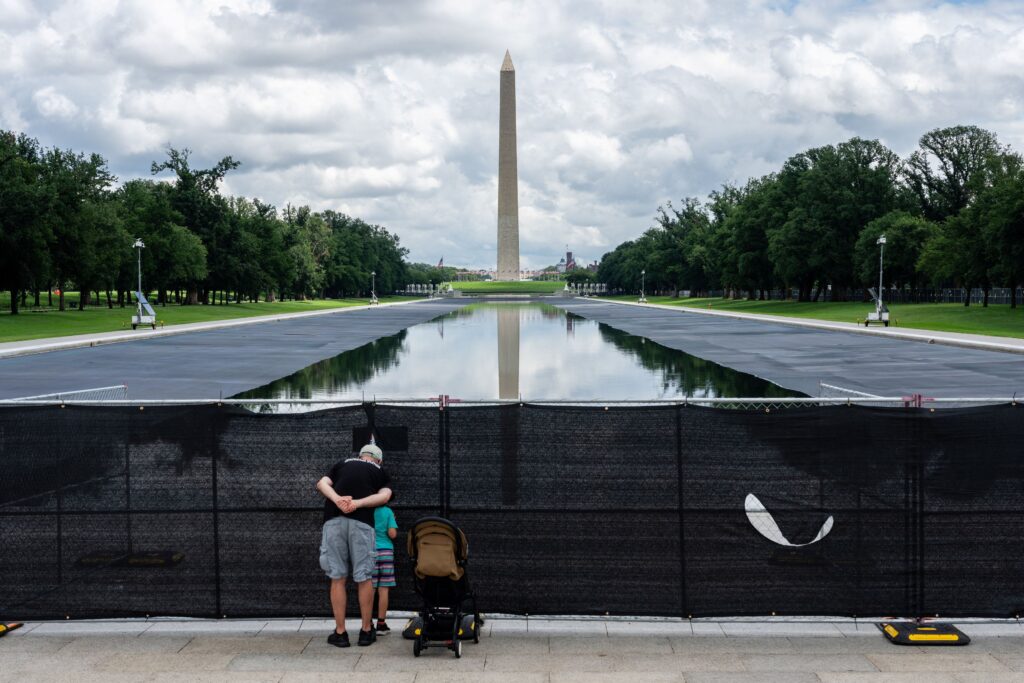
When I read the Aug. 6 Metro article “Woman recounts ‘scary’ Reflecting Pool arrest,” I thought about my staunch Republican father. Consistent with his deeply held traditional American values, he taught me many life lessons, including “pick up trash on public lands and waters” and “apologize when you make a mistake.”
After I turned 10, my family drove across the country to visit D.C., and I remember us dutifully picking up trash in the various parks and forests we visited.
If my father had seen something floating in the Reflecting Pool that looked like trash, he definitely would have spontaneously reached into the water to remove it, just as Sophie Dennison-Gibby did. My heart and brain ache thinking about the possibility that my father could have been, in front of my mother and a patriotic 10-year-old, immediately handcuffed, arrested and publicly vilified. But then my father would have reminded us that mistakes happen, and he would have made sure that charges would be dropped and an apology was forthcoming. After all, this is America. Where is the apology for Dennison-Gibby?
Deborah Williams, Goleta, California
Regarding the Aug. 5 editorial “The absurdity of the Reflecting Pool prosecutions”:
There is a cure for law enforcement weaponization, which was epitomized by U.S. Attorney Jeanine Pirro’s bogus felony charges against David Hearn, a former Olympian canoeist, for alleged vandalism of the Reflecting Pool. (Pirro later dropped the charges.)
Congress should terminate the absolute prosecutorial immunity for constitutional torts or malicious prosecution bestowed by the Supreme Court’s Imbler v. Pachtman (1976) decision and its progeny. The knowledge that prosecutors can be sued for damages predicated on abuses of prosecutorial power would concentrate their minds on steering wide of the danger zone.
Bruce Fein, Washington
The writer served as associate deputy attorney general under President Ronald Reagan.
American history for everyone
Regarding the July 30 online Opinion commentary “‘Quite the escalation’: Three takes on the Smithsonian battles”:
I took my toddler to visit the Smithsonian’s National Museum of American History the day after President Donald Trump ordered that signs be installed saying that the museum does not accurately reflect American history.
When we arrived, my son led me downstairs, past the bright summer colors of the 250th anniversary exhibit announcement to a 1918 Waterloo Boy kerosene tractor. I cheerfully followed him as he designed a playground at “Change Your Game” and played with a soybean futures simulator at “American Enterprise.” Upstairs, he swayed in front of “El Rey” and whispered: “It shines like gold.” We wrote visitor comments to show our support for the staff and institution. His was simply: “I liked all the shiny cars.” Mine was longer, but no less heartfelt.
I thank God for National Museum of American History Director Anthea Hartig and Smithsonian Secretary Lonnie G. Bunch III for the work they are doing on behalf of all Americans, even the littlest ones. And I look forward to returning again and again to the National Museum of American History to teach my son about our country and watch him learn the joy of a summer Saturday at the museum.
Jessica Dickinson Goodman, Arlington
The writer is a co-leader of Citizen Historians for the Smithsonian.
I’m a rancher. These easements work.
Cody Peterson’s July 30 op-ed, “My family farm has prairie potholes. In swooped the feds.,” argued prairie pothole wetland easements unfairly burden farmers. I’m a third-generation rancher and farmer who has worked alongside prairie potholes, and I see things differently.
Critically, these easements are voluntary agreements that have benefited both landowners and wildlife for decades. My family ranch has benefited from a wetland and grassland easement; it’s working well for our operation, and it will help make it possible for us to bring the next generation back home and into the business.
The wetlands protected through National Wildlife Refuge System easements have helped sustain working lands while also preserving the prairie pothole region, which produces nearly half of the continent’s ducks. Even though I’m a cattle guy, I’m proud of that duck designation as a lifelong resident of the region.
Once these wetlands are drained, they may be gone forever. Weakening protections now would jeopardize that public investment and open the door to the permanent loss of critical habitat.
That would mean fewer ducks, and diminished hunting opportunities as well as less pasture, less water and thus fewer cattle at a time when we’re trying to regrow the cow herd and produce more beef to satisfy American demand.
The Fish and Wildlife Service should continue honoring voluntary conservation agreements. Doing so protects wildlife habitat, respects long-standing commitments to landowners and ensures future generations inherit a healthy prairie.
Troy Vollmer, Wing, North Dakota
Letter submissions
Send letters to [email protected].
Submissions must be exclusive to The Post and should include the writer’s address and day and evening telephone numbers. Letters are subject to editing and abridgment. Please do not send letters as attachments. Because of the volume of material we receive, we are unable to acknowledge submissions; writers whose letters are under consideration for publication will be contacted.