

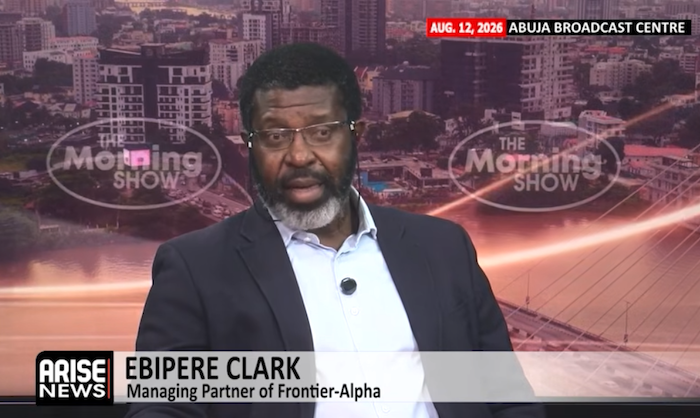
Former Special Adviser to the Central Bank Governor on Infrastructure and Industry, Ebipere Clark, has asserted that Geregu Power’s sharp decline in revenue and profitability requires closer scrutiny, questioning whether the company’s earlier strong performance reflected a “liberal” interpretation of revenues owed to it by the Nigerian Bulk Electricity Trading Plc (NBET).
Speaking in an interview with ARISE NEWS on Wednesday, Clark said the company’s financial performance had changed significantly following the change in management and a period of turnaround maintenance, but argued that the scale of the decline could not be explained by maintenance alone.
“As to the drop in revenue, which is probably more significant, especially to the shareholders, that needs to be interrogated and similarly, one could have some sort of ideas as to why there was such a massive drop in revenue. One thing I would say is that Geragos is a thermal genco. So two-thirds of its monthly bill is essentially payment for gas.
And there may have been a different sort of payment schedule that might have explained part of it. But even then, that would be part of it, not all of it.”
He further suggested that Geregu’s previously reported profitability may have been influenced by how revenues owed to the company by NBET were accounted for. ”I don’t think that the power sector itself has changed as much as the profits of Gerigou has changed. But yes, there has been a turnaround maintenance and that might account for the drop in revenue.
But I do imagine that for Gerigou to be so profitable, before the handover, there would have needed to have been a liberal interpretation of the revenues owed to it by Enbet.And that liberal interpretation may have changed now with the change of management.”
Clark’s questioned the recent backdrop against Geregu Power’s recent default on its corporate bond, which he described as the first corporate default in Nigeria in seven years and the first such default in the power sector. “Profit’s a very strange thing, how corporate profits are accounted for, we have a situation where the generation companies themselves are being paid a fraction of what they’re meant to receive.
Now, the accounting treatment of that money that is owed to them by Enbet and how you treat that will have a significant change on the profits you report. So I would imagine there is now a completely different way of how they are reporting their profits relative to how they reported their profits before that might explain part of the change.”
According to Clark, the default was particularly concerning because it occurred less than a year after a change in management. “It indicates that there are some issues at the issuer, and this is a bit of a worry coming under one year after a change in management, So something is going on at Gerigou, which the shareholders and bondholders are probably now quite concerned about.”
Something has obviously changed. I wouldn’t want to speculate on what that is Now, essentially, Gerigou has been going through a turnaround maintenance, and that can explain the drop in revenue.”
He said the company’s ongoing turnaround maintenance could account for part of the revenue decline, but maintained that it did not fully explain the financial deterioration.
“One thing I would say is that Geragos is a thermal genco. So two-thirds of its monthly bill is essentially payment for gas.”
Clark also questioned why Geregu failed to make a relatively small bond coupon payment when the company should have been aware of its obligations well in advance. “So seeing as the payment should not have been a surprise, we have to ask ourselves why it wasn’t made.”
He explained that the bond had a total issuance of N40 billion, with the interest payable on the semi-annual coupon amounting to about N2.9 billion, describing the amount as relatively small compared with the size of the issuance.
“So they should have paid $2.9 billion, I think, if the total issuance was $40 billion. So it is a relatively small amount.”
Clark said the default could still be remedied within the stipulated period, but stressed that the failure to pay on time remained a significant warning sign about the company’s financial position. “So Geragos can still make this whole within a certain period, but it should be counted as a default. And the fact that they’re not able to pay on time indicates that something is going on at Geragos itself.”
He said Geregu’s creditworthiness had also been affected by the default, particularly because investors would question how a thermal generation company operating in Nigeria’s troubled power market could consistently meet its bond obligations. “It’s very hard for me to understand how in 2022, there was confidence that should the CBN have stopped paying Geragos, how Geragos would have got its money to pay the bondholders from market revenues.”
Clark noted that NBET typically pays generation companies only a fraction of their total invoices, creating an underlying challenge for Gencos seeking to meet financial obligations.
“We know that typically, NBET pays a fraction of the revenues to the Gencos.”
However, he said Geregu could recover from the current difficulties, particularly because of the Federal Government’s ongoing repayment of historic debts owed to power-sector operators.
“I would imagine that Geragos should be able to come back from this.”
He added that Geregu was among the Gencos expected to benefit from the government’s debt repayment process, potentially improving its liquidity position. “My understanding is Geragos was one of the Gencos who was in the first stream of getting money back from the presidential process on debt repayment.”
Clark also raised the possibility that the change in ownership or the parent company could have affected arrangements supporting Geregu’s bond obligations. “I would imagine at the time, and this is me just guessing, that there would have been some sort of parental company guarantee for this bond, given that the power sector itself has payment issues. Now, perhaps because the parent company has changed, that might be the issue.”
The analyst was also asked about Geregu’s financial figures, which showed revenue falling from N137 billion previously to N18.6 billion in the first half of 2026, while profit before tax dropped from N41.2 billion to N3.5 billion. “Now, the accounting treatment of that money that is owed to them by Enbet and how you treat that will have a significant change on the profits you report.”
He said the company’s current reporting may therefore reflect a different approach to recognising revenue compared with the period before the management and ownership changes. “So I would imagine there is now a completely different way of how they are reporting their profits relative to how they reported their profits before.”
Clark nevertheless maintained that the wider power sector had not deteriorated to the same extent as Geregu’s reported profitability, reinforcing his call for closer examination of the company’s financial figures. “I don’t think that the power sector itself has changed as much as the profits of Gerigou has changed.”
He acknowledged that turnaround maintenance had affected revenue but maintained that the extent of the decline warranted further investigation. “But yes, there has been a turnaround maintenance and that might account for the drop in revenue.”
Erizia Rubyjeana
Follow us on: