
China’s rapidly expanding aircraft carrier fleet may be vulnerable to submarine attacks: Report

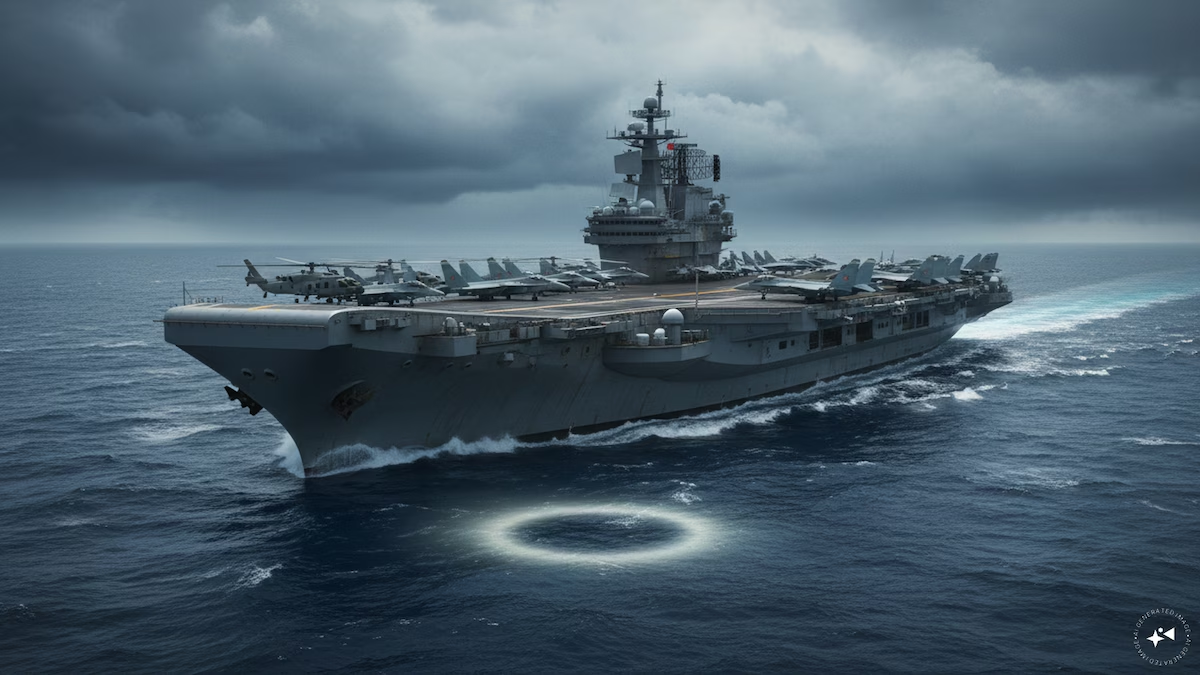
A recent report from the Washington-based Centre for Strategic and International Studies (CSIS) outlined a “cost-imposition” strategy that could help the US and its allies threaten China’s carriers.
It included the use of land-based strike networks, long-range air strikes supported by satellites, cyber and electromagnetic attacks and drone swarms.
However, the fifth element of the strategy – submarine ambushes – could exploit one of the Chinese navy’s key vulnerabilities, the Hong Kong-based South China Morning Post reported on Tuesday, citing the CSIS study.
Specifically, the report identified US attack submarines operating in the western Pacific as one of the potent threats to Chinese carrier groups, arguing that gaps in the navy’s undersea detection and tracking capabilities could leave the high-value ships exposed.
Last November, China commissioned its third aircraft carrier, the Fujian, at a ceremony attended by President Xi Jinping. The Fujian is equipped with an electromagnetic aircraft launch system (EMALS), making it the world’s second aircraft carrier to use electromagnetic catapults, after the US Navy’s USS Gerald R Ford.
China’s first carrier, the Liaoning, a refit of a Soviet-era ship, was commissioned in 2012, followed by the indigenously built Shandong in 2019.
The Fujian is the largest of China’s three carriers, with a full-load displacement of more than 80,000 tonnes. Fujian-based aircraft including the J-15T, J-35 and KJ-600 have successfully completed catapult-assisted take-off and arrested landing training on the carrier, according to China’s Defence Ministry.
All three Chinese carriers – Liaoning, Shandong and Fujian – are conventionally powered.
Analysts say that with tensions on the rise with the US, China may build more aircraft carriers to operate on various global maritime routes, including the Indian Ocean.
The CSIS report says submarines and other forces could be used to threaten Chinese navy carrier groups as they pass through strategic waterways.
Further out to sea, carrier-based aircraft could also be used to strike Chinese carriers, with satellites supporting surveillance and targeting, while attacks on sensors and communications could disrupt PLA operations.
Christopher Sharman, director of the China Maritime Studies Institute at the US Naval War College, told the Post that the undersea vulnerability identified in the report “remains significant today”, although it was “not a static weakness”.
In recent years, the PLAN (People’s Liberation Army Navy) has invested heavily in capabilities intended to improve its awareness of and ability to predict the undersea operating environment, Sharman said.
However, he added that important gaps remained, saying PLAN-affiliated authors acknowledge that China’s meteorological and oceanographic capabilities still lag those of the US Navy.
“This comparative lack of knowledge about the undersea ocean battlespace remains an impediment to PLAN submarine and anti-submarine warfare operations, particularly beyond the first island chain,” Sharman was quoted as saying by the Post.
Timothy Heath, head of defence research firm Perceptum, said anti-submarine warfare remained a challenge for China, particularly because US submarines are among the quietest in the world.
He also said Japanese intervention in any conflict over Taiwan would raise the stakes, because Japan could seek to target Chinese warships operating near its coast, according to the Post report.
In such a scenario, carriers could be deployed in the western Pacific to provide air cover for naval forces seeking to delay or prevent third-party intervention in a Taiwan conflict.
But Heath warned against deploying Chinese carriers too far from the mainland, given the multiple ways the US could target them.
“China’s land-based IRBMs (land-based intermediate-range ballistic missiles) are still the best option for threatening US ships out to the second island chain. The carrier is too valuable and costly to deploy in such a vulnerable way,” he was quoted as saying by the Post.
The report’s authors argued that the challenges China faces in protecting its carriers as they operate farther from its shores should shape US procurement choices, and called for greater investment in torpedoes, undersea drones and missile production with allies including Japan and Australia.
For Beijing, the challenge is not only to expand its carrier fleet but also to ensure that its ability to protect the ships from undersea threats keeps pace with its ambitions to operate them farther from China’s shores, the Post report said.