

Politics
By Anthony Isibor
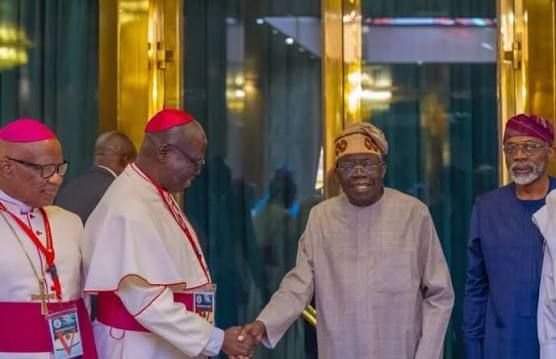
THE meeting between the Catholic Bishops’ Conference of Nigeria, CBCN, and President Bola Tinubu on July 31, 2026, at the Presidential Villa, Abuja, has continued to generate widespread debate after the bishops warned of growing hardship, insecurity and declining public confidence in Nigeria’s democratic institutions, while the President defended his administration’s record.
Led by CBCN President, Archbishop Lucius Iwejuru Ugorji, the bishops told the President that many Nigerians were weighed down by poverty, hunger, insecurity and the rising cost of living.
In their address, the bishops said that the government’s reforms had imposed severe hardship on Nigerians, with many families struggling to survive amid rising food prices, transport costs, unemployment and insecurity. They also expressed concern over declining public confidence in the electoral process and urged the government to guarantee credible elections in 2027.
Responding, President Tinubu acknowledged the concerns, but insisted that his administration had rescued the economy from collapse.
“I can tell you categorically with sincerity that the country has been placed on a sound footing. The economy has recovered. The alarm for bankruptcy and the dark tunnel of uncertainty that we had when I came in has been changed,” the President said.
“This government has stabilised and there is prosperity on the horizon. Life is improving.,” he added.
On preparations for the 2027 elections, Tinubu defended the Independent National Electoral Commission, INEC, saying: “The opportunities are equal. INEC is neutral. They have never intimidated anyone.”
The President’s response quickly became the subject of public debate, with critics arguing that it contrasted sharply with the realities facing many Nigerians.
Speaking after the meeting, Archbishop Emeritus of Abuja, Cardinal John Onaiyekan, said that President Tinubu disagreed with the bishops’ assessment of the country’s economic and security situation.
According to the Cardinal, the bishops told the President that many Nigerians were suffering from worsening hardship, but Tinubu maintained that the economy was improving.
Onaiyekan described the exchange as frank, saying the bishops had a duty to speak on behalf of the people.
As criticism mounted, the Presidency, through Special Adviser to the President on Information and Strategy, Bayo Onanuga, said that the President’s remarks had been misconstrued.
He said that Tinubu did not dismiss the concerns raised by the bishops, but explained that the administration’s reforms were intended to restore long-term economic stability despite the short-term pains.
The controversy also drew a reaction from Peter Obi, the presidential candidate of the Nigeria Democratic Congress, NDC.
In a statement posted on his Facebook page titled “Hunger and the Insensitivity of Mr. President,” Obi said that he watched “with deep concern” President Tinubu’s remark that hunger had always existed in Nigeria.
“While it is true that hunger has been a part of human life and has existed in our country for decades, such a statement appears insensitive to the plight of the millions of Nigerians who face worsening economic hardship today,” he said.
Obi argued that the country’s socio-economic indicators had deteriorated since the current administration assumed office in 2023.
According to him, the number of Nigerians facing acute food insecurity had increased from about 17 million before the administration took office to about 35 million, while the number of people living in extreme poverty had risen from an estimated 87 million to nearly 140 million.
“No one disputes that this administration inherited serious challenges. However, leadership is measured not by the challenges inherited, but by the results achieved. The government must honestly acknowledge that its response has fallen far short of what the situation demanded, with millions more Nigerians pushed deeper into poverty and hunger,” Obi said.
He blamed the worsening conditions on persistent insecurity, poor economic management, fiscal indiscipline, wasteful public expenditure and inadequate investment in productive sectors.
He urged the government to prioritise education, healthcare, agriculture, security and support for small businesses to create jobs and reduce poverty.
One of the strongest civil society reactions came from the Good Governance Group, GGG, which said that the bishops had gone to Aso Rock carrying “the pain of millions of Nigerians” rather than seeking political favours. The group criticised what it described as the government’s responses to concerns over hunger, the economy and electoral credibility.
Drawing from the biblical account of King Rehoboam in 1 Kings 12, the group warned that leaders who surround themselves with praise-singers instead of listening to citizens risk repeating history. It argued that governments should pay closer attention to the concerns of ordinary Nigerians instead of relying on political messaging.
The controversy has underscored the widening gap between the government’s assessment of the economy and the experiences of many Nigerians struggling with inflation, high food prices and declining purchasing power, while keeping the conversation about governance, economic reforms and democratic accountability firmly in the public spotlight.
A.I
Aug. 3, 2026
Tags: Anthony Isibor Archbishop Lucius Iwejuru Ugorji Bayo Onanuga CBCN INEC President Bola Tinubu