

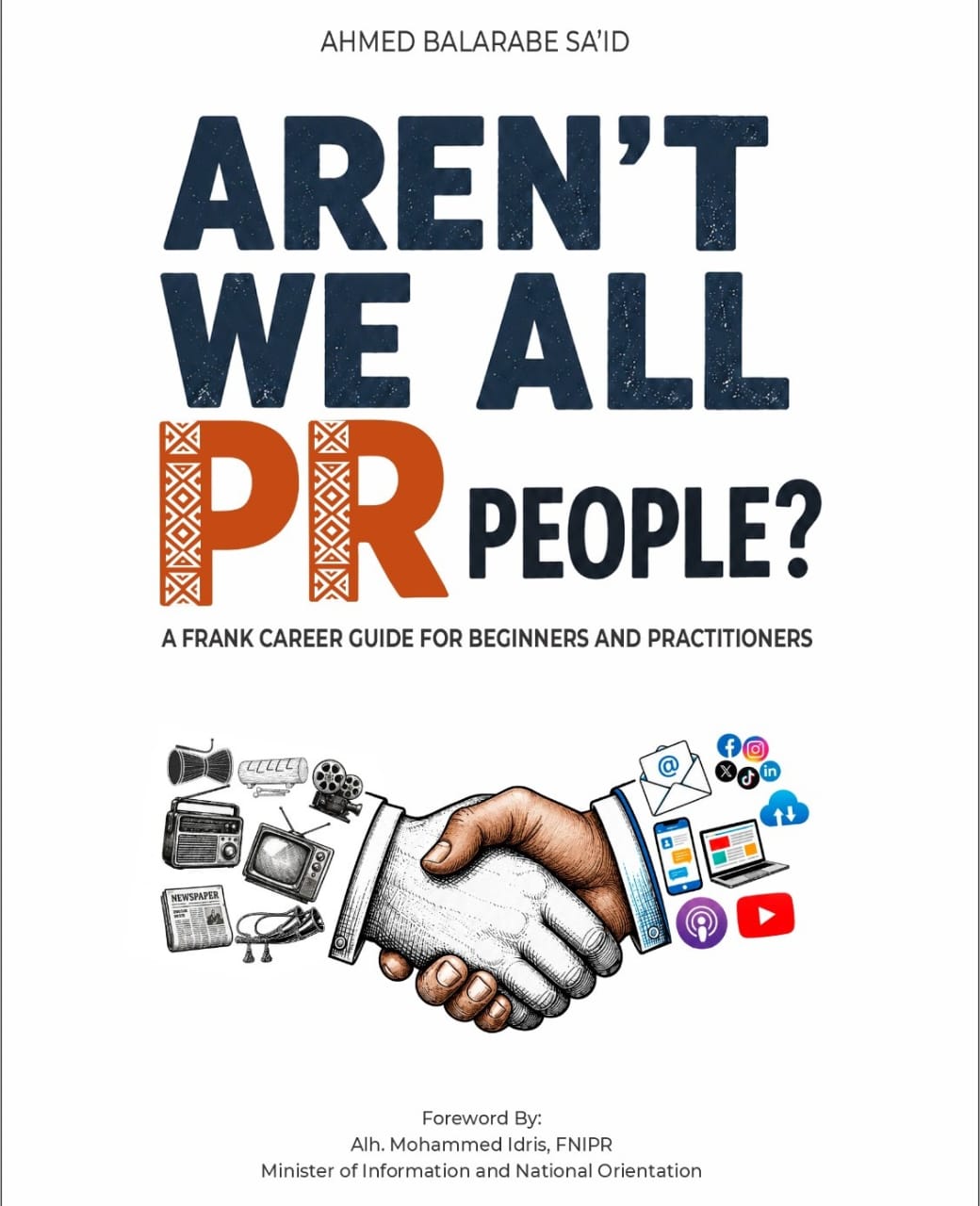
BOOK REVIEW: Aren’t We All PR People? A Guide for Communicators
By Yushau A. Shuaib
Ahmed Balarabe Sa’id’s new book “Aren’t We All PR People?” is one of those rare works that immediately announce themselves as more than textbooks. It is a field guide, a mentor in print, and a career compass for anyone stepping into the demanding but rewarding world of Public Relations. After carefully reviewing the book, I am genuinely tempted—without any flattery—to call it the definitive PR career guide for emerging communicators. It is a standout resource that sets a new benchmark for the field.
Balarabe, a Mass Communication graduate of Bayero University Kano (BUK) more than two decades ago, is not merely a communication scholar; he is a true PR professional in every sense of the word—far beyond regulatory certification. Calling him a practitioner feels almost inadequate because he breathes, speaks, writes, and conducts himself with the instinctive discipline of someone who genuinely lives and promotes Public Relations through his relationships, engagements, and professional ethos.
What makes this book remarkable is not only its breadth but its narrative style. Balarabe writes with a clarity that demystifies PR practice and a warmth that draws readers into the profession’s human side. His storytelling approach, just like my recently released memoir “MNI Versus MNIPR in NIPSS”, creates curiosity, making even foundational principles feel fresh and urgent. For budding communicators who often encounter PR as abstract theory, this book offers something different: a vivid, practical, and relatable journey into the craft.
Several chapters carry uniquely crafted titles that immediately spark curiosity and offer clear glimpses into their thematic direction. Chapter One, “From Ancient Rhetoric to Digital Dialogue,” sets the tone by tracing the evolution of communication from classical persuasion to today’s fast paced digital exchanges. Other standout chapters—“A Constellation of Concepts,” “Professionalising the Practice,” “That Good PR Practitioner,” “A Universe of Opportunities,” “Some of Your Mentors,” “Ethical Traps and Hidden Dangers,” “You and AI,” and “PR Shots”—present their subjects with clarity and creative framing. PR Shots, in particular, is an engaging compilation of short, sharp professional posts originally shared on social media, now curated into a chapter that reads like a pocket guide for daily practice. The final chapter, which foregrounds the emerging role of Public Relations in Nigeria’s national project, provides a thoughtful and forward looking conclusion—positioning PR not just as a profession but as a strategic pillar in nation building.
The book succeeds on multiple fronts. First, it bridges the gap between theory and practice. Many PR texts lean heavily on academic frameworks, leaving young practitioners unsure how to apply them in real world situations. Balarabe flips that script. He grounds every concept in lived experience—crisis moments, ethical dilemmas, communication landmines, and the subtle art of managing reputation. The result is a book that teaches not only what PR is but how PR is done.
Second, the book is structured to guide readers through the profession with increasing depth. From foundational ethics to the anatomy of a good practitioner, from crisis communication to the evolving role of AI, each chapter builds on the last with intentional clarity. The inclusion of real personalities—role models whose careers illuminate different pathways in the field—adds a human dimension that young readers will find both inspiring and instructive.
Third, Balarabe demonstrates a rare courage in addressing contemporary issues. His challenge to the Nigerian Institute of Public Relations (NIPR) on the absence of AI regulation is bold and necessary. His exploration of digital crises, misinformation, and emerging technologies shows a practitioner who understands that PR is evolving rapidly—and that the next generation must be prepared for a landscape far more complex than what existed a decade ago.
The book also shines in its treatment of ethics. Balarabe does not present ethics as a checklist but as the backbone of professional credibility. His insistence that ethical grounding must precede technical skill is a message young communicators urgently need. In a world where speed often competes with accuracy, and visibility competes with integrity, this emphasis is both timely and timeless.
One of the book’s strongest features is its use of narrative to teach principles. Balarabe’s stories—of practitioners, crises, institutions, and turning points—are not decorative. They are instructional. They show how PR works in real life, how reputations are built and broken, and how communicators must think, act, and adapt. This narrative approach makes the book accessible without sacrificing depth.
The book is also refreshingly honest. It does not romanticise the profession. It acknowledges the pressures, the politics, the ethical crossroads, and the emotional labour involved in communication work. Yet it balances this realism with optimism, reminding readers that PR remains one of the most impactful careers for those who master its principles.
For emerging communicators, this book will serve as a mentor. For educators, it will be a teaching companion. For practitioners, it will be a reminder of the discipline’s core values. And for the profession at large, it will be a contribution that strengthens the intellectual and practical foundation of PR in Nigeria.
In my sincere assessment, this book is more than a guide. It is a benchmark. A resource that will inspire, instruct, and challenge. A book that emerging communicators will return to repeatedly as they navigate their careers.
And truly, “Aren’t We All PR People” is a book our profession has been waiting for.
Yushau A. Shuaib, Award-Winning PR Practitioner, is the author of “MNI Versus MNIPR in NIPSS- Tackling Institutional Bullying” [email protected]