

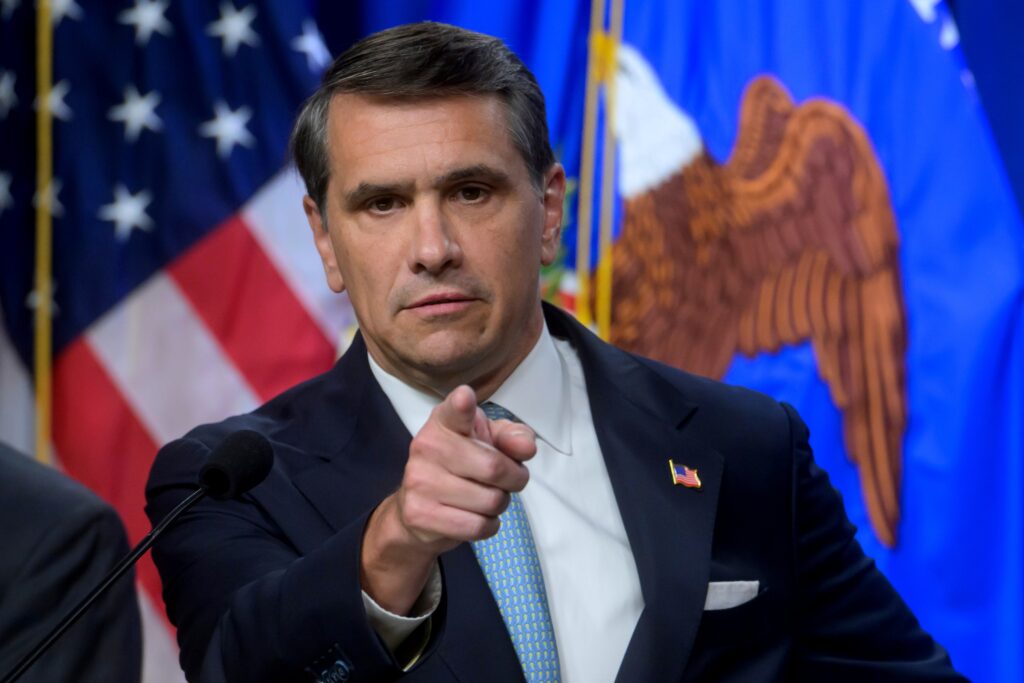
With his bruising confirmation battle behind him, Todd Blanche will soon be sworn-in as the Senate-backed head of the Justice Department.
But the hardest part may be what comes next.
Blanche, President Donald Trump’s former criminal defense lawyer, will officially assume the title of attorney general and take command of an agency he has led on an acting basis since April.
But he will do so under competing pressures from a president intent on seeing his enemies put on trial, a federal judiciary increasingly skeptical of those efforts and a Republican-led Congress harboring growing doubts about Blanche’s ability to say “no” to his boss.
The Justice Department’s career staff has been ravaged by firings, departures and low morale over the past year and a half, as its traditional independence from the White House has evaporated. And its to-do list has only grown longer, including stepped-up efforts to prosecute fraud, illegal immigration and violent crime while pursuing the sweeping, politically charged investigations of foes that the president has demanded.
Blanche acknowledged those challenges and the difficulty of meeting Trump’s expectations as he spoke to reporters ahead of his confirmation last week.
“It’s not as if I remain blissfully unaware of what will happen if I am confirmed,” he said. “When President Trump talks about what he expects this department to do to make this country safe, I don’t think the American people should look at that as some sort of threat to me or warning to me. He wants this country to be safe.”
But as Blanche assumes his new role, now with the imprimatur of Senate backing, walking a tightrope between satisfying Trump and fulfilling an attorney general’s obligations to the rule of law is likely to only grow more perilous.
Over the next several months, the Justice Department is expected to make a number of charging decisions in sensitive cases of keen interest to the president.
Prosecutors in Florida have been at work for months on what Trump allies have referred to as a “grand conspiracy” investigation of former Obama- and Biden-era officials, including former CIA director John Brennan, who they say engaged in a long-running scheme to violate the president’s civil rights through efforts to undermine his presidency — allegations Brennan denies.
Meanwhile, department investigators continue to seek evidence to back Trump’s unproven assertions that the 2020 election was stolen, that there exist broad left-wing conspiracies to oppose his second-term agenda and that his critics, including former FBI director James B. Comey, deserve to be put in prison.
Despite concerns raised by lawmakers about Trump’s role in those probes, Blanche has repeatedly defended the president’s “right” to intervene in Justice Department business — a significant departure from long-standing norms.
“If we have discussions where we have to talk about a case and whether we’re going to charge a case or whether we have charged a case, that’s okay,” Blanche told reporters last week. “I’m not concerned about that.”
The Senate’s 50-49 vote to confirm Blanche early Saturday came in spite of reservations expressed by some Republicans over the growing politicization of the department under Trump.
In casting the pivotal votes, Sens. John Cornyn (R-Texas), Thom Tillis (R-North Carolina) and Bill Cassidy (R-Louisiana) each said they worried about Blanche’s ability to put the interests of the American people above those of his former client.
But each said Blanche had provided them with personal assurances that had assuaged their doubts about his ability to effectively counsel Trump when the president’s instincts run contrary to the rule of law.
“I am realistic that President Trump can be unrelenting,” Cassidy said Friday, but added: “This will be true no matter who the attorney general is. And this is the rationale for having a Senate-confirmed attorney general with more leverage to push back.”
Yet, even as Blanche was making those promises to the senators last week, Trump continued to pick at some of the very issues that had stoked lawmakers’ concerns.
He threatened to revive the controversial proposal for a nearly $1.8 billion fund to compensate those who claim they were victims of political prosecutions, casting doubt on Blanche’s pledge to Congress that the fund was officially dead.
He insisted the U.S. attorney in D.C., Jeanine Pirro, should refile cases that she withdrew against four people previously accused of damaging the Lincoln Memorial Reflecting Pool, even after she determined that there was no evidence to support the charges and that a government contractor was to blame for the damage.
And, in a letter this week, the White House revived its efforts to oust Lisa Cook from the Federal Reserve Board over unproven allegations of mortgage fraud, despite a Supreme Court ruling in June blocking that move and the fact that the Justice Department has not filed any charges despite months of investigation. Cook has denied any wrongdoing.
Publicly, Blanche has pointed to the unique relationship he built with Trump while defending him against the four criminal cases he faced in his years out of office, saying it gives him a base of trust from which to advise the president on issues tied to the Justice Department.
But Blanche has also acknowledged that he can only do so much.
“President Trump trusts me to give him counsel,” he said during his confirmation hearing in July. “Counsel does not mean a ‘yes man,’ and that’s true in my case like it should be in any attorney general’s.”
He added, though, that “the Department of Justice, like every single department in the executive, is part of the executive” branch.
Current and former members of the department’s career workforce have said they, too, once hoped that Blanche could serve as a moderating check on Trump’s most aggressive impulses, only to see those expectations dashed.
When he was confirmed last year as the Justice Department’s No. 2 official, under then-Attorney General Pam Bondi, Blanche brought to the job experience as a federal prosecutor in Manhattan and, later, as a partner at a prestigious law firm.
Career officials said they expected that background had instilled in Blanche a recognition of the department’s tradition of independence and respect for the rule of law.
Their optimism quickly faded, they said, as Blanche publicly embraced Trump’s calls for disruptive change in the department and pursued legally questionable cases against the president’s rivals.
Behind the scenes, Blanche has at times demonstrated a willingness to gently push back against the president, though not always with success.
The Washington Post reported last year that he joined Bondi in advocating to save the job of Erik S. Siebert, the former U.S. attorney for the Eastern District of Virginia, who concluded in September that there was insufficient evidence to charge two top Trump targets — former FBI director James B. Comey and New York Attorney General Letitia James — with crimes.
Trump ousted Siebert anyway, replacing him with Lindsey Halligan, who secured the indictments Trump wanted against both. Those cases were later thrown out by a federal judge who ruled Halligan had been appointed illegally.
And on Wednesday, as Trump suggested Pirro’s job could be in jeopardy over her decision to withdraw the Reflecting Pool cases, Blanche offered her his full endorsement.
“Judge Pirro is doing a great job, and our city, Washington, D.C., is a lot safer in no small part to her effort and the prosecutors’ efforts that she works with,” he said.
Still, Blanche added: “Hypothetically, if the president chose to fire a U.S. attorney, he’s allowed to do that because he’s the president of the United States.”
The same applies to attorneys general — and Trump’s relationships with those who have previously occupied the role under him have been famously fraught.
He fired Jeff Sessions two years into his first presidential term, following months of acrimony over Sessions’s decision to recuse himself from the Justice Department’s investigation of Russian interference in the 2016 presidential campaign — a move that cleared the way for the appointment of special counsel Robert S. Mueller III.
William P. Barr, Trump’s second Senate-confirmed attorney general, resigned after publicly contradicting Trump’s claims about the 2020 election being stolen.
Trump fired Bondi in April over frustrations with her slow pace and limited success in bringing cases against his adversaries.
Blanche, speaking to reporters soon after the president chose him to replace her, contemplated that he, too, could one day find himself on the wrong end of Trump’s expectations.
If that day comes, Blanche said at the time, he would thank the president for the opportunity to serve, adding: “I will say, ‘Thank you very much. I love you, sir.’”