

According to Phys.org, the impact will also allow scientists to test a new technique for identifying where objects strike the Moon, which could support future lunar seismic experiments.
The paper, available on the arXiv preprint server, calls on scientists and amateur astronomers to monitor the event and record its impact.
The impact is expected to take place on the Moon’s Earth-facing side, giving astronomers a chance to observe it. According to the researchers, capturing the event will require high-speed video cameras, as the debris is currently expected to strike at around 06:35 UTC (12:05 pm IST).
Rocket to impact Moon
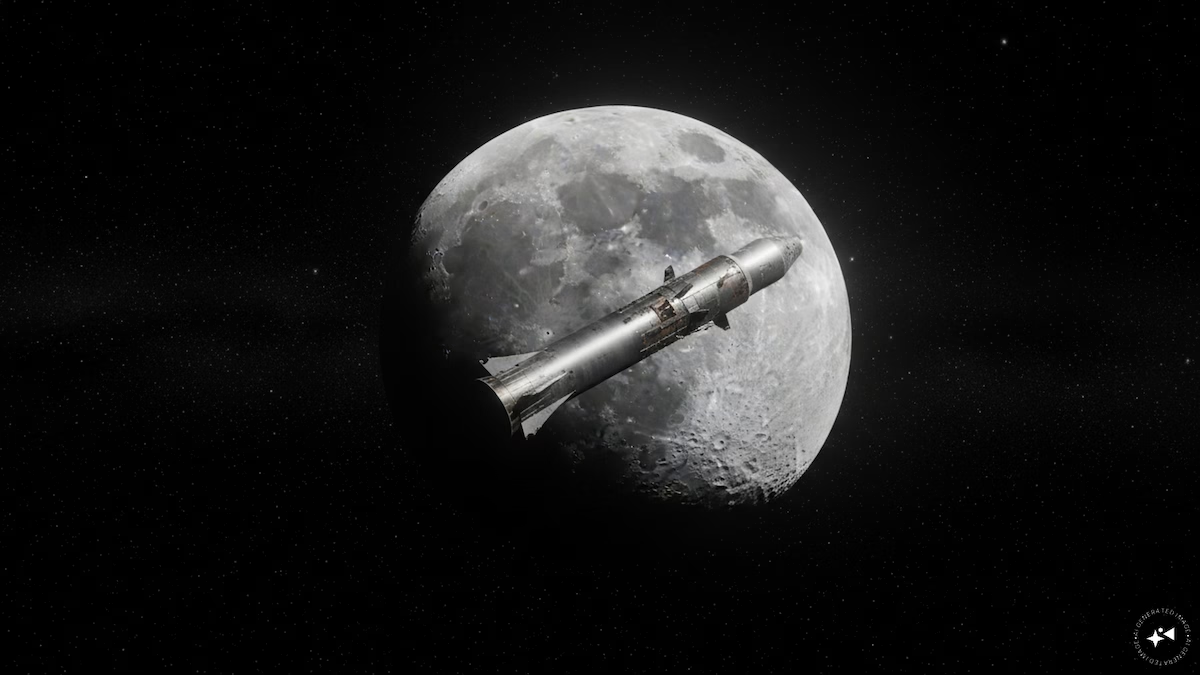
The SpaceX rocket stage was launched in January 2025 to carry two commercial lunar landers toward the Moon. After completing its mission, it did not have enough fuel to return to Earth or travel into deep space. Instead, it continued drifting in space before ending up on a collision course with the Moon.
The rocket measures about 12 metres (39 feet) in length, 4 metres (13 feet) in width and weighs nearly 4,000 kgs. It is expected to strike the Moon at a speed of around 8,750 kmph (5,400 mph).
A chance for scientific research
To predict what the impact could look like, researchers used tracking data calculated by astronomer Bill Grey and ran it through a physics simulation. The results suggest the hollow rocket stage is unlikely to dig as deep into the Moon’s surface as a solid asteroid would. The collision is expected to create a crater around 20 to 30 metres wide and send a cloud of lunar dust several kilometres above the surface.
“Potential observables from this event include the flash at the time of impact (likely lasting less than a second) and the ejecta plume (lasting minutes to tens of minutes). Although some specifics of the impact (such as its precise visual magnitude) remain unclear due to the complexity of the physical processes involved, this event is an ideal opportunity to calibrate measurements of flash brightness and plume dynamics against a known event, should either be detected,” researchers wrote in their paper.
(Edited by : Sudarsanan Mani)