

A couple of years ago, Peter Galassi realized that he had a problem: His 9-year-old son was still, somehow, constantly on Roblox, despite the screen-time limits Galassi had set for him. He soon discovered that his son had used his mom’s phone to secretly open multiple accounts on the platform. Why? Because, like a gambler with a fistful of lottery tickets, he wanted to increase his odds in games such as Adopt Me, in which players hatch eggs for a chance to win rare pets.
Every time the boy played, though, he seemed to sink into distress. Fighting games offended his sense of fairness: He was outraged that players could pay to be VIPs, killing everyone within seconds. And watching other players get “lucky” over and over left him in tears. Then came the “apoplectic meltdowns,” three broken tablets, and this devastating refrain: “My luck is horrible; my life is horrible.” It was, Galassi said, like “we had a son who was on meth.”
A tech-savvy Millennial who also games, Galassi had vetted Roblox before allowing his son to play. Roblox itself doesn’t design the games that appear on its platform; it provides creation tools to third-party developers, whose games Roblox then hosts. Galassi’s first impression, as he surveyed the landscape, was: “These games all seem really crappy and boring—I don’t understand what is the appeal.” It wasn’t until he looked again, after his son started throwing tantrums, that he realized something much more complex was going on.
Not all video games are created equal, of course. Some build social connection, boost memory and focus, and even encourage physical activity, Jason Nagata, an associate professor of pediatrics at UC San Francisco, told me. But many of today’s most popular games involve a style of play unlike any that parents might have seen before, if they were raised on Super Mario Bros. and Tetris. The games have cartoony graphics that may look innocuous, especially when compared with hyperrealistic first-person shooters. But in many cases, their design and interactive elements are less Zelda, more Vegas.
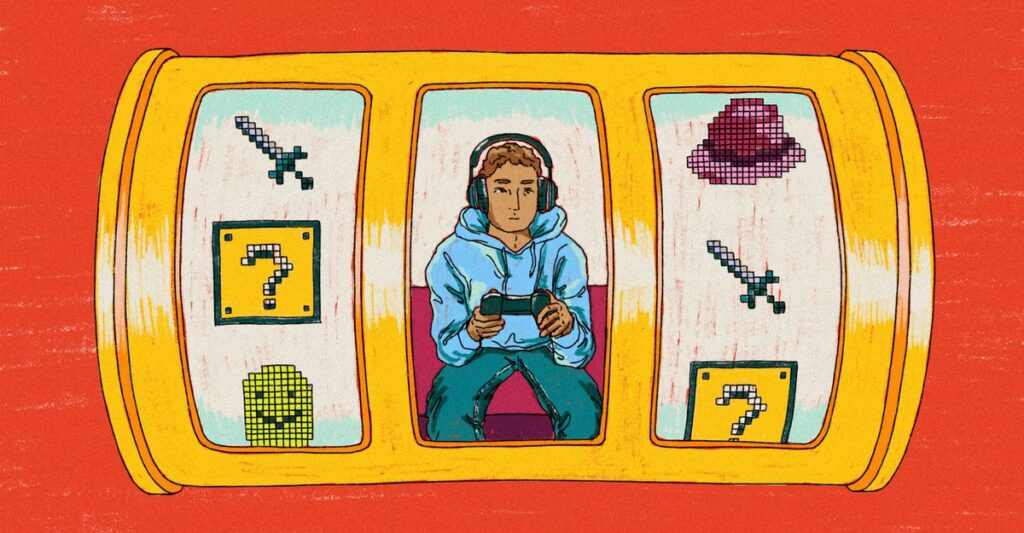
Many games that might appear, to the casual observer, to be an obstacle course or a world-building challenge also contain tempting loot boxes: virtual items that players open blind, revealing surprise rewards of varying value. Nearly 60 percent of the top-grossing games on Google Play and iPhone include them. Although they can be earned, they’re also typically available for purchase. The promise of winning rare items—such as limited-edition hats and extra-lethal weapons—may prompt additional spending. It’s like the Pokémon pack-opening craze, in which people buy dozens, sometimes hundreds, of packs hoping to snag a rare card—except that with games on Roblox and other platforms, players need not schlep to the store or even rise from the couch.
Video games have long operated on a system of challenges and rewards. But earning those prizes usually depended on defeating a dragon, solving a maze, unearthing clues. Today’s bounty, by contrast, can be a player’s instantly—if they’re willing to pay for multiple rolls of the dice or a boost of luck.
These mechanics are not incidental. In the games that employ them, they are designed to maximize engagement. And they’re nearly identical to the variable-reward loops that slot machines and sports-betting apps use in games for adults and that research has shown to be particularly addictive. Games that look like simple fun, according to addiction experts I spoke with while reporting this article, may be normalizing behaviors that could lead to serious consequences down the road.
In recent years, since the 2018 Supreme Court decision that overturned a federal ban on sports gambling, researchers and psychiatrists specializing in addiction have argued that the rise in problem gambling has become a more and more urgent public-health concern. Thirty-nine states and Washington, D.C., have legalized sports gambling, to the tune of nearly $167 billion wagered and roughly $17 billion in revenue last year. Prediction markets such as Polymarket and Kalshi, once curiosities primarily for finance and math nerds, are now mainstream. (Both companies have disputed that their prediction-market services are a form of gambling.) Last year, the National Problem Gambling Helpline reported a steady rise in calls to helplines year over year from 2020 to 2024, and a “significant” increase in calls from younger people, ages 13 to 34, from 2023 to 2025. Meanwhile, scientists and regulators are scrambling to understand and mitigate any potential impacts.
[From the April 2026 issue: Sucker]
All mammals, humans included, are evolutionarily primed to prefer random rewards over predictable ones, Anthony Vaccaro, a psychologist at the University of North Carolina at Chapel Hill, told me. It’s a drive that helped our ancestors find the tree with the best fruit or the hunting ground with the most game—and a fact of our nature that can make us inclined to find gambling really, really fun.
Normally, the brain’s control center keeps its reward center in check to curb behavior such as compulsive gambling. But in gambling addicts—and in kids, whose brains are still developing—that balance can tip. “The adolescent brain might be particularly vulnerable to developing problems” such as addiction, Marc Potenza, a psychiatrist and gambling researcher at Yale, told me. That’s because brain regions sensitive to rewards develop earlier than those that exert control. Thus, children’s early exposure to games that emphasize intermittent rewards might derail normal brain development, the thinking goes, leading to a higher risk of addictive behaviors in adulthood.
This pattern has clear analogs in other contexts. Take e-cigarettes: Some studies have found that kids who vaped were “much more likely to become hooked on nicotine” than if they had not vaped, Vaccaro said. Research into whether gambling-like play among video gamers can be linked to problem gambling is still nascent. And it is unclear whether loot boxes inspire gambling or simply attract people already prone to gamble. But some evidence—including analyses of behavioral patterns among people who, as children, played games featuring loot boxes—suggests a connection. One 2023 longitudinal study observed, for example, that young adults who played games with loot boxes were, six months later, more likely to start gambling than those who did not play with loot boxes.
Anna Lembke, a professor and medical director of addiction medicine at the Stanford University School of Medicine, told me that one can look to other patterns of addiction and begin to connect the dots. “There is evidence showing that the earlier that a child is exposed to social media, the more likely they are to get addicted to social media,” she said. “The earlier that they’re exposed to drugs and alcohol, the more likely they are to get addicted to drugs and alcohol. So we can infer from that that the earlier they’re exposed to gambling, the more likely they are to get addicted to gambling.”
Even if loot boxes aren’t creating problem gamblers, Vaccaro told me, exposure matters. When gambling mechanics are embedded in so many games, they end up “capturing more people that would be at risk,” he said. If at age 6 you’ve spent hours in a game hatching eggs compulsively, it could be that in your 20s, throwing some action on a Knicks game might not feel like such a leap. Or, as Galassi told me: “It’s hard for me to not believe that, like, we’re not priming these kids to just dump their money into FanDuel the second they have a checking account.”
Lembke noted that it is important to not overstate the risk. “Typically, the majority of people exposed to an addictive substance do not get addicted to that substance,” she said. “But if you have a substantial-enough minority of folks getting addicted, then you have a public-health problem. I think we’re beginning to recognize that we have a public-health problem when it comes to addiction to all kinds of digital media, including gambling.”
Many parents don’t realize that their children are being ensnared by psychological tricks similar to those that casinos use to hook adults. “They just think, Oh, my kid wants some money to spend in an online game,” Michael Robb, a researcher at Common Sense Media who released a report in January on gambling and boys, told me. But frequent requests such as this could indicate that the games children play are cultivating compulsive behavior.
Many of the parents I spoke with who caught on fastest to these dynamics work in tech fields that employ gambling-like strategies. Tony Nguyen, a digital marketer in Orange County, California, told me that when his 11-year-old son started playing games on Roblox, his personality changed practically overnight. Some mornings, his son would wake up at 5 a.m. to attend “limited drop” events, in which rare items are doled out to participants at random. “He would just sit for all three hours” for a chance to win one skin, a custom outfit for an avatar, Nguyen said. His son also gamed while watching streamers: people playing in real time for a live audience on YouTube, part of an entangled ecosystem of influencers, game developers, and players that keeps kids locked in. These influencers were also popular with Galassi’s son, the Adopt Me aficionado. Galassi shared one video with me, a 19-minute clip. In it, the host, who has 3.64 million subscribers, gets lucky just two minutes in: She squeals as she hatches a turtle, pumps her fist in the air, and chants, “Yes, yes, yes, yes, yes!”
[Read: My son’s math homework is essentially just Pokémon]
For many, seeing a rare item on a loot-box prize list, surrounded by bright colors and countdown timers, can trigger intense FOMO. A desire for social cachet—players can opt to make their treasured inventory visible to others—also tempts kids to try to land a coveted object. These pressures, coupled with a lack of knowledge about how probability works, can lead to significant financial fallout.
Parents may not notice until a credit card linked to a Roblox account has accrued substantial charges or until a child has begged or traded for one too many gift cards for Robux, the platform’s in-game currency. In a report last year, Fairplay, an advocacy organization working to shield children from exploitative business practices by tech companies, highlighted instances of children racking up thousands of dollars in purchases. “The kid just thinks, I gotta keep clicking until I reach this item,” Haley Hinkle, Fairplay’s policy counsel, told me.
In the United States, these gaming dynamics have largely escaped regulatory scrutiny. Most gambling laws were written for a pre-digital world, which means that loot boxes exist in a “crazy space,” Robb said. Not everyone, for example, considers loot boxes gambling—parents included. And federal law states that something of value must be wagered to qualify as gambling. So loot boxes, whose contents typically can’t be exchanged for money, may not meet this definition—though a robust marketplace of third-party vendors does offer opportunities for players to trade rare items for cash.
Some regulators and legislators are approaching the issue from a consumer-protection angle, the tactic taken in recent lawsuits against Meta and Google, which allege that these companies’ products are addictive and developmentally inappropriate for minors. (Both companies have disputed the lawsuits’ accusations.) Legislators in New York State are considering several loot-box bills that would prevent platforms such as Roblox from offering gambling-like features such as skin cases and pay-to-win transactions on platforms children use. And in May, Fairplay, together with other advocacy groups, asked the Federal Trade Commission to investigate Roblox for unfair and deceptive practices designed to keep kids online and spending. Their request, which the FTC has not yet responded to, argues that the platform’s mechanics—layered currencies obscuring real prices, complex probability calculations that even an adult would find confusing, casino-style visuals, ads bombarding players the moment they log on—cause harm. It also argues that because so many children are on Roblox (in 2024, the company reported that roughly 40 percent of its active daily users were younger than 13), the potential impact on kids is profound. Roblox has stated that it “strongly disputes these claims.”
Complicating questions about who is liable when problems arise is the fact that Roblox doesn’t design its own games. Independent developers, some as young as 13, have created the more than 40 million “experiences,” or games and interactive worlds, available on the platform. Theoretically, developers must follow Roblox’s community standards and creator guidelines, which outline what counts as prohibited types of gambling. But those definitions are both narrow and subjective. Many games may not look exactly like slot machines or roulette wheels, for instance, but they contain imagery that strongly resembles such games, substituting cute characters for coin or playing-card imagery. (AI tools are likely to make it even easier for people to quickly spin up addictive games.) It is also unclear how many developers who skirt the rules will ever face consequences: Potential breaches of the guidelines are largely self-policed, with the company relying on moderators and gamers to report violations.
Roblox, which had $4.9 billion in revenue last year but is not profitable, takes a substantial cut—up to 70 percent—of every in-game item a developer sells to players. So creators must earn, and earn a lot, to see a return, which can influence how they design. They might, for instance, lean more into creating games involving trading and random chance, Taylor Hardwick, a postdoctoral researcher who studied Roblox’s revenue-generating strategies while at the University of Sydney, told me. She was part of a team whose research began as a broad look at Australian children’s spending choices. In one study, the researchers gave 22 children 20 Australian dollars each to spend as they wished. But when half used the money on Robux, the most popular choice by far, the team quickly pivoted their research to an analysis of Roblox itself. She described the “pay to play” ethos on Roblox as “ambient.”
When I asked Roblox about the widespread presence of pay-to-play games on its platform, a spokesperson noted that “only 1.4 percent of our 132 million daily active users were payers” and that it has “clear policies prohibiting both actual and simulated gambling.” It also pointed to its recent rollout of age-based accounts, which it said “bring age checks, content ratings, ongoing game reviews, and parental controls into an easy-to-understand framework for kids, teens, older users, and parents.” Of course, 1.4 percent of daily active users could still be a lot of children, based on the company’s reported number of young users.
Chance-based games and predatory sales practices have plagued other companies that welcome third-party developers, including Minecraft and Fortnite, although Minecraft doesn’t directly profit from these games. Lamar B., a Minecraft player from Kentucky with whom I chatted on Reddit, and who asked that his last name not be used because he feared being harassed online for criticizing the platform, posted that his 10-year-old niece had gambled away her allowance on loot boxes in third-party Minecraft servers, including some appearing under the Official Minecraft Server List. He’d encountered roadblocks when trying to report some loot boxes as offensive content. “Most of the time, you cannot get a human to answer—they have an AI chatbot on their support site,” he told me. Games he reported months ago continue to thrive. When I contacted Minecraft to ask about Lamar’s claims, a spokesperson wrote that the company’s usage guidelines “prohibit gambling-related content, and we take action when experiences violate those standards.”
Hinkle told me that companies trusted to self-regulate sometimes fall short. Roblox’s age checks and expanded parental controls may represent progress, but they don’t address the underlying gameplay mechanics, she said. That would require more substantive structural changes to the way games earn money, which would inevitably cut into companies’ profits. Overall, the global market for in-game purchases is huge—estimated at $81 billion for mobile games in 2024, and $34 billion for games on PCs and consoles last year.
For now, parents must decide where to draw the line. That is possible only with awareness, however. Some parents, such as Galassi and Nguyen, have banned their children from playing any games with gambling-like mechanics. Yet with screens infiltrating many aspects of life, kids have abundant opportunity to play out of sight of even the most vigilant families. Grassroots advocacy groups, such as Parents Standing Together and Parents Together Action, offer support and education. But ultimately, the burden rests with families to set boundaries—and stay alert.