

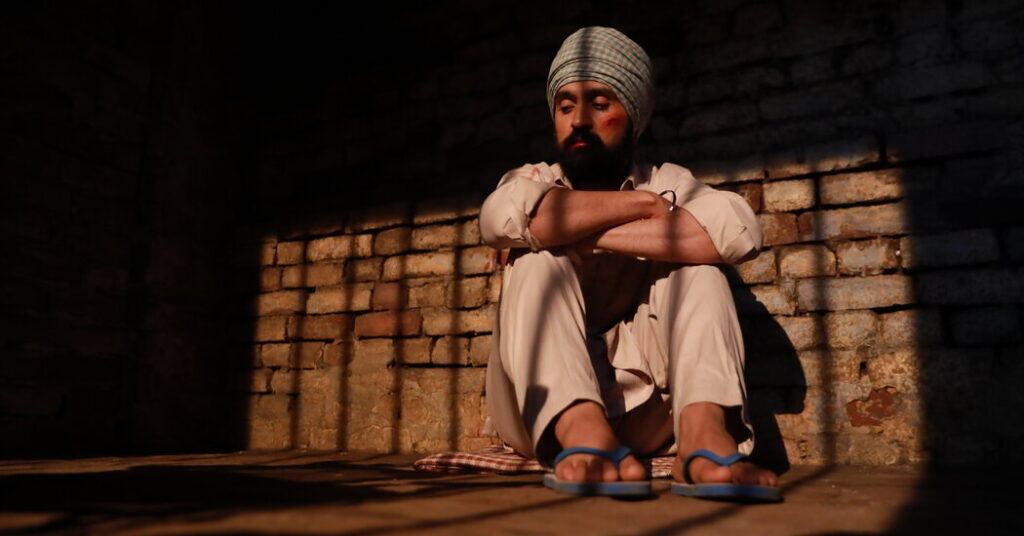
The film features one of India’s biggest stars. It took about a year to make but almost another four trying to get past censors.
Starring Diljit Dosanjh in the lead role, “Satluj” focuses on police abuses in the 1980s and ’90s, one of the most violent periods of independent India when an insurgency was roiling Punjab State. As the country’s Central Board of Film Certification presented an ever-growing list of demands for cuts and changes, the makers went to court. When that proved futile, they gave up on a theatrical release and put the film online last Friday, which does not require the board’s approval.
Within 48 hours, the streaming platform, Zee5, took it down.
Zee5, in a vague statement, said the film would no longer be available for viewing in India “in light of current developments.” The government has not released an official statement, but officials told local news agencies that they had ordered the film be taken down on security grounds and because it could be used by what they called “anti-India forces.”
The film’s odyssey is the latest example of what filmmakers and activists say is a deeply entrenched state of censorship under Prime Minister Narendra Modi, where making art that strays from official narratives has become extremely taxing.
“What’s happening with the movie has chilling effects,” said Navroz Seervai, a constitutional lawyer who has taken on cases against censorship. “It’s like telling the producers and distributors ‘you take the risk of making a film we may not like and we will have the last laugh.’”
“Satluj” focuses on the life of the human rights activist Jaswant Singh Khalra.
Mr. Khalra documented police abuses, such as the disappearances of thousands of people and extrajudicial killings, that occurred during a government crackdown on the separatist insurgency in Punjab. The film’s initial title, “Punjab ’95,” drew on the year Mr. Khalra was abducted and killed by the Punjab police.
The well-documented abuses in the film took place when the opposition Congress party was in power, but allegations of abuses against minorities persist under Mr. Modi’s government.
Since the film’s takedown on Sunday, it has taken on a life of its own. Bootleg copies are circulating online, and villages and temples in Punjab have hosted public screenings.
“The story has been delivered, and today Jaswant Singh Khalra is being talked about in every home,” Mr. Dosanjh told fans in a video chat. “The more you try to stop it, the more it is being discussed.”
The film, directed by Honey Trehan, had a budget of about $4.5 million, according to court filings.
The certification authority asked for 127 cuts, the director said.
After each round of cuts, Mr. Trehan said, the board still wasn’t satisfied. The demands included: changing the film’s name, fictionalizing the character’s name, removing any reference to the state, India’s flag and historical events such as the assassination of Indira Gandhi, who was prime minister when the crackdown in Punjab began. (The board has not commented on the film.)
“I’m waiting for the day when they will give us the script and say, ‘Here’s the script, why don’t you direct,’” Mr. Trehan said in an interview with the film journalist Sucharita Tyagi.
Mr. Modi’s ruling party has rewarded art that promotes its ideology.
Films like “The Kashmir Files” have selectively drawn on painful episodes of Indian history, leading some critics to label them propaganda for the Hindu nationalist government. They were cleared by censors and endorsed by officials — including receiving public support from Mr. Modi and tax breaks by many states run by his ruling party.
In recent years, that type of film has dominated mainstream Indian cinema: high-pitched, gory violence that often combines nationalistic fervor and religious chauvinism.
The slick, action drama “Dhurandhar” included heavy doses of violence. While papering over policy failures of Mr. Modi’s government, it portrayed the leader and his top security chief as macho heroes the nation had long waited for to stand up to rival Pakistan. The film and its sequel became some of India’s most lucrative productions, together bringing in over $300 million.
Films that veer from the prevailing political narrative face pressure from officials and vigilantes.
The list of films that have hit a wall with India’s censorship board is long, and the issues considered taboo has kept growing. Films that address caste discrimination, police brutality or major government failures have struggled to see the light of day.
Filmmakers say they’re frustrated by the opacity of the process. They say demands from the certification authority are usually expressed verbally and a film’s demise comes by stonewalling. Threats of violence by right-wing vigilantes add to the pressures, and streaming platforms often shy away from running these films.
The fear has become so entrenched that a deep layer of self-censorship has taken over, the filmmakers say. The projects that do make it to preproduction stage face such heavy vetting by lawyers, gutting references to no-go subjects, that many become boiler plate.
The ones that brave these risks face the fate of Mr. Trehan.