

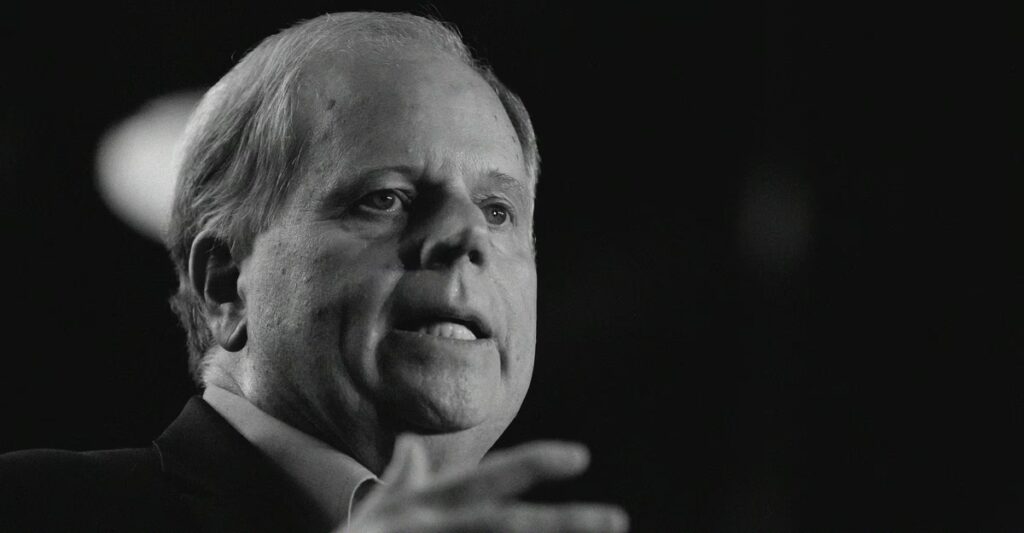
On Juneteenth, I watched Doug Jones, the Democratic nominee for Alabama governor, deliver a speech at the Scottsboro Boys Museum, in the northeastern corner of the state. I found myself thinking of the 1960s civil-rights rallies that I’d covered as a young reporter, and that many of the older Alabamians in the packed venue had attended. A former U.S. attorney who served three years in the Senate, Jones is a master of the old-time Bama stem-winder in settings such as the 150-year-old Black church that houses the museum, which commemorates nine young Black men who were falsely accused of rape nearly a century ago.
“We don’t want to go back, folks,” Jones said, in a rising preacherly cadence. The audience responded with Amens. “We have a different view of governing,” he said of his campaign. “We have a different view of Alabama than somebody from Florida that wants to be your governor. My view of Alabama, and what we’re trying to do in this campaign, is to build a house with a crowded table.” He went on, “We’re all a little broken, but in Alabama we all belong.”
The Florida quip was a shot at Jones’s opponent, Senator Tommy Tuberville, and a nod to the one issue that Alabama’s Republicans fear in this campaign to lead one of the reddest states in the South. A Democratic judge in Montgomery will rule soon on whether Tuberville meets the state constitution’s seven-year residency requirement to run for governor. His opponents argue that his real home is the 5,000-square-foot Florida beach mansion that he bought after his 10-season coaching stint at Auburn University.
Tripp Skipper, a former paid consultant to Tuberville, summed up the Republican view of the contest for me. “The only path for victory that I see for Doug is one that the courts provide for him, and I don’t see that happening,” Skipper said. “The voters have already rendered a verdict on Tuberville and Jones, and the political environment has not changed in any significant way since 2020.” That year, Jones, who was trying to hold on to the Senate seat he’d won in a 2017 special election, lost to Tuberville by nearly 472,000 votes.
[Adam Serwer: The Supreme Court has invented a right to discriminate]
Tuberville is certainly the favorite in the race. He is a committed loyalist to Donald Trump, who won the state by 30 points in the last presidential election. Alabama hasn’t had a Democratic governor in more than two decades. And yet, during a recent visit to the state where I was born and began my newspaper career, I came to believe that Jones’s candidacy has a long-shot logic, positing a collapse of Trump’s popularity. Jones must stir voter resistance to Tuberville’s political baggage and his gift for goofy statements. At the least, Jones’s candidacy is a bravely idealistic waving of the flag in a state that is growing more diverse and lurching toward modernity in its population centers.
Roving 187 miles from Scottsboro to the Montgomery bedroom town of Wetumpka, I didn’t see a MAGA cap on the sidewalks. The Trump faithful seemed hunkered down. Doug signs festooned the lawns in the rich suburbs south of Birmingham, just as they had when Jones won in 2017. Republican leaders in Alabama are demonstrably jumpy on the residency issue. A sure sign was the state GOP’s executive meeting on June 14, when Tuberville’s party put him under oath behind closed doors to testify about his homes. Tuberville told a committee that, since 2018, his effective residence has been a small house in Auburn that his wife and son bought in 2017; he presented tax statements that his lawyers said supported this. He also testified that he’d voted in Florida as recently as 2018 and hadn’t put his name on the Auburn deed until two years ago. The committee rallied behind Tuberville, dismissing a challenge by an obscure candidate who wanted to replace him on the GOP ticket.
In an interview, Jones, who is 72, told me that he is counting less on the residency issue than the national mood swing that he believes has reached even the Trump faithful in Alabama, and on the arithmetic of his previous campaigns. He scored a come-from-behind win in 2017 against a flawed Republican candidate, former Alabama Supreme Court Justice Roy Moore. Moore saw his lead vanish after several women credibly accused him of pursuing sexual relationships with them when they were minors. (He denied engaging in sexual misconduct.) This year, Republicans are fretting about a slide in voter participation. AL.com reported that, in the May 19 primary, the state moved from “as far red as you can go” to “something that might almost look purple in the right light” in terms of voter turnout. On primary day, 42.5 percent of the votes cast were Democratic, up by more than 20 points from 2022, while “Republican turnout dropped by nearly as much as Democratic turnout increased,” according to AL.com.
If this turnout pattern continues in November, Jones hopes that his “magic number” of 920,000—his vote count against Tuberville in 2020—could squeak him into the governor’s mansion. In short, he’s counting on MAGA no-shows rather than conversions. “We’re not going to spend any time trying to persuade the unpersuadable,” he said.
Jones is Alabama’s proven upset artist. Witness not just his 2017 victory over Moore but his successful cold-case prosecutions of Klansmen. While back home, I spent time with his political role model, former Alabama Attorney General Bill Baxley, another civil-rights hero who, like Jones, is an avatar of Alabama’s embattled, but occasionally decisive, progressive coalition. Made up of minority and white voters from the state’s professional classes—educators, trial lawyers, union members—and suburban independents, this bloc undercuts stereotypes about Alabama as a white conservative monolith. Elected in 1970, Baxley shamed the FBI into giving him the evidence needed to convict the infamous Klan terrorist Robert “Dynamite Bob” Chambliss of murder in 1977 for his role in the bombing of the 16th Street Baptist Church, which killed four Black girls on September 15, 1963. Chambliss had escaped punishment for 14 years because J. Edgar Hoover closed the celebrated case as unsolvable in 1968. Birmingham police had never shown much interest, because Chambliss operated under the personal protection of Public Safety Commissioner Eugene “Bull” Connor.
I covered the dramatic Chambliss trial in Birmingham for the St. Petersburg Times. Unbeknownst to me, Jones had skipped law-school classes nearby at Samford University and watched from the courtroom balcony as Baxley presented the tightly choreographed prosecution that put Chambliss in prison for life. Inspired by Baxley’s performance, Jones went on to become U.S. attorney for the Northern District of Alabama in 1997. The FBI’s Birmingham field office had quietly reopened the 16th Street case, and provided Jones with wiretap evidence that the bureau had withheld from Baxley. In 2001 and 2002, Jones secured murder convictions against Chambliss’s aging accomplices, the Klansmen Thomas Blanton Jr. and Bobby Frank Cherry. Chambliss was unrepentant when I visited him in prison in 1980, and both Blanton and Cherry died in prison without admitting their guilt. (All three men had lived in or near the industrial neighborhood in Birmingham where I came of age. I am revisiting those places now to research a book about “Bombingham.”)
To this day, repentance and empathy are not much part of the political ethos in Alabama. The Alabama style, with proven voter appeal, has more to do with anger, violent language, and an enduring sense of grievance about being looked down upon by outsiders in the public, the media, and the federal government. Scratch enough and you’ll surface these sentiments among even rich, educated Republicans in the most affluent suburbs of the big cities. It is no mystery, then, that Trump and Tuberville have both found success in Alabama by railing against elites and intellectuals, as George Wallace did in his day. Jones knows all about Alabamians who cast throwback votes, even as he declared defiantly in Scottsboro that the Confederate flags he’d spotted on the way to the museum are “a symbol of hatred.”
“I know I was preaching to the choir back there,” Jones told me as we drove away from the museum. Still, he insists that the zeitgeist is shifting in Alabama in light of socioeconomic change and the trickle-down effect from Trump’s erratic record. There is some truth to this; the state is now a land of high-rise financial offices, Mercedes and Honda plants, a nationally ranked medical center, and soon data centers and energy farms around Birmingham and Mobile, and in the Black Belt. Birmingham has even become a destination city for foodies. As a reporter for The Atlanta Constitution and The New York Times, I watched Atlanta evolve in the ’70s, and I’d judge that my hometown is on a similar arc, just one or two decades behind.
Tuberville, 71, has yet to campaign hard. He must recognize that the residency litigation could be a close-run thing. On June 29, Circuit Judge Brooke E. Reid said she’d read all the briefs, and noted that “it’s not a well-settled issue in my opinion.” Reid, a Democrat, said she expected her ruling to be appealed to the all-Republican state supreme court. There, a rejection of Tuberville’s candidacy would shake the highly political city of Montgomery to the foundations of the antebellum capitol building.
In a state that favors performative politicians, Tuberville is far from a perfect candidate. He sports nice suits and Conway Twitty hair, but he’s hardly charismatic. AL.com’s cartoonist and liberal columnists openly ridicule him as “dumb.” Tuberville’s 2023 blocking of Pentagon promotions was not popular in a state that’s heavily dependent on spending for military bases and NASA. His recent suggestion that President Obama should be jailed for imaginary offenses may be too absurd even in a state used to hyperbole. Tuberville also has a way of talking himself into trouble, as when he promised during his 2020 campaign to give his $174,000 Senate salary to veterans. Lagniappe Daily, a frisky newspaper in Mobile, recently reported, based on tax information released by the Tuberville campaign, that the senator might have broken that pledge. “Coach has to live with that himself, I know what he said and I know what he promised—me and the people heard that,” Chester McKinney, the treasurer of the senator’s own charitable organization, the Tommy Tuberville Foundation, told Lagniappe Daily. “I’m not trying to cover for him.” Tuberville’s office has declined to answer questions on the matter.
Then there’s the mystery of why anyone would give up a Senate seat to be governor of an eccentric state. “He’s an executive by nature,” Tripp Skipper offered. “The sausage-making of being in Washington does not suit his skill set. Being at the head of the table, head of a team overseeing departments, that’s his strength.” That is to say, he wants to be head coach again, and he wasn’t bad at that at Auburn: From 1999 to 2008, he defeated the Alabama Crimson Tide six straight years in the Iron Bowl. Auburn fans believe that his undefeated 2004 team was cheated out of a national championship, which fits nicely with Alabama’s traditional persecution neurosis. Both football and basketball seemed to be on Tuberville’s mind after a June 24 meeting in which he watched Trump dress down Republican senators who’d voted to limit the president’s war powers. “It was like a half-time speech from a coach,” Tuberville told White House reporters. “If we don’t do something with the filibuster, and we don’t get things passed, it’ll be the last time we have a Republican president or a Republican Congress. The ball’s in our court.”
Still, it’s a home truth that Alabama voters habitually forgive rascals and verbal excesses. Jones is not just running against a vociferous Trump puppet. He is running against the state tradition of entrenched, defiant passivity. Since Reconstruction, the state’s white majority has almost always voted against progressive change. For top offices, Alabama voters time after time have elected the candidates who put the state in the worst light nationally. Wallace was hardly the most extreme product of this strange land. In 1908, Representative James Thomas “Cotton Tom” Heflin shot a Black man on a Washington, D.C., streetcar for allegedly cursing within earshot of a white woman. In 1920, Heflin, a Klansman, was rewarded with a Senate seat, which he held until 1931.
[Read: The great resegregation]
On my visit to the state, I was struck anew that Alabama is the Deep South’s last stronghold of what V. O. Key Jr., in his 1949 classic, Southern Politics in State and Nation, called “a comic opera staged on a grand scale for the amusement of the nation.” The state’s carnival politics have frequently foreshadowed larger developments, as when Wallace’s race-conscious conservatism paved the way for the Nixon and Reagan presidential campaigns. Today, Alabama demonstrates the durable power of corrupt oligarchies to block progressive politics. From the start of the 20th century, the “Big Mule” cabal led by U.S. Steel and the Black Belt cotton-and-timber barons owned the Alabama legislature. Now politics in Montgomery are swayed by the Southern Company, a multistate utility that owns the Alabama Power Company, and Alfa, the insurance giant sprouted from the venerable Alabama Farmers Federation. National Republicans’ unfair tax policies that rip off MAGA voters are another example of what Kyle Whitmire, a columnist for AL.com, has dubbed “the Alabamafication” of U.S. politics. In Alabama, industrial and agricultural businesses pay only token property taxes on their large timber and mineral holdings. The cost of running the government is billed to consumers through taxes on food, gasoline, alcohol, tobacco, and household necessities. One reason this regressive system persists is that every newly elected legislator knows that someone with ties to Alabama Power or Alfa will show up to retire his or her campaign debt and finance the next campaign.
Alabama politics have a time-warp feel to them, on both sides of the aisle. Jones favors the humanistic homilies of the ’60s. He was received rapturously by the crowd in Scottsboro. After he drifted away for handshaking, I asked a friend of his, Jackson County’s Republican sheriff, Rocky Harnen, to assess Jones’s chances. He responded warily, and I sensed that he didn’t want to undercut Jones. He probably wouldn’t carry the very red Jackson County, the sheriff said. “But statewide you can’t even tell if he might have a chance.” After this very thin slice of optimism, Harnen sheltered in the idiom of Alabama’s civic religion, football. “Auburn people are all for Tuberville. Alabama people, they’re not so sure,” he said, making a holding-my-nose gesture. The suggestion was that Jones’s University of Alabama degree might be a factor against an Auburn man.
Tuberville’s campaign looks back to the ’60s too, but he emulates the apocalyptic tone that worked so well for Wallace. On statewide radio, I heard the Republican candidate call Alabamians to battle against the “socialistic, communistic Democrats.” It sounded both anachronistic and Trumpian to me. But Alabama voters have often responded well to dark warnings.