

Volodymyr Zelensky, the actor turned president of Ukraine, has taken pride in standing up to immense pressures during the war — but not when it comes to protests on the streets of Kyiv.
As several thousand people waving cardboard signs have descended on a central square in the capital, angry about the firing of the popular young defense minister, Mr. Zelensky’s administration has signaled an openness to compromise.
“Society’s position has been heard,” Kyrylo Budanov, Mr. Zelensky’s chief of staff, said in a statement on Monday. “I understand the people who are expressing their position. Caring is the strength that has sustained our state throughout these years.”
After first demanding the return of the defense minister, Mykhailo Fedorov, protesters pivoted on Friday to calling for the ouster of his chief rival, the commanding general in the war, Oleksandr Syrskyi. The two men had clashed over whether Ukraine had gone too far with the robotic warfare strategies championed by Mr. Fedorov.
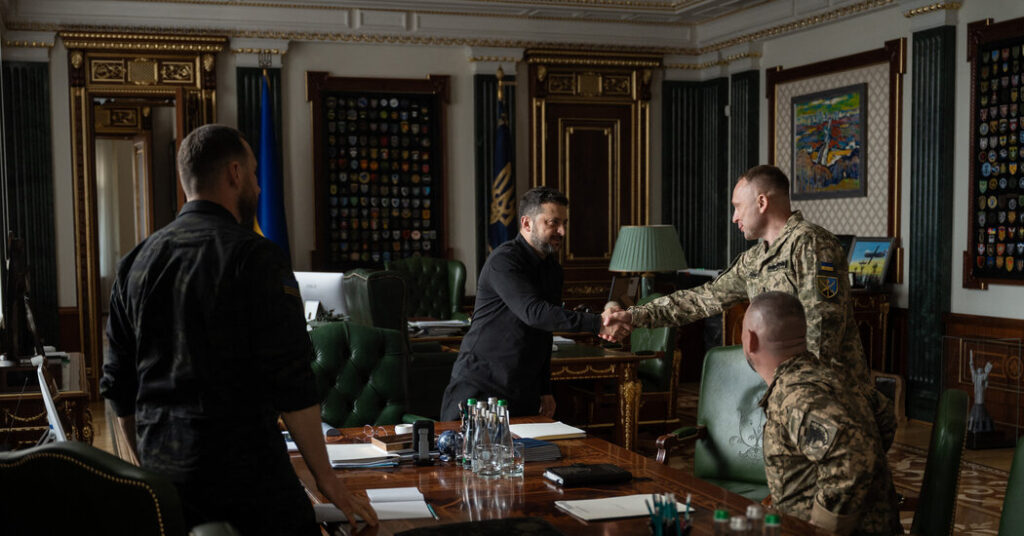
Mr. Zelensky has responded to the demonstrations by commencing days of back-to-back video calls with corps commanders in the army, showing a willingness to hear complaints. The calls were also seen as a public display of auditioning for a replacement for General Syrskyi. As of Monday night, the fifth day of the demonstrations, he remained in his job.
The president has offered other posts to Mr. Fedorov, including a role on the national security council, though the former defense minister has not accepted the offers.
Any leader of Ukraine must heed street protests. They are seen in the Ukrainian tradition as a pillar of democracy and as an important contrast with the path toward authoritarianism in Russia after the fall of the Soviet Union.
Crowds in Kyiv and other cities played a pivotal role in the country’s push for independence in 1991. Demonstrations in 2004 forced a revote in a presidential election, and protests in 2014 forced out a pro-Russian ruler.
Faced with more recent outbreaks of protest, Mr. Zelensky has quickly folded to demonstrators’ demands.
In an early, failed peace process with Russia that he initiated after his election in 2019, Mr. Zelensky pivoted to slow-walking concessions after street demonstrators accused him of treason. Last year, he reversed course on laws weakening anti-corruption oversight after protests broke out.
The president, who has a populist streak from his former career in show business, has ruled with selfie videos, a keen sense of timing and an Everyman touch. And when the crowd jeers, he listens.
Mr. Zelensky has also needed popular support to maintain political legitimacy during the war. He has relied on constitutional provisions under martial law to remain in office after his five-year term expired in 2024.
The current protests are smaller than the anti-corruption demonstrations that broke out last summer. But their ability to channel widespread anger was summed up with one handwritten placard that read, “A small but outraged piece of cardboard.”
The demonstrations were first prompted by social media posts from a former army medic, though the protests have so far remained leaderless.
Mr. Fedorov, 35, has not turned up to meet his supporters, in part because open political infighting is seen as aiding the enemy during the war. But a cardboard cutout of him that protesters created gets cheers when it appears on a balcony overlooking the demonstration.
The former defense minister had accused General Syrskyi of playing favorites in allocating weapons to subordinate commanders and of blocking his initiatives to procure more aerial drones and ground robots. Mr. Fedorov publicly called for the general’s removal.
Since then, Mr. Zelensky has met repeatedly with Gen. Mykhailo Drapaty, the commander of the Joint Forces, a recently created command structure. General Drapaty has openly backed Mr. Fedorov during the shake-up, in conflict with Mr. Zelensky’s position. With protesters on the streets, that insubordination has been forgiven.
On Monday, General Syrskyi, 60, a flint-hard man who has commanded troops in combat for more than a decade, issued an apology to Mr. Fedorov. “If I offended anyone in any way: Mykhailo, I apologize,” General Syrskyi wrote in an essay published by Militarnyi, a Ukrainian news outlet.
While the apology was addressed to Mr. Fedorov, it was also seemingly directed at the protesters on Franka Square in Kyiv clamoring for his firing.
In another apparent nod to demonstrators, General Syrskyi issued a statement on Monday saying soldiers in the besieged eastern city of Kostiantynivka would use drones and robots as much as possible.
“The main focus is on increasing the use of unmanned systems of all types,” he wrote.
Mr. Fedorov and General Syrskyi had clashed after the general demanded artillery ammunition that the defense minister declined to immediately purchase, instead favoring more drone purchases.
The street uprising poses the risk of snowballing if Mr. Zelensky does not backtrack after siding with his commanding general in the rift with Mr. Fedorov, said Liudmyla Buimister, a member of Parliament who was elected while in the governing party but has since broken ranks.
As with past demonstrations, the protests are powerful, and unpredictable, because they are leaderless, Ms. Buimister said.
“No politicians come to speak, and there is no structure,” she said. “Imagine what an uncontrolled crowd could do.”
Pressure had already been building in Ukrainian society over the heavy-handed methods of draft officers. Popular anger also mounted last fall as anti-corruption agencies implicated members of Mr. Zelensky’s inner circle in a multimillion-dollar kickback scheme.
As the protests continue, they could become more directly aimed at Mr. Zelensky, Ms. Buimister said. “Zelensky should do what the people say,” she said.
That has been his history. At the same time, however, he has stubbornly ignored other pressures. His administration dug in its heels and negotiated for months last year over a demand by President Trump to cede mineral rights as payment for previous military support. Mr. Zelensky has also harangued foreign leaders with demands for weapons.
But “it is impossible now for him to pretend that nothing is happening,” said Yurii Makarov, the former editor in chief of Suspilne, Ukraine’s public broadcaster.
“Zelensky is extraordinarily dependent to the masses,” he said. “He depends on his image as a popular president.”
Nataliia Novosolova contributed reporting.