

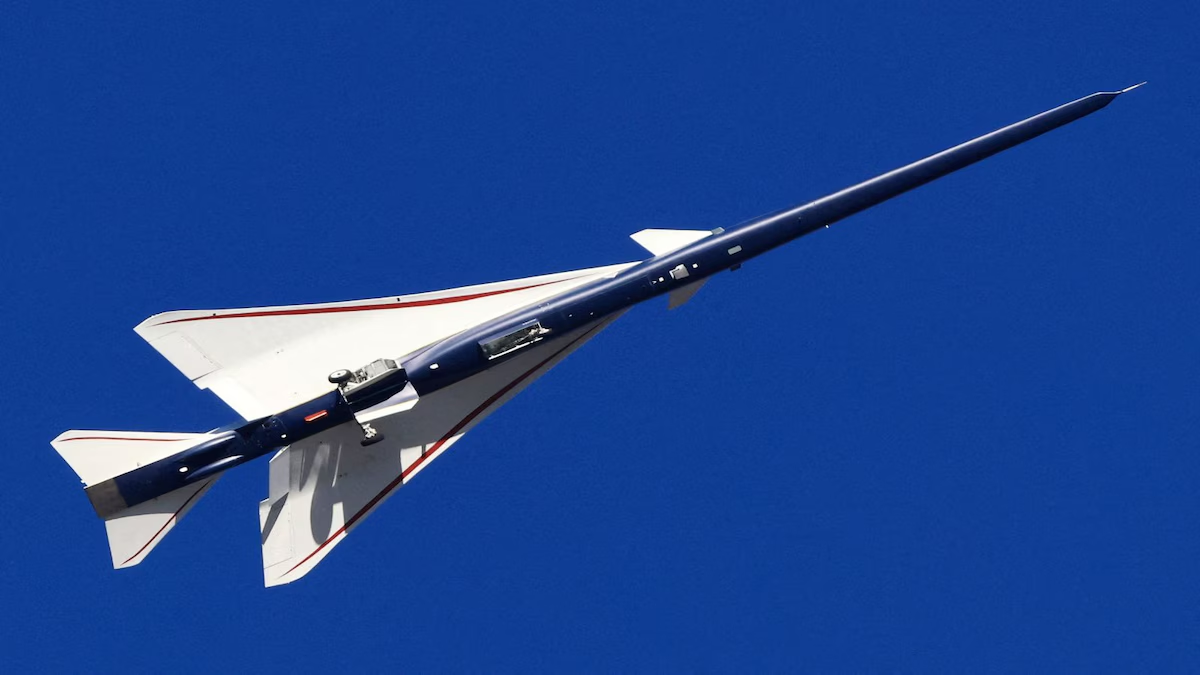
The US Department of Transportation’s move on Tuesday (June 30) came after NASA successfully tested the experimental X-59 aircraft, which flew faster than the speed of sound without producing the loud sonic booms usually associated with such flights.
Sonic booms can rattle windows and, at their most severe, risk damaging buildings.
The proposed Federal Aviation Administration (FAA) rule intends to replace the 1973 ban on overland supersonic flight with a noise limit.
The proposed rule would allow aircraft to fly faster than Mach 1 (the speed of sound, 767 miles per hour) over land, provided the resulting noise remains below a specified limit.
The FAA also plans to propose another rule later this year to establish landing and take-off noise standards for supersonic aircraft. The two rules are expected to be finalised by mid-2027.
Currently, airline operators require special authorisation from the FAA to fly aircraft faster than Mach 1, and only for research and testing purposes over isolated areas.
“Advances in aerospace engineering, materials science, noise reduction, and new operational concepts will eliminate the old sonic boom,” Federal Aviation Administration (FAA) chief Bryan Bedford said in a statement.
“This means we can ultimately repeal the ban from the 1970s on supersonic flight over US territory while minimising noise impacts to residents in communities along the route and near airports,” Bedford said.
Earlier this month, NASA demonstrated its “quiet” supersonic flight when it tested the X-59 aircraft, which reached a top speed of Mach 1.1 (around 713 mph) at an altitude of 43,400 feet.
The X-59 is designed to fly at supersonic speeds while producing only a quiet thump instead of a loud sonic boom, NASA said in a statement issued on June 5.
“Restoring supersonic flight over land isn’t just about speed, it’s about unleashing American innovation and ushering in a Golden Age of Travel,” said US Transportation Secretary Sean P Duffy.
“Thanks to President Trump’s leadership, we are working at lightning speed to safely enable the next quantum leap in aviation technology and deliver an exciting new way to fly to the American flying public,” Duffy said.”
“For too long, outdated rules held back our engineers and manufacturers. Under President Trump’s leadership, we are clearing the runway for supersonic flight, strengthening our industrial base, creating high-skilled jobs, and ensuring the future of aviation is invented and built in America,” Director of the White House Office of Science and Technology Policy Michael Kratsios said in a statement.
American ingenuity broke the sound barrier once before, and today’s action ensures it will define the new Golden Age of Aviation. Air France and British Airways introduced Concorde, which flew at twice the speed of sound (Mach 2) and crossed the Atlantic Ocean in about 3.5 hours.
However, such speeds were permitted only over the ocean, and the aircraft had to operate at subsonic speeds over land. Concorde service ended in 2003 due to high operating costs.
Besides NASA, other US companies working on supersonic aircraft include Boom Supersonic and Spike Aerospace, which also plan to offer future transatlantic flights in under four hours.