

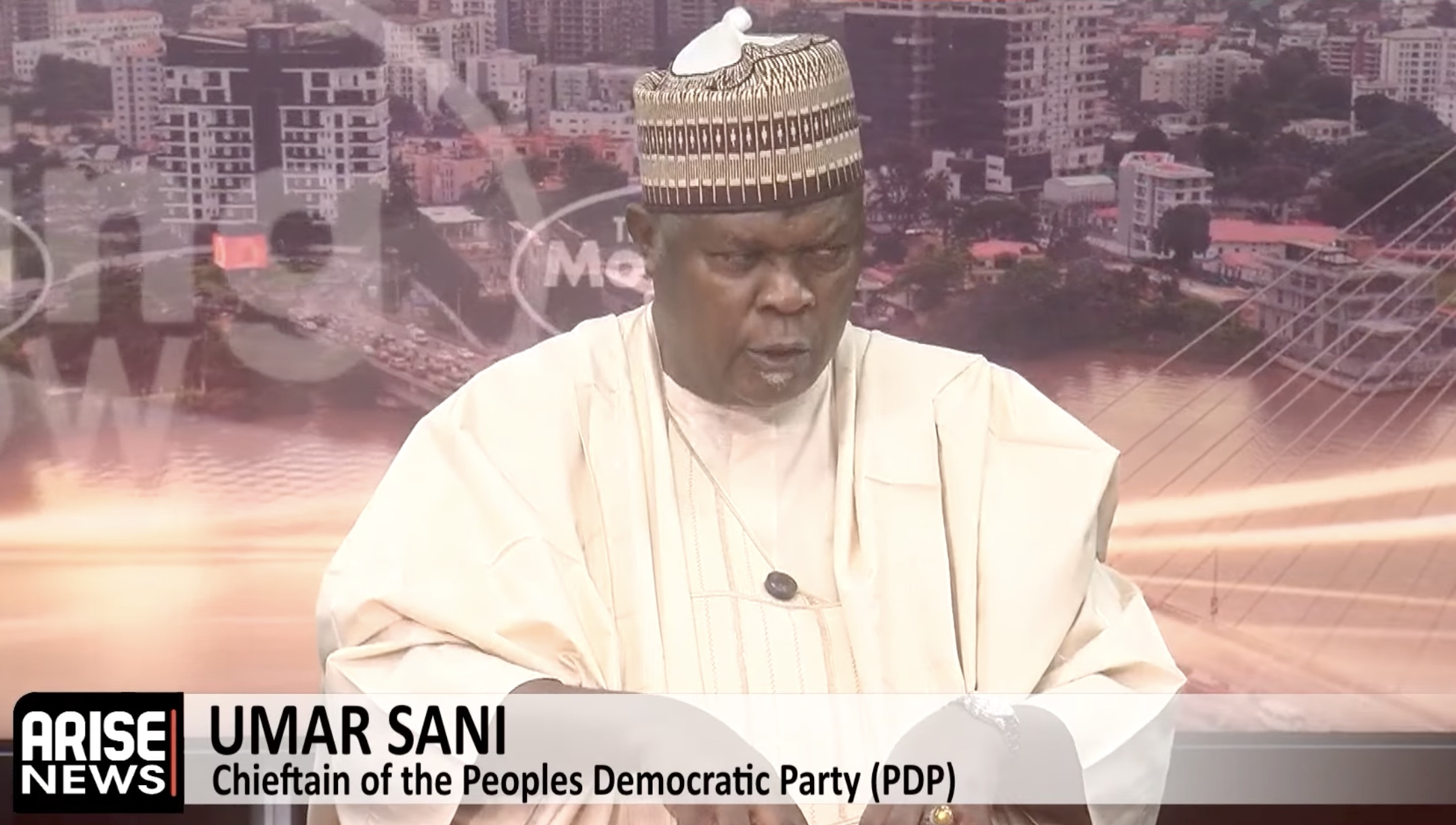
A chieftain of the Peoples Democratic Party (PDP), Umar Sani, has expressed confidence that the party will recover from its current leadership crisis, insisting that its internal disputes do not mark the end of Nigeria’s main opposition party.
Speaking during an interview with ARISE NEWS on Tuesday, Sani described the PDP’s challenges as “family matters” currently before the courts and maintained that the party’s rebuilding process would begin once the legal disputes were resolved.
“I wouldn’t say it is the end of the road. I would just say that we’re just having some family matters in the Supreme Court, the Court of Appeal and some other lower courts,” he said.
Sani explained that the PDP Board of Trustees (BoT) approached the court after writing to the Independent National Electoral Commission (INEC), insisting that Kabir Tanimu Turaki should be recognised based on judgments of the Court of Appeal and the Supreme Court.
According to him, the case before the Federal High Court was strictly about interpreting existing court judgments and directing INEC on their implementation, rather than relitigating issues already decided.
“The issue has to do with interpretation. It is not an internal party affair. What we are saying is: interpret the judgments and direct INEC to do the appropriate thing. That’s all.”
Responding to questions about the Federal High Court’s decision, Sani argued that the judge misunderstood the nature of the case.
“What we had before him were judgments of the Court of Appeal and the Supreme Court. We asked the court to interpret those judgments and, if it found merit in our position, direct INEC to recognise the Kabir Tanimu Turaki-led faction.”
He further maintained that the BoT was not attempting to reopen issues already settled by the courts.
“It is not a re-litigation. This is interpretation of the subject matter.”
Addressing the Supreme Court judgment nullifying the Ibadan convention of the Turaki-led faction, Sani argued that the ruling also affected the opposing faction.
“When the Supreme Court nullified the Ibadan convention, it also inadvertently said some people had no right to act on behalf of the party. When you look at the context of the judgment, it means both sides have been nullified.”
He added that the Court of Appeal had also questioned the legitimacy of another convention.
“The Court of Appeal went further to explain why the convention held by Wike is not acceptable. It said they had not been able to convince the court where the election was held, how he was elected and who elected him.”
Sani said the PDP had complied with the court’s decision by establishing an interim National Working Committee and notifying INEC within the period prescribed by law.
“We abided by that judgment. That’s why we constituted an interim National Working Committee and wrote to INEC. We did it within the window provided by law.”
On concerns that the PDP could fail to appear on the ballot ahead of the 2027 general election, Sani insisted there was still hope for the party.
“Once the matter is concluded, notwithstanding the outcome, the rebuilding process will begin. Most people do not believe in the current recognised PDP because it is just a contraption. It is not the original PDP and it is not what the founding fathers gave to us.”
He expressed confidence that the party would survive the ongoing legal battles.
“We believe the PDP will appear on the ballot. There is hope because the process has begun. If the courts interpret the judgments in favour of the Board of Trustees, then the party is recovered, and once the party is recovered, the rebuilding process begins.”
Sani maintained that the PDP remained Nigeria’s only surviving legacy political party.
“It is the only legacy party that is still standing, and we do not believe that the PDP will die. That is why all of us are putting in our best to ensure that the party survives and continues to wax stronger.”
Responding to questions about the party’s presidential candidate, Sani dismissed concerns over the absence of a formal acceptance.
“Our presidential candidate is there. You have never heard him deny that he is the presidential candidate. You have never heard him say he is not interested.”
He argued that the candidate’s silence should not be interpreted as rejection.
“If he has not accepted, he has also not rejected. And in law, silence constitutes consent.”
On why the Board of Trustees sought a Federal High Court interpretation of the Supreme Court judgment, Sani said the objective was simply to compel INEC to implement what the PDP believed was already decided.
“We have written to INEC, asking it to amend its documentation and recognise Turaki. INEC believes the judgment is in its favour, while we believe it is in ours. We are asking the court to interpret the judgment and direct INEC to do the appropriate thing. Simple and short.”
Boluwatife Enome
Follow us on: