

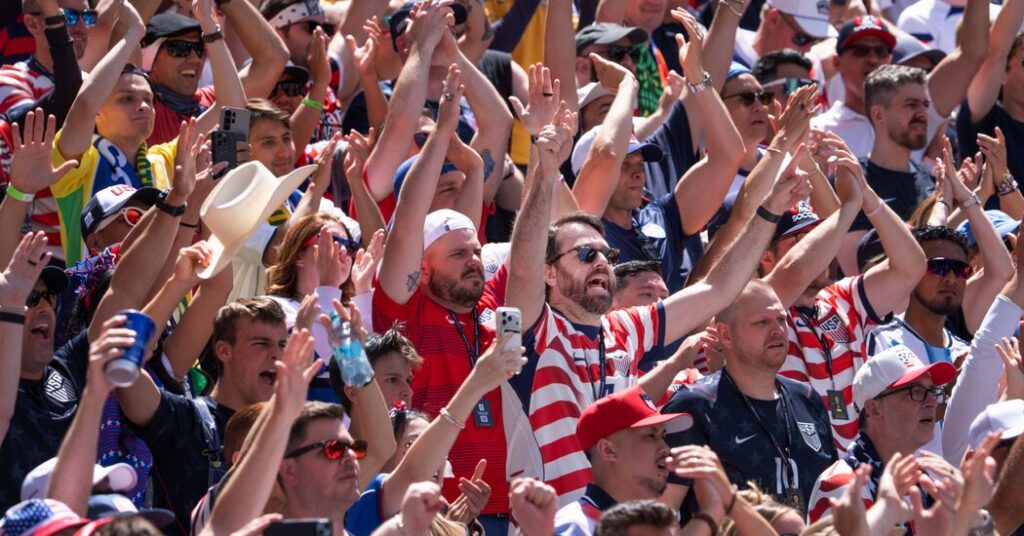
Fans who traveled to the United States for the World Cup have been amazed by ice machines, unlimited soda refills and Bass Pro Shops. But some of them have been less enchanted by one aspect of American culture: its soccer chants.
Chants like “U-S-A! U-S-A!” and “Because we support the U.S., the U.S., the U.S.!” have been mocked on social media as being unoriginal and lacking in passion. The ubiquitous refrain of “I believe that we can win” has even come under fire from fans at home, with the former Philadelphia Eagles center Jason Kelce calling it “the most loser mentality chant I have ever heard in my life,” and singer Noah Kahan describing it as “horrible.”
So what makes a good soccer chant?
Experts say the ones from Britain work well because they’ve been refined and modified over the decades — some of them date back to the 1890s.
“You can’t just invent that off the cuff, you develop it over generations,” said David Rowe, an emeritus professor at Western Sydney University in Australia and an expert in sports communications, who is from Britain. (His team, Plymouth Argyle, which currently plays in the third tier of English soccer, has 171 chants documented on the fan site fanchants.com.)
In the United States, where soccer has long been popular among immigrant communities but largely eluded mass appeal until the 1994 World Cup and subsequent founding of Major League Soccer, “fans are having to construct this culture largely on the fly, and I think they’re struggling a little bit,” Mr. Rowe said.
Good soccer chants usually have a catchy, easy-to-remember tune, often drawing on pop or folk songs that provide an instant familiarity for fans, said Katarzyna Herd, an associate professor of ethnology at Lund University who has studied football chants in Sweden.
They can borrow from other countries’ traditions. For example, Japanese fans chant “Vamos Nippon” — a combination of the Spanish word for “let’s go” and their country’s name in Japanese — to a tune popularized in South American soccer chants.
And they are often specific to a team and its community, Ms. Herd said, with references to specific players and rivalries, and some degree of realism — or irony — about the team’s prospects. Supporters of a team with a poor track record might, instead of making generic statements about wanting to win, draw on other qualities like their persistence.
That level of specificity can be most evident at the club level, said Jorge Knijnik, a Brazilian-Australian associate professor at Western Sydney University who has studied fan chants. But at competitions like the World Cup, that context can be lost and the chants become too generic, he said. For that reason, Mr. Knijnik said, he is not a fan of the Brazilian national team’s chant — which involves repeating the country’s name.
Strict rules put in place by FIFA, the sport’s global governing body, also mean that many chants become watered down at the international level, he said, adding: “It’s rare to get a very strong chant at a World Cup.”
An exception, Mr. Knijnik said, was Argentina’s unofficial anthem for the 2014 World Cup, “Brasil, decime qué se siente?” The song — whose title roughly translates to “Brazil, how do you feel?” — taunted host nation Brazil, Argentina’s bitter rival, to the tune of “Bad Moon Rising” by Creedence Clearwater Revival. It included references to past victories against Brazil and declarations that the Argentine superstar Diego Maradona was better than the Brazilian legend Pelé.
That song was adapted from a chant that supporters of Argentine club San Lorenzo de Almagro aimed at their longtime rival, River Plate. (Brazilian fans fired back with their own rendition of the same song.)
Inventing creative chants to insult a rival team is also part of the art form, Ms. Herd said. “How can you hurt them? How can you make them react? How can you rattle them?”
That might prove difficult for a country like the United States, which does not see football as a reflection of its national identity in the way that many European and South American countries do, and which lacks the intense rivalries of teams from those regions.
But some fans from Australia, New Zealand and Britain have tried to insult the United States with chants denigrating President Trump. And ahead of the U.S. game against Australia game on June 19 in Seattle, some Australian fans had one aimed more broadly at their American counterparts: “We get to go home. You’re stuck here.”