

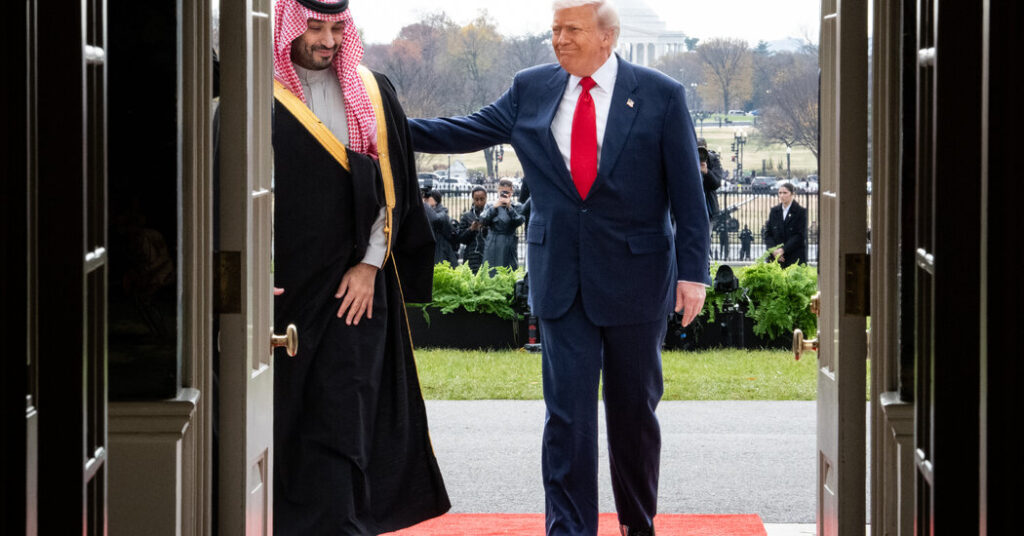
President Trump’s insistence on Thursday that Saudi Arabia normalize relations with Israel as a condition of its nuclear deal with the United States, which was already signed, puts Saudi officials in an extremely awkward position.
Saudi Arabia has its own condition for normalization of relations with Israel, which it has long insisted on — a pathway toward a Palestinian state. And in the hours after Mr. Trump’s sudden announcement, there has been resounding silence from the kingdom.
“I don’t think the Saudis want to give this air,” said Rosemary Kelanic, director of the Middle East program at Defense Priorities, a Washington research group. “They want it to quietly go away.”
Israel is extremely unpopular in Saudi Arabia, particularly over its handling of the war in Gaza following the Oct. 7, 2023, attack led by Hamas. Israel’s military activity in the territory and the Israeli government’s resistance to the creation of a Palestinian state make agreeing to Mr. Trump’s condition “so politically toxic, it could jeopardize the survival of the Saudi regime,” Ms. Kelanic said.
Mohammed bin Salman, the kingdom’s crown prince, is not an elected leader, but he does need popular support, she said. Agreeing to Mr. Trump’s condition, she added, “would poison the legitimacy of his government.”
Saudi Arabia is now in a bind, analysts said, assuming Mr. Trump meant what he said — which may not necessarily be the case. The terms of the agreement have not been released, and Mr. Trump has frequently used social media posts and other statements as a negotiating tool even after deals have ostensibly been sealed.
Analysts said the deal could still move forward, given the uncertainty about Mr. Trump’s demand.
“We don’t know if this is just a transitory reaction or a serious condition,” said Aaron David Miller, a senior fellow at the Carnegie Endowment for International Peace and a former negotiator and adviser on Middle East policy at the State Department.
The nuclear deal with Saudi Arabia sparked criticism in Israel and beyond — including from The Wall Street Journal editorial board, Mr. Miller noted — and he said that the president may be responding to critics who say that he has relinquished leverage over the kingdom by moving forward with the agreement.
Mr. Miller also doubted that Saudi Arabia would be willing to agree to Mr. Trump’s new demand. At this point, he said, getting Saudi Arabia on board with normalizing relations with Israel’s current government is not even a “thought experiment.”
Both analysts agreed that Mr. Trump’s unpredictable approach to international diplomacy could also mean that the deal proceeds without any apparent alteration.
Saudi officials “have good reason to think he might tweet something totally different” about the agreement later, Ms. Kelanic said. And, she added, whatever he posts about the agreement “doesn’t change the content of the deal.”