

Long before air-conditioning, people around the world came up with ingenious ways to beat the heat. But, really — wear dark, billowing robes? And drink tea?
The science can be surprising. As big chunks of the United States and Canada roast through the weekend, some of these ideas might be worth a closer look.
Water That Sidewalk
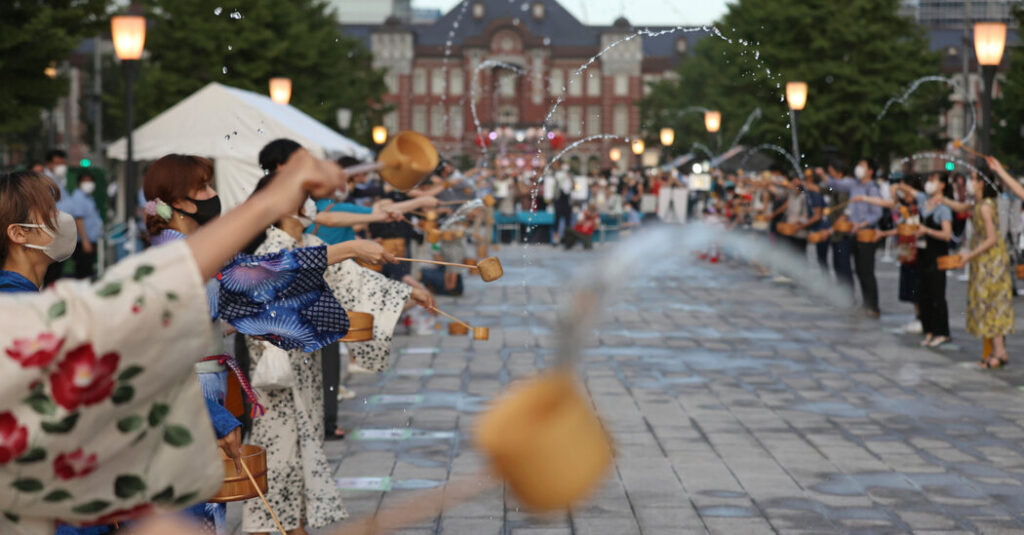
In Japan’s sweltering summer months, you might see storekeepers with a bucket of cold water, dousing hot pavement outside their stores.
The practice, called uchimizu, grew out of Japan’s tea ceremony tradition. It was originally a purifying ritual and an act of welcome for guests. But uchimizu also has an effect on temperature thanks to what’s known as evaporative cooling — when water evaporates, it pulls heat out of the hot ground.
A 2018 study in the journal Water found that uchimizu caused air temperatures to drop by as much as 10 degrees Fahrenheit near the ground, even with small amounts of water.
According to Shigenori Asai, director of the Japan Water Forum, the more neighbors join in and douse the pavement, the more effective it is. “You might even feel a cooling breeze,” he said. His group is sponsoring a global Uchimizu Day on Aug. 1.
Hang Screens of Fragrant Grass
Before air-conditioning, people in some of the hottest parts of India survived intense heat waves by weaving screens made from the spongy roots of a sorghumlike grass called vetiver.
The screens are kept wet and hung over doors and windows facing the wind for another version of evaporative cooling. Hot air blowing through is stripped of some of its heat. The grasses also smell good.
The process works so well, especially in dry environments, that some modern data centers are turning to a variation of this idea called indirect evaporative cooling.
If old-fashioned technologies like this can make a dent in the expected surge in air-conditioning use in India and other countries, that would bring great benefits, said Liza Raju Subhadra, an architect in Kerala, India, who works with alternative materials.
“It’s not just energy-intensive — when a neighbor uses an air-conditioner, the hot air gets passed onto me,” she said. “It makes a big difference if we can passively cool our homes.”
Wear Dark, Flowing Robes (or Seersucker)
It may seem counterintuitive to wear heavy, dark clothing in the desert, but communities in the Middle East and North Africa have done so for centuries.
A study published in Nature in 1980 found that dark robes can indeed create a cooling effect when worn in loosefitting ways. The robe absorbs heat and warms the air inside the garment, but as that hot air expands and rises rapidly, it escapes through the top. The upward flow acts like a pump, drawing cooler air from the bottom of the robe.
“The additional heat absorbed by the black robe was lost before it reached the skin,” the authors concluded.
For a different look, try seersucker. In the hot, humid summers of the American South, linen and seersucker, the thin, puckered cotton fabric, are staples.
Seersucker is woven in a way that causes some threads to bunch together, giving the fabric its distinct wrinkled texture. That prevents it from flattening and sticking to sweaty skin. It also creates tiny pockets that aid air circulation and cooling.
Eat Spicy Food, Drink Tea
It might also seem counterintuitive to eat spicy food during a heat wave. But chili peppers contain a chemical compound, capsaicin, that binds to receptors on the tongue that detect heat and pain.
This tricks the brain into thinking the body is overheating, creating a cooling reflex. Blood vessels dilate to flush heat to the skin, and sweat glands open to cool the body rapidly via evaporation.
It’s one reason that many hot places, such as India, Thailand and Mexico, have spicy cuisines.
Drinking an ice-cold, sugary soda, on the other hand, can have the opposite effect. It makes the brain lower natural sweat reflexes in response to the intake of cold liquid. And the body has to work to break down the sugar, generating internal heat.
In parts of Asia, people instead drink slightly chilled, unsweetened teas steeped from plants like barley. They hydrate and can also improve blood flow, allowing it to circulate near the skin to release heat.
What about a cold beer, you ask? Stay away. Alcohol can cause dehydration and make it harder for the body to regulate its internal temperature.
Take a Siesta
Siestas, the midday breaks once more common in Southern European nations like Greece, Spain and Italy, have reportedly been on a decline.
That’s a shame, some experts say. The human body generates heat simply by moving around and processing energy. Engaging in physical labor during especially high temperatures can cause heat exhaustion.
In recent years, as Europe has grappled with increasingly scorching summers, officials in countries including Germany have started extolling the virtues of a midday break.
“We should follow the work practices of southern countries during heat,” Johannes Niessen, then the chairman of Germany’s leading national association of doctors, told the news outlet RND in 2023.