

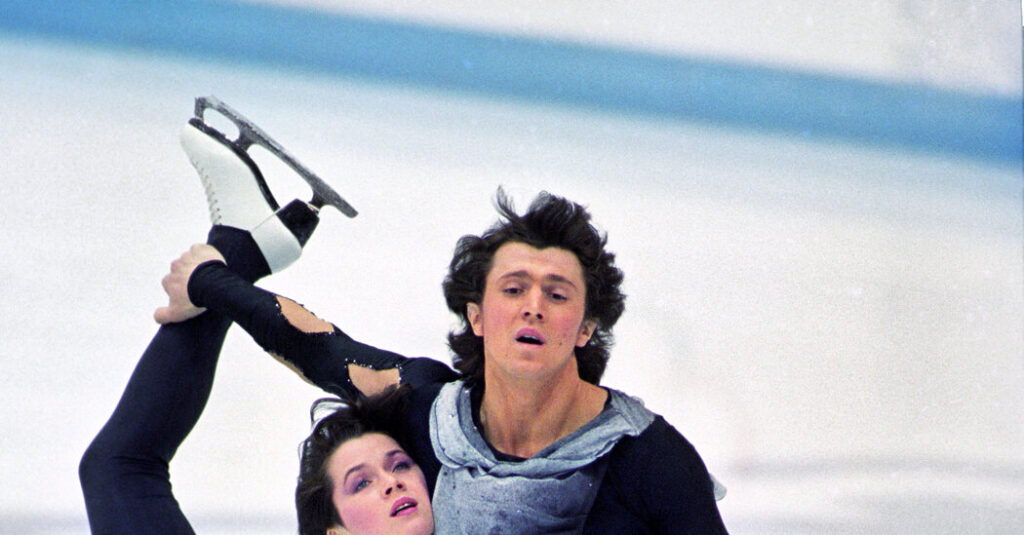
Artur Dmitriev, a two-time Russian Olympic champion in pairs figure skating who combined the build of a linebacker with the elegance of a ballet dancer and was the only man to win gold medals in the sport with different partners, died on June 28 in Moscow. He was 58.
His death was confirmed by Tamara Moskvina, his longtime coach, who said the cause was complications of surgery. Dmitriev had been transported to a hospital after having a heart attack at a skating camp.
Dmitriev won gold medals at the 1992 Winter Games in Albertville, France, with Natalia Mishkutenok, and the 1998 Olympics in Nagano, Japan, with Oksana Kazakova.
He received the same classical training as other Russian pairs skaters, an approach built on speed, synchronicity, strength, emotion and balletic line. But he also had a commanding presence on the ice, with his broad shoulders and athleticism, and Moskvina emphasized his expressiveness, dynamic power and what she called the width of his movement across the ice.
“Artistically, on the ballet stage, he could have been a great dancer, too,” Moskvina said in an interview. “And then he was a big man physically. We called attention to that in his performance.”
In pairs skating, the traditional role of the man is to be a kind of stagehand who shines the spotlight on his female partner. But Dmitriev’s performances could hardly be described as subsidiary; his showmanship often pulled the audience’s eyes toward him.
During the free skate of the 1994 Games in Lillehammer, Norway, in which he finished second, he pulled open the front of his costume to reveal a flap of red lining — a symbolic heart, demonstrating his devotion to skating and his eagerness to be part of the drama.
Dmitriev “is the star of the pairs event,” Paul Martini of Canada, a 1984 world pairs champion, told The New York Times at the 1998 Olympics. “You don’t look at the woman. You look at Artur.”
His dominating charisma was not to everyone’s taste. “In pairs skating, the man should present the lady,” Peter Krick, then the director of the German Ice Skating Union, told The Times in 1998.
But audiences routinely rewarded Dmitriev’s performances with standing ovations, and he rightly earned his place among the great Soviet and Russian pairs skaters who dominated the event, producing gold medals at 13 of the 14 Winter Olympics held between 1964 and 2014.
Outside of the Olympics, he was not always in top physical condition. He smoked cigarettes and liked to drink. At the 1997 World Figure Skating Championships, where he and Kazakova finished third, he struggled with his side-by-side triple jumps and appeared pasty and overweight.
By the 1998 Olympics in Nagano, he had dropped nine pounds and was noticeably slimmer. He gave up “all the extras” and “lost interest in parties,” Moskvina, his coach, said at the time.
“Every four years,” Sandra Bezic, a Canadian choreographer and former pairs skater, noted, “Artur never misses.”
Artur Valeryevich Dmitriev was born on Jan. 21, 1968, in Bila Tserkva, a Soviet city south of Kyiv that is now part of Ukraine. He grew up in Siberia in the nickel-mining town of Norilsk and began figure skating around age 6, quickly showing promise.
A youth coach of his called Moskvina, who has long been considered one of the world’s top pairs coaches; when Dmitriev was 16, he moved to Leningrad (now St. Petersburg), to train with her.
In the mid-1980s, Dmitriev was paired with Mishkutenok, a native of Belarus. In February 1992, less than two months after the Soviet Union dissolved, the pair delivered an ethereal performance in Albertville, to music by Franz Liszt, winning Olympic gold for what was called the Unified Team of former Soviet republics.
Another Winter Olympics was held in 1994 — in Lillehammer — to separate the Winter and Summer Games from occurring in the same year. By then, Russia’s skating system had entered a chaotic era, as some rinks were converted into shopping malls and auto dealerships. Mishkutenok told The Times in 2022 that it could be difficult to resurface the ice because Zamboni drivers were trading fuel for vodka.
Still, she and Dmitriev gave perhaps their best-remembered performance, a strikingly emotional and technically challenging program set to Rachmaninoff’s Piano Concerto No. 2. The audience seemed to think it was worthy of a gold medal, but the judges favored the classicist approach of their Russian rivals, Ekaterina Gordeeva and Sergei Grinkov.
It was a matter of taste and style, Moskvina told reporters afterward, reciting a Russian proverb: “Some prefer the priest, others prefer the priest’s wife and others prefer the priest’s daughter.”
Dmitriev’s survivors include his wife, Tatiana Fedorova; their son, Artem; another son, Artur Jr., from a previous marriage, to Tatiana Druchinina; his mother, Alevtina; his stepfather, Vladimir Andreev; and two grandchildren.
After winning a second gold medal at the 1998 Winter Olympics with Kazakova, who matched him in power and drama, Dmitriev planned to continue skating in ice shows and become a coach. But he said he preferred the pressure of Olympic-style competition.
“It’s always an exam,” he told The Times.
He appeared subdued once his final Olympic performance was over, a showman realizing the final credits of his remarkable career were rolling.
“A little sad,” he told reporters. “The movie’s finished.”