

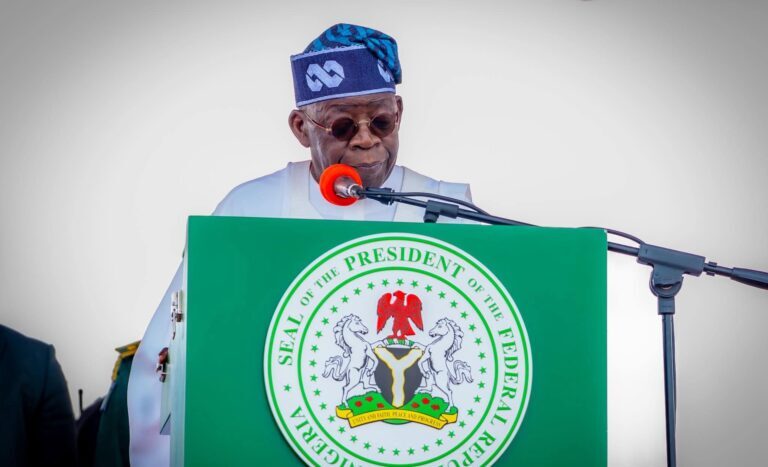
President Bola Tinubu has inaugurated a presidential working group tasked with preparing the legal framework for the nationwide implementation of state police, following the Senate’s passage of the Constitution Alteration (State Police) Bill, 2026.
The President, represented by his Chief of Staff, Femi Gbajabiamila, inaugurated the panel at the Presidential Villa in Abuja on Tuesday. Mr Gbajabiamila will serve as chairman of the committee.
In his remarks, President Tinubu noted that while the constitutional amendment establishes a dual policing structure comprising the federal police service and 36 state police services, the enabling legislation is required to operationalise the framework.
“The constitutional amendment bill establishes the framework for dual policing, but it does not operationalise it. That work is left to the national policing bill,” he said.
The proposed legislation, he explained, would address minimum policing standards, state readiness certification, federal-state coordination, accountability, human rights safeguards, fiscal conditions, and personnel transition.
The working group has been mandated to produce a technically robust, implementation-ready draft bill for transmission to the National Assembly immediately after the constitutional amendment process is concluded.
“We must not wait until the constitutional process is concluded before beginning this important assignment,” the President stated.
Members of the committee include the Attorney-General of the Federation, the National Security Adviser, the Inspector-General of Police, the President of the Nigerian Bar Association, the Chairman of the Nigeria Governors’ Forum, and the NGF committee on state police.
Speaking on behalf of the governors, Ogun State Governor Dapo Abiodun pledged the collective commitment of the 36 state chief executives to accelerate ratification once the bill reaches their respective Houses of Assembly, with plans to pass it unanimously on the same day.
Governor Abiodun described the proposed state police as a direct response to Nigerians’ long-standing demand for community-based policing, validating the effectiveness of regional security outfits such as Amotekun in the South-West.
He projected that state police would significantly boost national security personnel, estimating that each state deploying approximately 6,000 officers would add nearly 200,000 personnel to complement the existing federal police force.
Attorney-General of the Federation and Minister of Justice, Lateef Fagbemi, described the initiative as timely given Nigeria’s current security challenges, urging governors to expedite the constitutional amendment’s ratification by their state assemblies.
President of the Nigerian Bar Association, Afam Osigwe, reaffirmed the association’s full support for state police, stressing the imperative of adequate legal safeguards to prevent abuse and ensure accountability.
“We must ensure we do not create a monster. The right legal framework must guarantee accountability and prevent oppression,” Mr Osigwe said, pledging the NBA’s commitment to assisting the committee in crafting legislation that strengthens security while protecting citizens’ rights.