

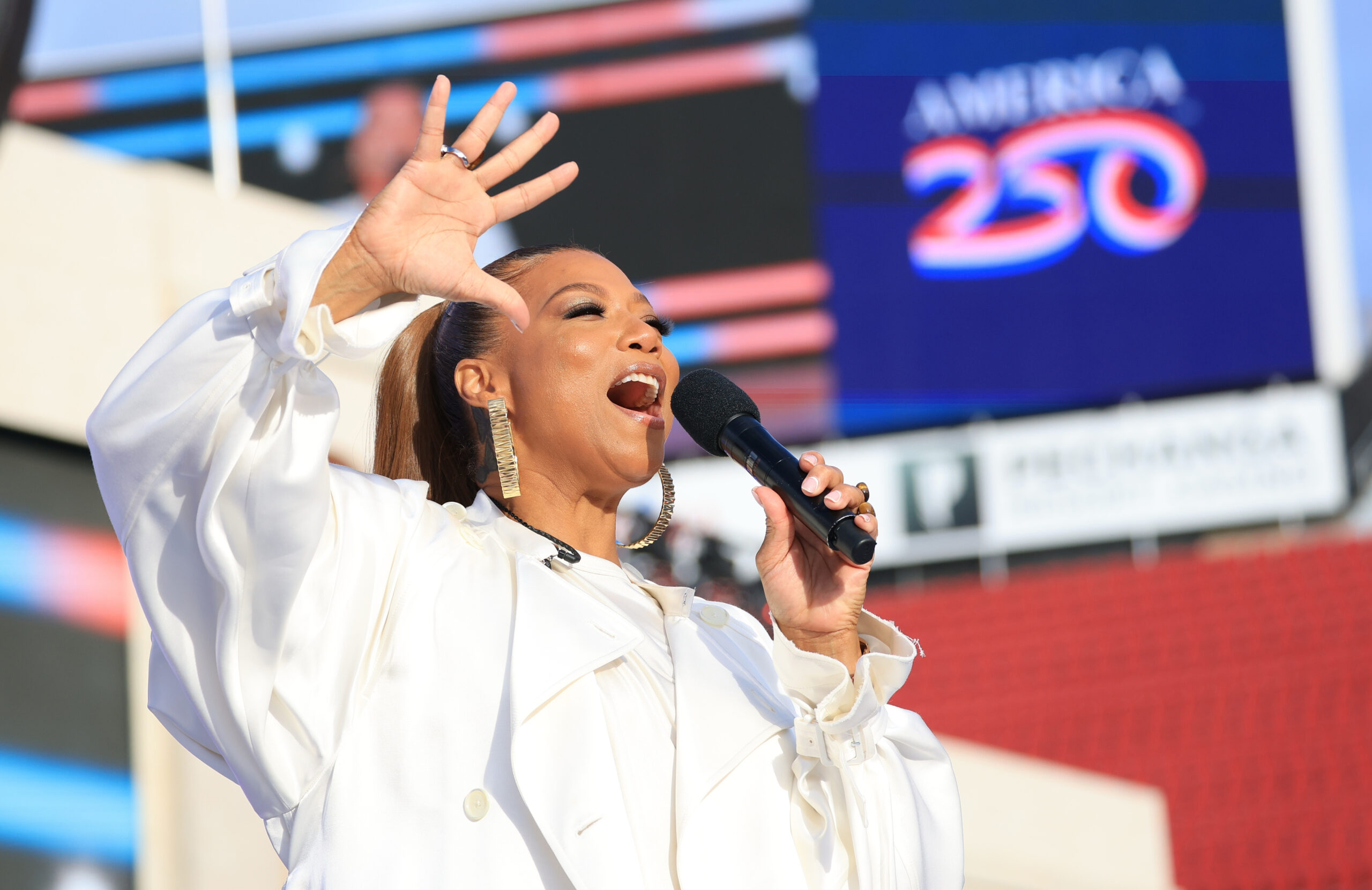
LOS ANGELES — The nonpartisan group originally tasked with celebrating America’s 250th birthday tried to steer clear of politics at its flagship event here Saturday. The crowd at America’s Block Party wanted to hear Chris Stapleton, Queen Latifah and the Smashing Pumpkins for the bargain price of $17.76 — to forget about division, to have a day that was not about President Donald Trump.
But the scene in liberal Los Angeles inevitably unfolded as a striking contrast to the celebration in Washington, D.C., anchored by the president, who many here worried was making the country less unified and less friendly to immigrant families like those who milled around the Los Angeles Memorial Coliseum in American flag gear.
“I believe we’ve kind of forgotten about the core values of America,” lamented Justine Haymes, 63, who drove from Las Vegas with her daughter, a Smashing Pumpkins fan. “The immigrants that came into America built this country, and we forget about that.”
“It’s just sad,” said Haymes, wearing a green, white and red “Mexico” hat that nodded to her family’s heritage. “We’ve forgotten to treat our neighbor as ourselves.”
The concert in Los Angeles was the flagship event of America250, the bipartisan effort launched by Congress a decade ago to mark the semiquincentennial. It pressed ahead even as Trump went his own way and launched his own group to plan 250th events — creating a remarkable split screen.
While many performers pulled out of Trump’s Great American State Fair and other events — leaving the president himself to headline — the Los Angeles event was stacked with celebrities. Where Trump’s Fourth of July was chaotic, largely due to oppressive heat and thunderstorms, the benefit concert in Los Angeles was orderly. Clouds helped blunt the 82-degree weather. There was even a breeze.
The audience was, to some, a testament to the diversity that they say is under attack in Trump’s second administration. People of all ethnicities and accents wore Fourth of July regalia in the belief that “this is their country, too,” one young man marveled. Dozens waited in line for a food truck, Oaxaca on Wheels, down the way from a baked potato truck and a hot dog stand.
Drina Lucero said she was so upset about Trump’s return to office that she didn’t celebrate the Fourth of July last year. She hated the way he talked about immigrants — people like her own Hispanic Filipino family.
But on Saturday, standing in line for cotton candy, she said she felt hopeful enough to party. She thought the tide was turning against Trump, whose approval ratings have declined amid high gas prices and aggressive immigration enforcement.
“It’s falling apart,” she said. “The Trump administration is going to come down.”
Plenty of others were trying to tune out the politics.
“People want to have fun,” said Devin Ortiz, 23.
“Putting aside things that are happening,” said her boyfriend, Daniel Maldonado, 22.
“Let’s just get along for today,” Ortiz added.
“Put it aside,” Maldonado echoed.
Democratic lawmakers on the bipartisan commission behind America250 have criticized Trump for “making America’s 250th birthday all about himself,” as one member, Sen. Alex Padilla (D-California), put it during a recent congressional hearing.
Trump allies, in turn, have criticized America250, with Freedom 250 spokesperson Danielle Alvarez saying the other group “had nothing to show” for its decade of planning.
America250 Chair Rosie Rios has said little about Trump’s clashing effort and avoided politics while promoting her group’s events.
Asked on Saturday whether she wished the president had not created his own competing task force, Rios downplayed the split.
“The more organizations who plan 250th activities, the better,” she said.
Soon she joined actors on stilts dressed up as Abraham Lincoln and Benjamin Franklin for a photo. They all smiled.
Near a “Proud to be American” sign, 23-year-old Heaven Oros said that the statement still rang true for her — even though, as a Latina American with an immigrant father, she found Trump’s mass deportations alarming.
She could separate the government from the country, she said. “America has nothing to do with it.”
Addressing the stadium later that evening as the program got underway, Rios nodded to the immigrant story that so many in the stadium shared.
Her mother came to the United States from Mexico with “nothing,” she said, seeking a better life.
“We are the personification of the American Dream,” she said, “and that story doesn’t happen everywhere in the world, but it happens here.”