

Whatever your thoughts about the president of the United States, it’s pretty clear that every time he injected himself into the World Cup, something bad happened. Whether it was the FIFA Peace Prize that kicked the whole thing off, or the shameful way the Iranian team was treated, or the whole Folarin Balogun red-card reversal, or how FIFA head Gianni Infantino had to keep shuffling him out of Spain’s trophy-celebration photos (they ended up cropping him out), every time Donald Trump stepped in at the World Cup, he stepped in it.
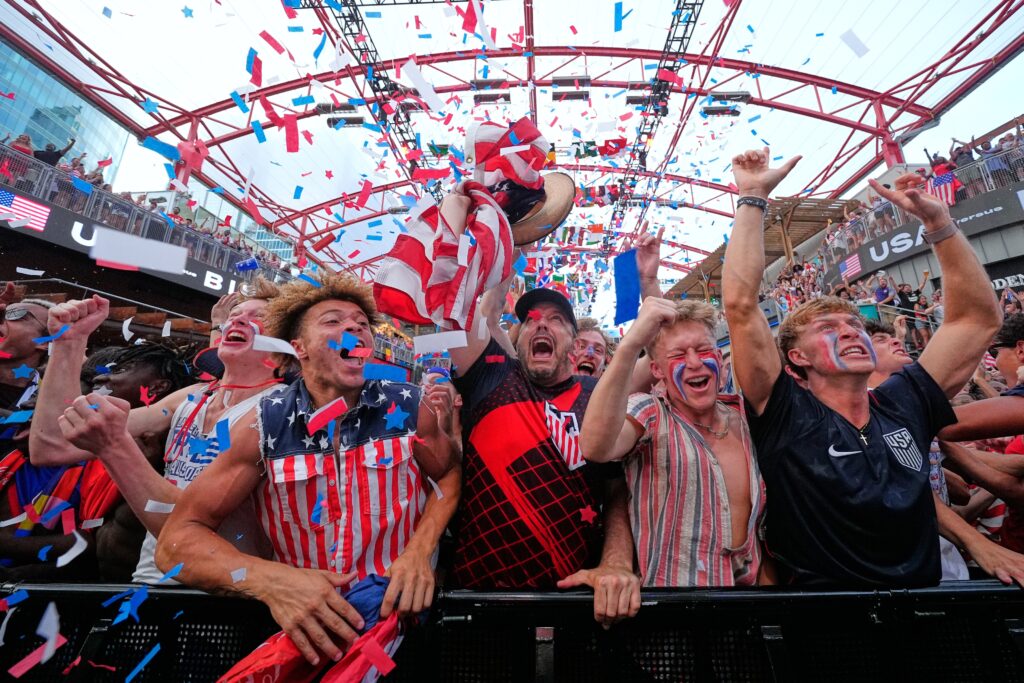
And it didn’t make one bit of difference. The tournament brushed Trump off like lint from its shoulder. This was the most successful World Cup in just about every way — financially, athletically, competitively, perhaps most of all sociologically — and it basically turned into a five-week party in America’s streets. The World Cup was pure pleasure, but it was more than that: It restored my faith in people. I’m so sad it’s over.
The thing is, the World Cup — for all its political machinations and grotesqueries, for all of FIFA’s shameless grift, for all the pausas de hidratación — is the greatest sporting event in the world that no one, not least of all the humans who pretend to be in charge of it, can screw up.
And it was particularly wonderful having it in America.
Part of this is just good old U.S. logistics. While previous hosts scrambled to build stadiums for all the rabid fans — often with horrific, tragic consequences — the U.S. already had them, in soccer-mad areas with infrastructure capable of absorbing it all without breaking a sweat. Yes, ticket prices were cartoonish, but it should be noted that crowds showed up for every game: Turns out we can fill up a 75,000-seat stadium for a match between the Czech Republic and South Africa at noon on a Thursday. The tournament ran smoothly, without crowd-control issues, public discord or logistical nightmares. There were plenty of hotels, there were plenty of transportation options, and everyone got along.
When Infantino and FIFA chose the United States as a host, this was what they had in mind: a big country with big buildings and big cities. American brawn, for all its downsides, still has considerable value.
But this was also a World Cup that reminded us what America is at its best. Heading into the tournament, much was made about the Trump administration’s inhospitality; in November, then-Homeland Security Secretary Kristi Noem said she hoped fans “would come and enjoy our country, and then they would go home. And go home in a timely manner.” But that was not how this World Cup went down. The joy of the competition was how welcoming Americans were, not just to visitors who came to watch the games but also to all the different people and perspectives the tournament brought out from within.
Watch parties — joyous celebrations of diversity, community and collective warmth — became the norm in cities across the country. You could watch Morocco play among their fans at a restaurant in Queens, or Bosnia with an expat community in St. Louis, or Congo among former refugees in Silver Spring, Maryland. Or you could just watch whatever team, wherever you wanted, with whoever happened to be nearby: The games were always on, and there was always someone you didn’t know next to you, ready to become a friend.
The tournament also showcased all of America’s charming eccentricities to people who may have only seen us from the outside — which means through Trump — for the past decade. Think of the awe in the eyes of Hondurans taking in a 100,000-seat college football stadium, or the European tourist’s jaw dropping at all the stuff we have at a Buc-ee’s, or the Brit having his first real barbecue. It reminded me, and I suspect millions of others, how much there is to love about America. And how it is found not when we isolate in our silos but when we come together. I found it more inspirational and, yeah, patriotic, than anything Freedom 250 has done: As exports go, I’ll take barbecue ribs and Ted Lasso over Lee Greenwood and octagons on the White House lawn any day.
And the best part: It was so great that we’re probably going to get to do it again.
At the finale, right before he got cropped out of Spain’s celebratory photo, the president told Infantino that he wants to see the World Cup return to America in his lifetime, and finally he found some common ground. After what just happened, the World Cup is likely to come back sooner than you think: The next available hosting date is 2038, when Trump would be 92, and the U.S. is already favored to be selected.
And why not? This is what we do best: host, welcome, celebrate and congregate. This is who we actually are. Trump won’t be president, but I do hope he gets to see another World Cup in the United States. Because there is nothing like it. It’s sports at its best. And it’s America at its best. This World Cup made me feel better about America, about soccer and about the future. I miss it already. Don’t you?