

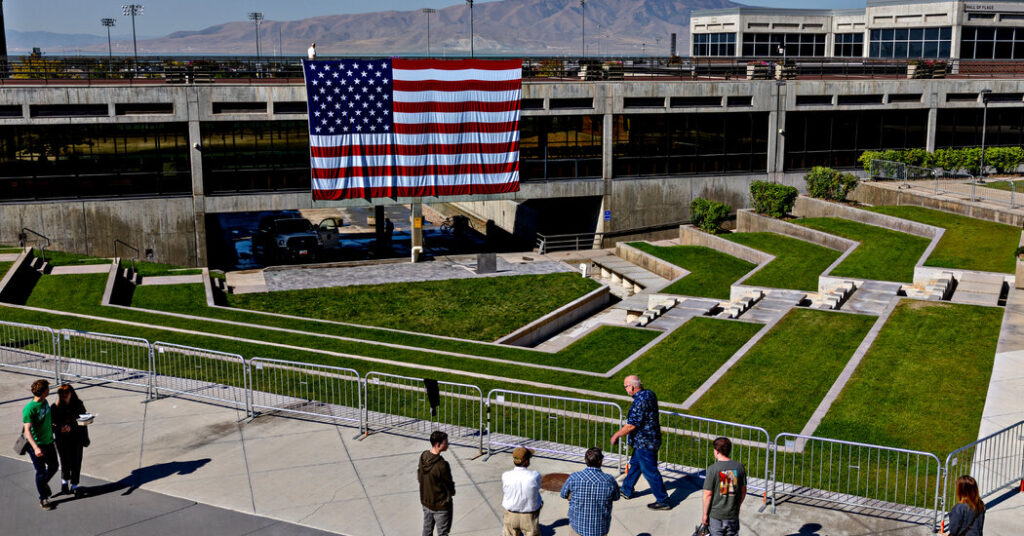
The pilgrims come every day to Utah Valley University, wandering through the sunny hillside campus in search of the spot where Charlie Kirk was assassinated.
Some cry and say a prayer when they find the sunken plaza where it happened. Others come to snap selfies and livestream, squinting at the rooftop of the student center 400 feet away, where prosecutors say a man took aim with his grandfather’s bolt-action rifle and killed Mr. Kirk at a crowded event in September.
“It feels reverent,” said Teresa Seeley, 42, who made a point to visit this week while her daughter was competing in a volleyball tournament at the university. “Somebody lost their life. Here.”
Utah Valley University does not want to be defined by Mr. Kirk’s killing. But well before hearings began this week on whether to try Tyler Robinson, 23, for the assassination, the 48,600-student campus in Orem had become a pilgrimage site — and a magnet for conspiracy theorists and assassination tourists.
It is also wrestling with a divisive new quandary: How to commemorate the shooting that thrust a commuter college little known outside Utah onto the world stage.
The makeshift memorials and huge American flag that hung above the plaza after Mr. Kirk’s killing are long gone. Even the grass near where he stood has been replaced by pavers and planters of red and purple petunias.
The courtyard was quiet on Friday as prosecutors and defense lawyers in a courthouse five miles away wrapped up a weeklong hearing in the death-penalty case against Mr. Robinson, who is charged with the killing.
A few students lounged on the grassy terraced steps overlooking the sunken platform where Mr. Kirk was shot. Tourists flitted in and out taking pictures. Earlier in the week, a police cruiser was posted nearby.
The placid area has become a battleground after Utah Valley University created a committee last year to study what kind of memorial to build there. Suggestions include a statue of Mr. Kirk, a table to symbolize the importance of civil discourse or just a simple plaque.
Liberal student groups objected, saying that Utah’s largest university should not venerate an activist who, among other divisive views, called George Floyd a “scumbag,” mused about whether Black airplane pilots were qualified, called Islam incompatible with Western civilization and opposed same-sex marriage.
“I don’t see those views as worth memorializing,” said Ethan Cunningham, an environmental-studies student and president of the campus chapter of Students for a Democratic Society, which has held protests to oppose a memorial.
Others said they simply did not want a visual reminder of the day when they ran for cover and locked themselves in nearby campus offices, unsure whether the attack was targeted or a mass shooting. Some said they had spent weeks going to therapy and knew traumatized friends who dropped out.
“I just don’t want to dwell on it anymore,” Cris Anderson, a student adviser, said, as he strolled on a walkway overlooking the plaza on Friday. “We’re moving forward. Everything’s back to normal — almost.”
University officials said they had worked to keep students enrolled after the shooting, and that enrollment numbers did not drop noticeably. Their summer enrollment of more than 12,000 was a record, they said.
With the fall semester starting next month, several students said they did not want to spend another school year reliving the trauma, especially with the first anniversary looming on Sept. 10. A judge’s ruling is also expected sometime that month on whether the murder case against Mr. Robinson proceeds to trial. He has yet to enter a plea.
The university, whose slogan is “A Place for You,” prides itself on an ideologically and demographically diverse student body and large population of first-generation college students. It has doubled down on that pluralistic mission since the shooting, and started an initiative called “Our Better Selves” to focus on civil debate and the peaceful navigation of political divides.
“What we want to be known for is how we responded to the tragedy, and not the tragedy itself,” F. Wayne Vaught, the university’s interim president, said in an interview.
On Friday, Haely Griffin, a fourth-year psychology student, sat at the top of the courtyard, listening to a water feature cascade down the concrete steps. She recalled how she had been standing in the crowd of 3,000 people when she heard the rifle shot that killed Mr. Kirk.
She clustered for safety with a group of friends that afternoon, and went to therapy to deal with the lingering trauma. She does not wander around the campus as much as she once did, but said she would like to see a memorial to honor Mr. Kirk.
Sitting there stirred up painful memories, Ms. Griffin said. But she also felt a sense of peace as a Christian who believes that Mr. Kirk’s death — and her being there — were part of God’s larger plan.
“I come out here and feel God’s presence,” she said. “It’s surreal.”