

It was in Canada, on an evening in late December, when a psychonaut friend of mine—let’s call him “Jamie”—said with a mischievous smile: “Hey man, look what I’ve got.”
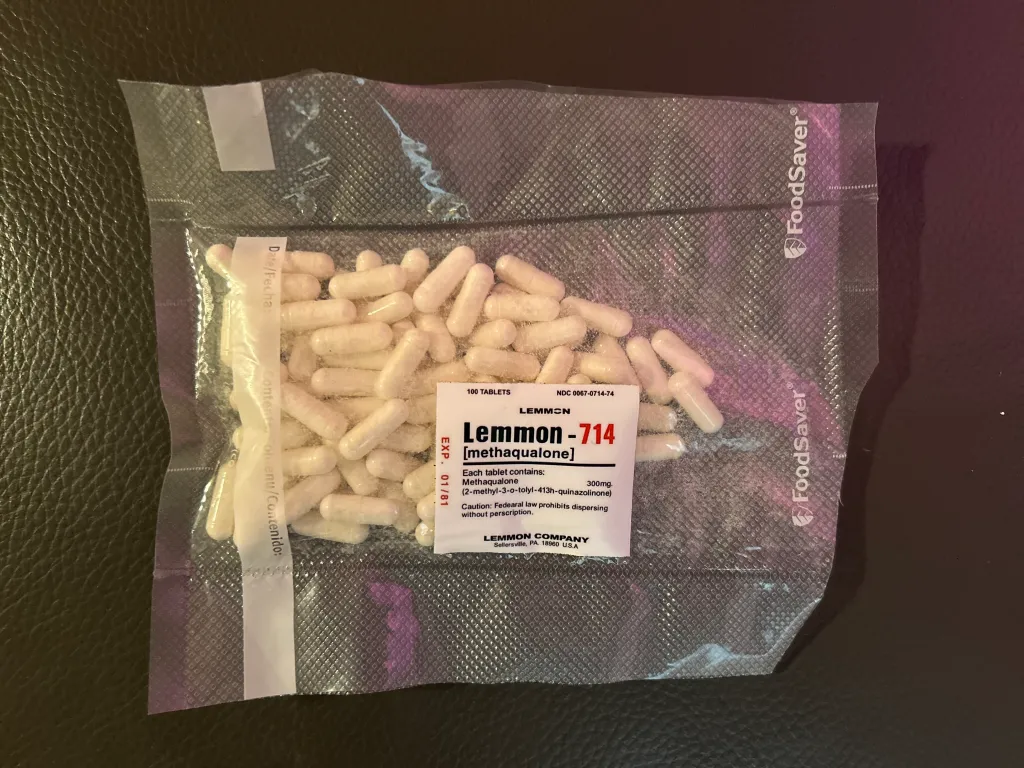
From his rucksack he pulled three airtight packages of capsules, each filled with white powder. “It’s the second coming of the ‘ludes,’” Jamie declared.
I read the labels on the serrated bags. “Lemmon-714 (methaqualone),” they said. I was familiar enough with the lore of the drug to know that these were the version infamously taken by stockbroker Jordan Belfort in the early 90s, and subsequently immortalized in The Wolf of Wall Street. Smaller print stated that each tablet contained 300mg of methaqualone. The pharmaceutical-style sticker cautioned: “Fedearal law prohibits dispersing without perscription.” The spelling mistakes were far from reassuring, but what struck me was the ancient expiry date: January 1981, a full 13 years before I was born. “It’s an homage,” said Jamie.
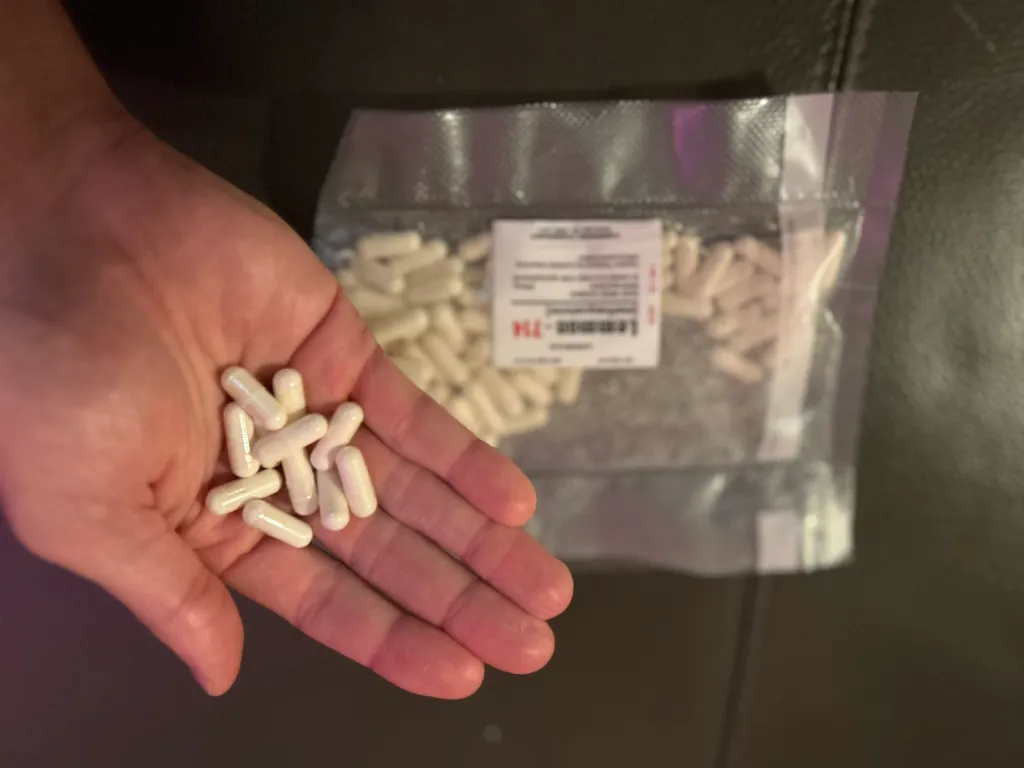
I had at my fingertips roughly 300 pills of an extremely potent sedative that hasn’t meaningfully been in circulation for decades. (Belfort’s batch, acquired painstakingly and at great expense, were remnants from Quaaludes’ 1970s heyday.) But I had work to do and wasn’t eager to surrender my sanity that night. Jamie, brimming with a slightly nefarious childlike glee, insisted I try them, rather dubiously reasoning that they might even make the writing process more enjoyable.
He said that they were recently manufactured and had come from a trusted source, showing me an email confirming he’d had them tested at a local checking center. “Sample (expected as methaqualone) tested as methaqualone with no additional detectable cuts or adulterants identified above the 5% limit of detection by FTIR spectrometer,” the report read. “This sample tested negative for fentanyl or fentanyl analogs and negative for benzodiazepines by test strip.”
Curiosity got the better of me. Against my better judgment but under Jamie’s direction, I took two tablets, each containing 300mg of methaqualone, unwisely forgoing the usual research I’d do before taking a new drug. For about 15 minutes, writing did become more fun, but then my thoughts began to evaporate into a gooey flow state and I just wanted to chill on my bean bag. Within 24 hours, I would unenviably end up like Belfort’s madcap character in that iconic scene—lying horizontal on a sidewalk.
“I had at my fingertips roughly 300 pills of an extremely potent sedative that hasn’t meaningfully been in circulation for decades”
During their golden era, Quaaludes, the most popular brand name given to methaqualone, helped refashion society into a decidedly higher one; sold as a smoother, safer chill pill than the barbiturates which at the time were commonplace. Methaqualone was first synthesized in India in 1951 and used to treat malaria. Identified for its sedative-hypnotic quality in the 1960s, it was introduced legally into the U.S. pharmaceutical market as sleeping pills and anti-anxiety medication. For a drug that slows things down, its rise was meteoric.
The trading name Quaaludes is said to be an abbreviation of “quiet interlude” but the penpushers at Pennsylvania pharma company William H. Rorer Inc., the major producer which gave the Quaalude its name, could never have imagined the ruckus the drug would go on to cause. “A good morning after a sleep-through night,” one of the company’s hopeful adverts said. “Its therapeutic value has been established in controlled clinical studies and by wide usage of methaqualone throughout the world. Side effects reported have been mild, transient, and have often been proved to be significantly insignificant.”
The drug was unexpectedly adopted by the counterculture thanks to its heavenly effects—even by hippies who had previously drawn a moral line between their parents’ soul-deadening downers and their own consciousness-expanding stashes of weed and LSD. By the early 70s, with prescriptions estimated in the millions, Quaaludes had escaped the doctor’s office and taken over the dancefloor, referred to as “disco biscuits” and prized for their loosening, inhibitionless buzz—one ripe for potentially catastrophic impairment.
David Bowie sang about “Quaaludes and red wine” in his 1973 tune “Time”, Black Sabbath singer Ozzy Osbourne used them, Bill Cosby gave them to his victims, and Frank Zappa told of “hurtin’ for sleep in the Quaalude moonlight.” Led Zeppelin’s Robert Plant, no stranger to intoxicants, has referred to them as “poison.”
Despite the mixed reports, the white tablets escaped “this binary thinking” amongst youth that all pills were bad, says drug historian David Herzberg, the author of Happy Pills in America: From Miltown to Prozac: “They were able to claim it for the home team as they deemed it to create connection and love.” Many sought to transcend their anxieties, stresses, and sexually repressed upbringings to supercharge the wellspring of liberatory joy and experimentation that was emerging out of the 60s. “Imagine an aphrodisiac drug that allowed you to just feel groovy,” adds Herzberg.
Pill mill “stress clinics” operated by amenable doctors doled out the drug liberally and billboards advertised it as an entirely benign panacea. But as Quaaludes’ physiological addictiveness and dangerous motor function-busting side effects became clearer, authorities got nervous. Legislators bristled and the drug was duly placed into Schedule II of the U.S.’ drug controls. In 1974, there was a crackdown in which millions of doses were seized.
Recreational use and abuse continued to grow, however, as did its presence in pop culture. (Director Oliver Stone blamed a cocktail of drugs including “a Quaalude or two” for a botched 1979 Golden Globe award acceptance speech; author Benjamin Stein wrote about Hollywood’s Quaalude addiction in his novel, Ludes). But as Quaaludes went from miracle to scourge at the height of the War on Drugs, a fast-tracked Schedule I ban took effect in 1984. “We eliminated the problem,” former DEA chief Gene Haislip said at the time. “We beat them.”
But unlike any other drug ever, the clampdown ultimately wiped out the supply, transforming ludes into a disco-era relic, the Holy Grail of pharmaceuticals, with expired batches long forgotten in desk drawers becoming gold dust, like Belfort’s 1993 discovery of the batch of Lemmon-714 Quaaludes. For every expired batch that was consumed, ludes faded further into the annals of drug history.
Until now. Over the past 12 months, Quaaludes have begun making an improbable renaissance. The sedative has been popping up in psychonaut circles and drugs forums, threatening to unmoor consumers on a scale not seen since the 70s. So too have closely related analogs burst onto drug markets, including some of a purported 100-fold higher strength.
In the 2020s, Quaaludes aren’t being taken against an effervescent cultural backdrop of moon-eyed hippies banging on the doors of perception, disco fever, or scratchy footage of the Vietnam war. They’re not being widely sold by county lines teenagers or taken in pub toilets in Morecambe. Rather, they’re being administered at solemn private ceremonies with wellness branding and a set itinerary, or taken while ambiently scrolling through Instagram at a high-end ski lodge. A part of that comes down to its contemporary accessibility.
However, if you have an open line to a small and select band of underground chemists who specialize in rare, boutique drugs on either side of the Atlantic—or know the kind of dealer who might occasionally offer hard-to-find psychedelics, dissociatives, and sedatives—you might be able to acquire some. Or you simply need an invite, like the one Jamie received, to private parties at wellness retreats, where they are being taken as part of a narco-cocktail that can also include GHB, designer dissociatives, or the cactus-derived psychedelic mescaline.
Use of Quaaludes so far has to some extent been consigned to these exclusive druggy cliques, and it’s unlikely to become a widely beloved national pastime, like cocaine and ketamine have in much of the planet. But it is a drug that feels apposite for the bizarro world we’re living in, its return another crack in the crumbling plaster wall of our shared reality. Online, Redditors are increasingly reporting their experiences of ludes.
“It’s like the champagne of exalted states,” says Aaron*, an organizer of one event in Portugal, where drugs have been decriminalized, and where Quaaludes are offered to attendees. At the parties, people can request a certain state and receive the drugs most likely to put them into it. “It’s a way to induce relaxation and shake off earthly concerns,” he says of Quaaludes.
Multiple sources compared Quaaludes to GHB, the “liquid ecstasy” that conjures a feeling reminiscent of being drunk and high on MDMA at the same time, and which has been referred to as “the rapist’s weapon of choice” by the BBC. In some ways, Quaaludes are different—users tend to be less sexually aroused and more “manageable”—but remain, like GHB, very easy to overdo. However, Jamie adds, “GHB gets me in trouble for being slutty; you don’t get horny on this.”
“It is a drug that feels apposite for the bizarro world we’re living in, its return another crack in the crumbling plaster wall of our shared reality”
Both drugs work on GABA, which is the brain’s primary inhibitory transmitter, binding themselves to receptors and slowing neural activity, which produces a calming effect, but methaqualone gravitates towards a distinct part of the GABA system that other drugs do not affect.
While this makes their effects borderline unique, it also adds to the risks. Or, as Jamie put it: “When you take too much, you start fucking derping out. The sweet spot is quite close to the derp spot.”
He learned this the hard way at the last Quaaludes party he went to in Portugal, while rushing to assist a friend stricken by the effects of a different drug. “I ate shit on the concrete and still have this massive scar on my hands,” says Jamie, ruefully. Another friend of his passed out after taking such a high dose of Quaaludes.
For now, at least, what’s stopping Quaaludes becoming more prevalent is that they’re difficult to manufacture and the demand is still low. “Synthesizing methaqualone isn’t like LSD level of complexity, but it’s more difficult than something like meth because the precursors are quite specific and it’s a reasonably large molecule,” says Guy Jones, a drugs expert and senior scientist at drug checking organization The Loop. “You’ve either got to do lots of steps yourself, starting from very basic chemicals—which reduces your yield and increases your costs—or find a similar chemical that already contains most of the structure that you can then manipulate in fewer steps.” Another testing lab, Kykeon, has also recently tested pills that were positive for methaqualone, most of which were pure but one also included the sedative drug diphenhydramine.
“There’s a loose network where one hears about rare drugs emerging from different labs,” says Aaron. He first tried a methaqualone analog before bulk buying Quaaludes around two years ago. “I caught wind, made some enquiries, and sampled some. I was surprised by how pleasant they were.”
Precursor scarcity is likely a key bottleneck, but if demand increases and suppliers create a large enough production system, the cost to produce would be low. “It always happens like this, there’s a trickle and interest and demand is noted,” says Jamie, who paid just over $5.50 per pill, a costly amount at source. “And now, I bet your ass clandestine Quaalude super labs are setting up as we speak.”
Just like Quaaludes helped people purposefully enter sexually-open stupors in the 70s, as a prurient generation cast off the shackles of their parents’ conservatism, some suggest they might affect today’s sex-cession. “They were the original chemsex drug,” says drugs journalist Mike Power, author of Drugs 2.0: The Web Revolution That’s Changing How the World Gets High. Quaaludes have, he says, “a unique place in drug mythology and popular culture.”
But the dangerous consequences of sustained use of the drug stretch back just as long. “People would lie down to go to sleep and just not wake up,” Justin Gass, author of the book Quaaludes (Drugs: The Straight Facts), has said, with 117 related deaths in 1980 alone—though most of those were polydrug-induced misadventure and fatal overdoses involving more than just Quaaludes. On their own, they’re not particularly toxic, even if one too many can make you eat curb, which is where much of the danger arises.
“They were the original chemsex drug”—Mike Power, author of Drugs 2.0
“I can see the moreish attitude towards Quaaludes becoming a problem very quickly,” adds Jack Allocca, an honorary neuroscience fellow at the University of Melbourne. “The spasticating motor side effects that I have observed are not particularly acceptable, and tolerance develops rapidly.” He hopes that Quaaludes do not become mainstream again, “because it can develop into a problematic substance even just after a few days taken consecutively.”
Equally, Power warns that the return of Quaaludes will likely herald “a spike in Quaalude-related overdoses and deaths,” and consumers should avoid concurrent use of other sedatives such as benzos, alcohol, and ketamine. It is the drug, he adds, “for wild, unrestrained times.” People are seeking them “with the promise of debauchery and loosened lips and hips.”
It is not hard to see why they are finding their place again in 2026.
The effects of the Quaaludes newly in circulation can be just as intense as back in the day, not least the “cerebral palsy stage” that DiCaprio acted out in the movie. “I think 1.5 grams is the most I’ve taken, which is like a Wolf of Wall Street dose,” Jamie told me. Quaaludes, he laments, “always win. You can’t figure out your balance. There’s nothing you can do about it.” Even if a person manages to stay awake under a high dose, their voice often degenerates into a ghastly croak.
Another acquaintance tells me that she took Quaaludes on New Year’s Eve in San Francisco after paying $20 for a pill from a friend of a friend who had produced them. “It was a little bit strong all at once,” Sophie* recalls. “I was super clear but then it was almost too much.” The next time she took them, at a “conscious rave” a few weeks later, she took a lower dose. “It was like I was connecting with people on a deeper level.”
But even if you are able to find the hallowed sweet spot, Quaaludes come with a cognitive cost. Compared to ketamine, Quaaludes have a long half-life and the sedative effects can last more than two days. I personally found myself making spelling mistakes on important emails the day after my first foray. Even worse, another acquaintance, who did not want to be named for obvious reasons, totaled his truck driving in the snow one morning after a night on ludes. On another occasion, he walked straight into a railing and continued down the street bent forwards, like he was on fentanyl.
Sam*, an experienced psychonaut who also came into some Quaaludes two years ago, says he has taken up to 1.4g, which he describes as an excessive amount that he regretted consuming. “When I woke up I had double vision for hours,” he recalls. But with “a reasonable amount,” he continues, “you feel more chill, even without being lethargic. It’s both stimulating and relaxing, minus the anxiety, and it feels very stable, meaning there’s no rush or crash.”
“I personally found myself making spelling mistakes on important emails the day after my first foray”
Meanwhile, Quaaludes have begun appearing on Telegram drug markets and the dark web. “I would say its about a valium if it made u happy and a little more motor impaired,” one Redditor wrote on 2 April. “Danced with my girlfriend a bit lol.” Another said: “Makes you very calm due to the GABA agonism, and it doesn’t feel like a benzo, because if you take more you get even calmer.”
With such reports, it’s easy to imagine Quaaludes becoming the comedown drug of choice, but if it did it would present far greater dangers; you do not have to go far to read unsettling reports about their use. “I took them for seven years straight every day,” one Redditor wrote recently. “In the end I was doing around 15 a day. I’ve fallen out of a car I was driving, I’ve woke up in a dumpster, I’ve woken up in a hospital more than once from overdosing, [and] I allowed quaaludes to totally destroy my life.”
My own eminently pleasant initial experience didn’t degenerate into a rubber-leg apocalypse at first. The first effects were pro-social and euphoric, yet relaxing. Wonky like ketamine, but less dissociative and K-holey. However, I didn’t fight the urge to sleep particularly hard. And so ensued a syrupy slide into one of the deepest sleeps of my adult life; the kind where you vanish completely and wake up immediately after. And that might be exactly the problem, and the seed of Quaaludes’ addictive power. By mid-afternoon the next day, New Year’s Eve—despite the lingering mental fog—I found myself wanting another one. Suddenly, the rise and fall of the Quaalude made a lot more sense.
I managed to resist the temptation until 3AM, in the first hours of 2026. I had already taken a cocktail of other drugs at a rave when I took a single Quaalude. Then I began to “derp out” and the sedation hit me like a freight train. I needed to sleep, and it wasn’t pleasant: almost like being drunk and on the verge of throwing up, but unable to, and my bed was several miles away. Eventually, thanks to Jamie, I made it there, but I was lucky. Had I been alone, it could have been dangerous. Not wishing for a repeat of the experience, I resolved not to take any more of Jamie’s ludes. Which is, I’m told, exactly the kind of decision that becomes harder to keep the longer the ludes stay in the drawer.
Follow Mattha on Instagram @matthabusby