

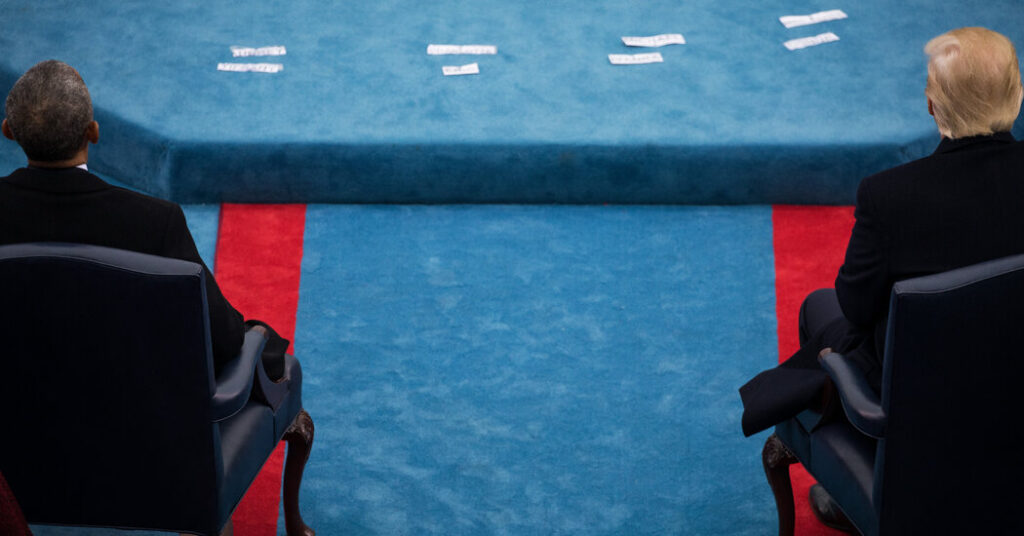
I don’t want to see the 22nd Amendment repealed. But I’ll admit to some frustration that it has denied us the campaign America needed: a direct contest between Barack Obama and Donald Trump.
Obama and Trump are so thoroughly opposite that they can feel like characters out of Dickens. Their philosophical divide re-expresses itself in temperament, speaking style, even physiology. Obama is lean, disciplined, deliberate and restrained. Trump is hulking, bombastic, gaudy and unrestrainable. Obama is defined by his superhuman self-control, his (exaggerated) seven lightly salted almonds before bed; Trump, by his superhuman appetites — for attention, for fame, for money, for women, for power.
But the deepest difference between them — what they represent that goes far beyond themselves — is their opposing visions of what makes America great, even their opposing visions of what makes America America. And while we will not get the campaign that pits those two men and the two visions they embody against each other, over the past few weeks, a shadow version of that debate has played out. Both Obama’s and Trump’s successors should take note.
On June 18, Obama marked the opening of the Obama Presidential Center in Chicago with a speech that laid out his vision of America. “Since we’re a few weeks away from America’s 250th birthday, it is worth remembering just how radical the whole idea of self-government really was back in 1776,” Obama said. “To that point, human history was a tale of conquest and caste and rigid hierarchies, a world where the strong dominated the weak, where power and wealth and status flowed through lineage and the many were ruled by the few.”
Obama continued:
In forming our union, the founders fell terribly short of the Declaration’s promise, leaving slavery intact, allowing states to restrict the franchise to white men who owned property, but in drafting a Constitution and a Bill of Rights, they did have the foresight, the genius to provide us with a framework that allows each generation to make our union more perfect.
And over more than two centuries, through petitions and protests, marches and strikes, moral appeals from the pulpit and conversations at the family dinner table, men and women from all walks of life of every color, every faith, every region took up the cause of democracy and made it their own, until “We the people” came to include not just some of us, but all of us.
America was not just born. America was made. Part of Obama’s political genius has been his ability to present those who sought and seek to make America, to force it into alignment with its ideals, as the true inheritors of the American tradition. In an era when a flag pin adorned nearly every politician’s lapel, he offered a competing vision of what it meant to believe in the country. America is a process, not a place; those who believe in it are those who do the work of making its radical vision real.
You can see this vision of the country etched into the side of his presidential center. The words come from his speech marking the 50th anniversary of the march across the Edmund Pettus Bridge in Selma, Alabama.
“You are America,” it reads. “Unconstrained by habit and convention. Unencumbered by what is, ready to seize what ought to be. For everywhere in this country, there are first steps to be taken, there is new ground to cover, there are more bridges to be crossed. America is not the project of any one person. The single most powerful word in our democracy is the word ‘we.’ ‘We the people.’ ‘We shall overcome.’ ‘Yes we can.’ That word is owned by no one. It belongs to everyone. Oh, what a glorious task we are given to continually try to improve this great nation of ours.”
As that choice of speech suggests, Obama sees himself as an inheritor of a long political tradition, one that has given America a meaning it did not initially have. As my colleague Jamelle Bouie writes, “To read the words of Black Americans, free and enslaved, is to see the Declaration in motion — to see it as a living document with meaning far beyond the circumstances of American independence. And it is to see the fact that this meaning was made: constructed by people with an intimate, fundamental sense of what freedom meant and what it required.”
The contrast with Trump’s approach to the 250th has been stark. Trump memorably anchored his celebration of America’s 250th with U.F.C. Freedom 250, a cage match on the lawn of the White House. It was a veneration of the strong’s ability to dominate the weak, not of the weak who joined together to reimagine strength.
Trump’s speech at the Great American State Fair on the National Mall, kicking off his celebrations, similarly revolved around the idea of America’s renewed strength. “There has never been anything like the United States of America, and together we are making it bigger and better and stronger and far more exceptional than ever before,” he said.
America, Trump continued, had nearly been lost. “As you know very well, a short time ago we were a dead country. We were dead. Now, we’re the hottest country anywhere in the world. We’re respected by everybody. Nobody’s laughing at us anymore. Two years ago, they were laughing. Now, we’re the most respected anywhere.”
Two years ago, little was different in the American economy. The world admired America more than it does today. So what is it, exactly, that Trump has secured? Trump has secured power from those who sought to change America.
“Just like those patriots of 1776, over the past 17 months, we have taken power back from the far-off political class,” he said. “They’re trying to gain it back, but it’s not gonna happen. We have reclaimed our sovereignty, regained our liberty, restored our prosperity, and we have saved our country in all things. We’re once again putting a thing called America first.”
Then, of course, Trump released financial documents showing that his net worth had swelled by $2.2 billion in his first year back in office. That is what Trump actually puts first: himself, his power, his wealth. In his America, the strong dominate the weak, wealth and status flow through dynastic lineages, and he is the strongest of them all.
But what America’s forces of progress have long understood is that America’s ideals are a trap that can be sprung on those who betray them, and Trump has betrayed them. What Democrats have not known, at least since Obama, is how to spring that trap.
Trump’s dominance of the post-Obama landscape has led many Democrats to abandon the optimism of Obamaism. If Trump is what Obama’s politics got us, then what good were they, really?
But that’s the wrong lesson. Trump has, since Obama, faced a series of Democrats who could not tell America’s story as he could, and often did not even try. He has faced a left that saw Obama’s belief in America as naïve, who sought a more direct and constant confrontation with our sins than with our hopes, who spoke more of our villains than of our heroes.
And even so, Trump’s record of converting the American people to his cause has been poor. He lost the popular vote in 2016. He lost both the popular vote and the election in 2020. And while he won the White House and the popular vote back in 2024, buoyed by inflation, he quickly saw his standing collapse to one of the lowest levels of any modern president at this point in his second term.
There is room to take back from Trump not just the story of America but the definition of what it means to be a good American. Obama, clearly, sees political possibility in Trump’s venality and indecency. He braided his speech with an encomium to values that he believes unite most Americans, even now:
A belief that qualities of character, honesty, integrity, kindness, compassion, a sense of duty and honor, those things matter in our public dealings, just as they do in our private lives.
These are the values and traditions I believe in, and they are not Republican or Democratic values. They’re American values we can all share, regardless of party, values every president here today, as different as we are, has tried our best to uphold, values that John McCain and Mitt Romney believed in, no less than I did.
It is our greatest inheritance, the story of America at its best, because it reflects a basic faith in the decency of our fellow citizens and the possibility that despite all of our differences, we can see each other and understand one another and make common cause together.
Is he right? When CNN polled the standings of every living president, Obama topped them all, with 57 percent approval. Trump is languishing at 34 percent. In the contests to come, there will be much that Democrats can still learn from Obama, and much that Republicans may find they need to unlearn from Trump.
The Times is committed to publishing a diversity of letters to the editor. We’d like to hear what you think about this or any of our articles. Here are some tips. And here’s our email: [email protected].
Follow the New York Times Opinion section on Facebook, Instagram, TikTok, Bluesky, WhatsApp and Threads.