

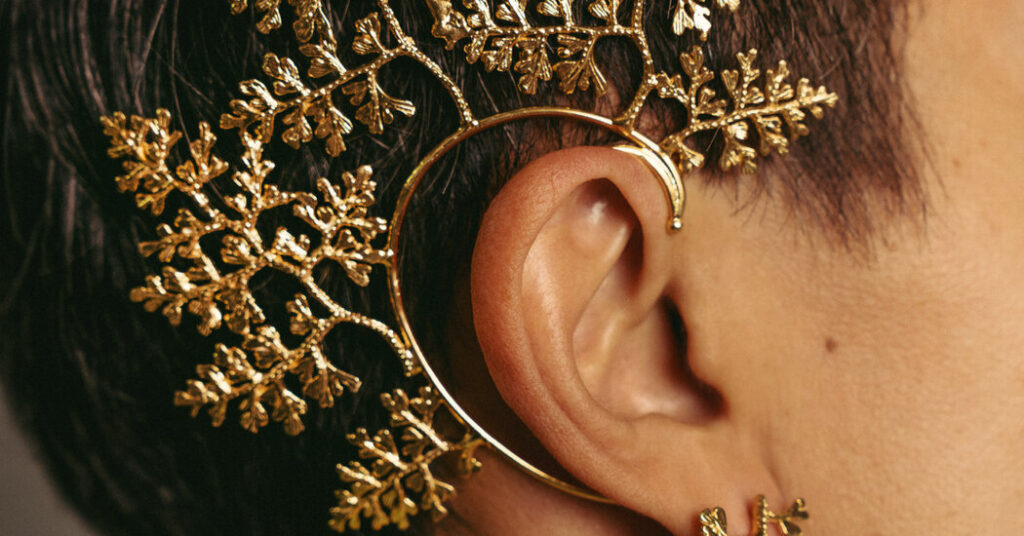
His surroundings have always inspired the jewelry maker Jonathan Yun, whether it was his childhood in his Chinese grandmother’s home, scuba diving around Southeast Asia or observing the flora and fauna of his native Malaysia.
On a recent sweltering afternoon, as tourists gathered at the 200-year-old Lebuh Aceh mosque in the area or rode by in the umbrella-covered bicycle rickshaws that are a signature of this colonial city, Mr. Yun showed off his collections at his atelier, Jonathan Yun Jewelry.
“I opened my first shop in this neighborhood in 2006 when this area was a ghost town, before the property boom in this district,” Mr. Yun said, gesturing toward the bustling street. “Now it’s so vibrant and full of life.”
The two showrooms in this building, which was built around the late 19th century, display several of his collections, which range from jewelry inspired by the sea to pieces that nod to the rich history of jewelry and gems on the island of Penang. Two of the main inspirations for his designs, he said, have been his fondness for scuba diving and a need to connect to the bright colors and textures of his youth in the local Chinese community.
Born and raised in Penang, Mr. Yun, 51, graduated in 1992 from the Royal Melbourne Institute of Technology in Australia with a degree in fine arts and worked for a few companies in Singapore, including the gold and jewelry company Risis. He returned to Malaysia in 1996 and worked in product development in Kuala Lumpur before returning to Penang in 2002 to start his own jewelry company.
During the years in Australia and Southeast Asia, he fell in love with scuba diving.
“I started scuba diving when I was living in Singapore and I would go off every weekend for a dive, and I was inspired to create things that I was seeing,” he said. “Coral was my main inspiration when I started this company and was the first motif that I made.”
And jewelry that mimics coral’s branched configurations abounds in the atelier’s display cases. There are earrings of silver that seem to have the delicacy of cotton candy or a similar brooch with four small emeralds. Pearls are the centerpiece of a ring and a matching pair of earrings, all set against a coral motif (prices from about 250 Malaysian ringgits, or about $61, to about 7,000 ringgits).
The delicacy of his designs mirrors what Mr. Yun sees as the fragility of the world’s oceans.
During his early diving days, “I was also impacted at the same time by the fact that we are not taking care of the environment very well,” he said. “There was a lot of coral dying at that point, and I realized that one of the ways that I can help in my small way is to educate people through my designs.
“We don’t have to poach corals or destroy them, and I developed this line to show the fragility of it all,” he said. “I started this line 20 years ago, and I’m still selling them today.”
Mr. Yun, who creates all his designs, employs six craftsmen full time to execute them, using gold and silver from local dealers and gemstones from traders in surrounding gem-producing countries such as Myanmar and Thailand. “In 2006 it was just me on a bench creating everything,” he said. “Now I employ eight people, including two salespeople.”
After the coral designs became popular, he decided to design a line that celebrated the rich marine life he had witnessed during those initial years of scuba diving. “I started with sharks, lobsters and botanical life,” Mr. Yun said. “Then I began to incorporate gemstones. I started with pearls, which seemed like a natural fit since they come from the sea.”
From there he began to incorporate the flora and fauna of nature on land, incorporating dragonflies, butterflies and frogs into his designs.
In the past few years, he said, he has felt the need to return to his roots, which he once shunned as a design student. Much of his youth was spent in his maternal grandmother’s house in Penang. She was Peranakan Chinese, a descendant of the Chinese who settled the Malay Peninsula starting in the 15th century, and she had their traditional vibrant but sometimes soft colors in both her home and her clothing.
“Growing up, I ran away as far as I could away from that, the colors,” he said. “As a design student, I went toward minimalism where everything is very clean.” But he has come to embrace those early influences now.
“My maternal grandmother wore the kebaya, which is a kind of blouse that women wear with a sarong, and it’s one of my earliest memories,” he said. “There was also the kitchen, where everything happened. I remember the smells, the pounding of the pestle and mortar. The lifestyle was very colorful and ornate, and maybe slightly over the top, in terms of decoration.”
Hilary Manecksha, an English-born resident of George Town since the 1970s, has patronized Mr. Yun for years.
“Every time I got into the shop it’s like a bit of heaven because Jonathan has a different take on so many ideas,” she said. “For example, he took the two smaller brooches that are typically worn on the kebayas in Peranakan culture and made them into earrings.”
For Ms. Manecksha, it was an ideal solution as she liked the idea of brooches but found them to be constricting when used to keep the kebaya closed. “I’ve always worn the kebaya as a jacket without those jewels, just so it’s more open and freer,” she said. “But I can still wear the brooches as earrings.”
Finding such ways to celebrate his heritage feels natural, Mr. Yun said, and he also has begun to incorporate some of the early images from his childhood into his collections.
“The phoenix, for example, is featured very prominently in the Peranakan Chinese culture, which is also a very matriarchal society,” he said. “Those two seemed like a good match. Experimenting has been very creative for me. I guess it’s in my DNA.”