

Since seeing Christopher Nolan’s new adaptation of “The Odyssey” last week, I haven’t been able to get one moment out of my head.
It’s a famous scene: Odysseus, warned of the sirens and their fatally alluring song, has his men stuff their ears with wax for protection. But he wants to hear the music, so he has the crew tie him to the ship’s mast. The sound, he soon finds out, is a beautiful torment.
Nolan offers only a distant glimpse of the sirens, and he doesn’t give away a note of their music. Instead, as the men row and their leader screams at the mast, you hear Ludwig Göransson’s soundtrack: a reedy tune of longing and sorrow that makes you share, briefly but profoundly, Odysseus’ feelings as he hears the sirens.
On TikTok, fans have posted pirated clips of the scene and Göransson’s music, with text like “This sound won’t leave my head,” “This was the most beautiful thing ever” and “I cannot stop thinking about the siren sequence.” People have already covered it on their guitars and their pianos, their English horns and their saxophones.
Homer doesn’t say much about the actual sound of the sirens, aside from descriptions of their song as “honeyed” and “melodious,” in Emily Wilson’s translation. Odysseus says he “longed to listen to more,” but he doesn’t give in, remaining tied to the mast until the ship passes through.
Nolan makes the scene more dramatically expansive, a reflection of Odysseus’ homesickness, his guilt over the sacking of Troy and his long recovery from the war. Asked what the siren song was, he answers:
All the things you want it to be. Then, all the things you wish you had never wished for. It was the delicious itch you go to scratch but find it’s under the skin, you can’t reach it. So the delicious itch becomes unbearable. Told you what you most want is what you most can’t have. And what you most can’t have is what you already had, and lost.
For most of the movie, Göransson’s music is metallic. He has said in interviews that he and Nolan didn’t want to use a traditional orchestra, so he assembled a chorus of gongs that are heard both acoustically and abstracted through synthesizers, making an earthy sound otherworldly. He occasionally brings in other textures, too, like the plucking of a lyre for a motif associated with Odysseus’ bow and, in the siren scene, an ancient reed instrument called an aulos.
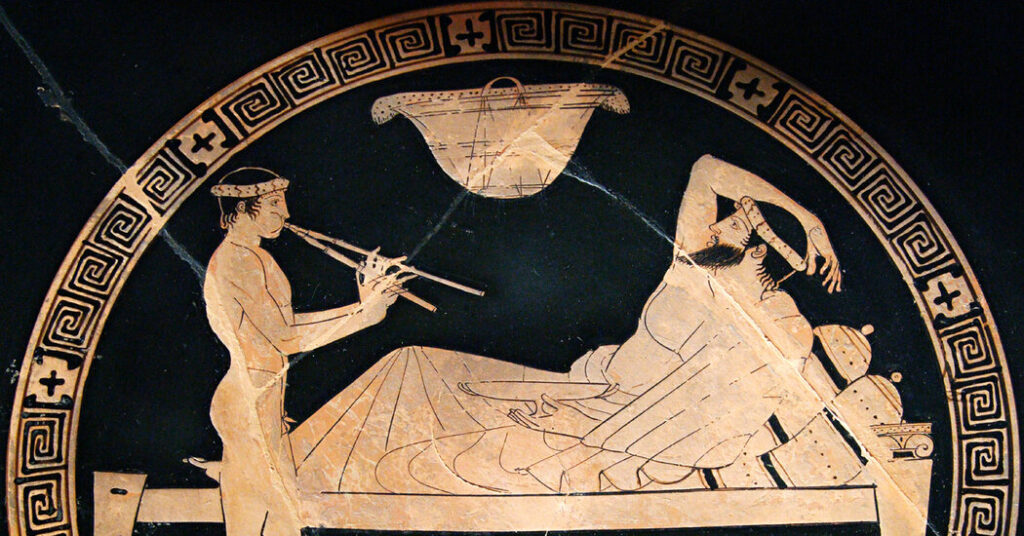
The aulos appears throughout Greek art, depicted in military and domestic scenes alike. To modern eyes it looks like two recorders that come together at a player’s mouth, blown at the same time. Its construction allowed Göransson to use one pipe for a droning pedal tone, and the other for melody.
That melody is just four notes: two that reach up, as if yearning, and two that fall, like a collapse. It’s so simple and so sad.
Together, the melody and the pedal tone form a series of intervals, each with their own meanings in Western classical music. The first is known as a tritone interval, which creates a dissonance that your ear expects to be resolved with the following note. Instead Göransson’s next interval is a second, whose sound is more brightly and harshly dissonant. Then, he brings the melodic line up, pining again, but in what is called a fifth interval, which is consonant but not necessarily harmonious, only to fall to a note in unison with the pedal tone.
The phrase repeats, over and over, its harmonic tension becoming the itch under your skin that Odysseus describes. Göransson’s music for this scene never truly resolves. It’s unsatisfying yet endlessly tantalizing, its own kind of siren song.