

Hardly anyone walking up Peppertree Lane notices the Hollywood Bowl Museum on the way to the amphitheater entrance. The overlooked museum, however, has been refreshed with an enchanting new exhibition. Well-timed, it provides an excellent primer on changing L.A. mores seen through the history of the Bowlover the past century.
Change is again upon us. As Angelenos have evolved, so have our ideas about the Bowl. A concert was a concert and audiences of yore dressed for the Los Angeles Philharmonic, indoors or out. Men wore coats, ties and fedoras. I have a photo of my mother at the Bowl on a chilly 1940s evening sporting, like other ladies around her in the inexpensive bleachers, her mink stole.
The Bowl was said to boast, before the construction of the Hollywood Freeway, a natural acoustical, well, bowl. Even so, sonic adventurers, beginning with Leopold Stokowski in the 1930s, experimented with amplification in an obsessive, seemingly quixotic effort to locate a mythical sonic grail on the Cahuenga Pass. Boys with their toys, thought The Times’ feisty critic Isabelle Morse Jones.
We now have it with a spectacular new sound system along with the old caveat: Beware of what you wish for.
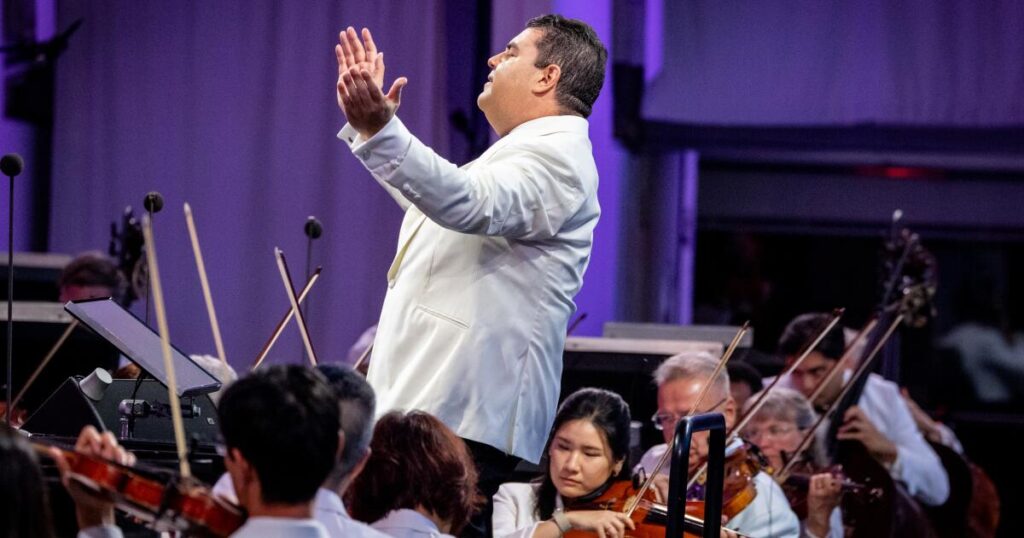
The Bowl, of course, remains the Bowl. Last week when the Los Angeles Philharmonic opened its summer season in the venue it built and has managed for over a century, there were all the familiar alfresco and musical pleasures: convivial picnicking, fine weather, inimitable atmosphere, a white-jacketed orchestra on an iconic stage. The museum’s panorama of ageless ambience is this summer enhanced by increased yet snappy security and a handsome “John Williams Stage” plaque honoring L.A.’s beloved composer.
The newly designed white French loudspeakers suspended over the Bowl stage along with ground-level white cubes of super-effective subwoofers have clean, unobtrusive lines that well fit the shell. Their unobtrusive placement complements their immersive musicality, hitherto only possible outdoors with high-end earphones or headphones connected to sophisticated digital acoustic conversion equipment costing a bundle. For the first time, a dollar seat (there are still a few for the L.A. Phil) strives for such sonic bliss.
It feels miraculous. You are in an excellent concert hall-like acoustical environment while in the great outdoors. Our earbuds have already trained us to think of music as a private escape from reality. Even so, to be in that environmentally exclusive sonic world while sharing music with thousands of others in a special setting, ironically begins to feel more artificially escapist than a crummy sound system that reminds you of where you are.
Will we — should we — learn to love it and find anything less artificial? Car audio systems creating concert hall conditions suggest we will. Audiophiles well know that you get used to new equipment, no matter how revelatory it first sounds, very quickly.
A few years ago, when I heard a demonstration of a supped-up, hi-res recording in surround Dolby Atmos of excerpts from Wagner’s “Die Walküre” on a 32-speaker Burmester audio system crammed into a fancy Mercedes SUV, I was scared out of my wits. “Apocalypse Now” on the 405 is not for the faint of heart.
Yet I’ve spared no expense on what I find a more refined sound system in my Volvo, which I now use more and more for audio books than music. The richer, more human quality of a recorded voice is like having a virtual companion reading to you. I’m less in a hurry. It’s nice to have a pal at rush hour.
It is far too soon to say what ways the fabulous new Bowl sound system, which happens to be AI endowed, might become friend and/or foe. In the first two L.A. Phil classical concerts, the white speakers brought out wonders and caused problems. But the minimal Bowl rehearsal time allows little opportunity to fine-tune.
One big change in Bowl priorities has been the rise of pop as king. Not that long ago, the L.A. Phil’s opening night was the Bowl opening night, suitable for conspicuous socialite picnicking. Not only has the Bowl opener been turned over to star pop performers (who bring in bigger bucks), this year, there wasn’t even a first L.A. Phil Tuesday. That date became yet another money-maker with private event — a screening of “Moana” with live orchestra, luckily before the disappointing reviews and box office performance. The first L.A. Phil concert of the season was moved to Wednesday and poorly attended.
The back-to-back Wednesday and Thursday night programs featured music composed and performed by Americans. Each included a short new work commissioned by the L.A. Phil. On Wednesday, moonlighting Hollywood Bowl Orchestra music director Thomas Wilkins led the premiere of Shaina Taub’s “Suffs” Song Cycle — orchestrations of four songs from her recent musical about women’s suffrage that played just down the road at the Pantages last year. The next evening, Tito Muñoz made a strong L.A. Phil debut in a program that included the premiere of “The Art of the Goal,” celebrating Los Angeles Football Club, and that was credited jointly to filmmaker Josh Kahn and composer Adam Schoenberg.
Both premieres were reminders that the sound system will have many purposes. In “Suffs,” stalwart amplification emphasized the predictability of forthright lyrics and score. A.I. is supposed to make voices stand out, but it is not helpful to singers’ limitations. On the other hand, is brought out the sumptuous quality Alex Newell’s voice potently making the adamant “Keep Marching” keep marching.
Munoz’ program was titled “The Classical World Cup,” with music by Argentinian composer Alberto Ginastera, Mexican composer Silvestre Revueltas and U.S. composers Samuel Barber and Aaron Copland along with Schoenberg. As it turned out, Mexico and the U.S. were already out of World Cup competition, and “Art of the Goal” came across as an eight-minute advertisement for the L.A. Footballers. They’re in the dressing room revving up and, on the field, revved up, sped up, cut up with music that excites and far too many shots of a soccer field lined with advertisements, just the kind of branding we hope to escape at the Bowl.
Then again, even though “Goal” was shown only on video monitors, the Bowl with its new sound system worked brilliantly as the grandest cinema on the planet. Hollywood may be hurting, but let the Bowl now save the day by inspiring Hollywood to reinvent, in its backyard, film with live music.
As for regular orchestral music, the sound system was hit and miss. On Wilkins’ program, Valerie Coleman’s dark “Fanfare for Uncommon Times” brought a listener inside brass and percussion. Leonard Bernstein’s lavish orchestrations of his “Three Dances from ‘On the Town’” and Ellington’s “Harlem” benefited from Wilkins’ low-key conducting, offering ease and freedom to the players.
Muñoz’s program was bookended by dance scores — Ginastera’s “Four Dances from ‘Estancia’” and Copland’s ballet, “Billy the Kid” — that evoke the prairie and the people in it in both viscerally and spiritually. The new sound system and eager performances made the prairie feel close. In between, violinist Randall Goosby brought richness to Barber’s Violin Concerto and the L.A. went in for gripping weirdness in “Sensemayá.”
But who did what? Were balances the conductors’, the sound engineers’, AI’s? While the amplified soundstage is now as huge as the Bowl, attention was increasingly drawn to individuals, heightened by video closeups. A horn flub (and horns flub) stands out. The sound is not just big and bold, but scrubbed clean by AI with the goal of maddening perfection. Will such scrutiny, in the end, make players uptight or liberate them? It’s well to remember that in the early days of synthesizing instruments, violins with perfect vibrato sounded especially fake, until tiny errors generated by chance were added to the sine waves.
The Hollywood Bowl has created a beast. If humanized, the Bowl could serve as antidote to a worrisome AI future. But the question remains whether we can change AI or the newly potent sound waves only make matters worse.