

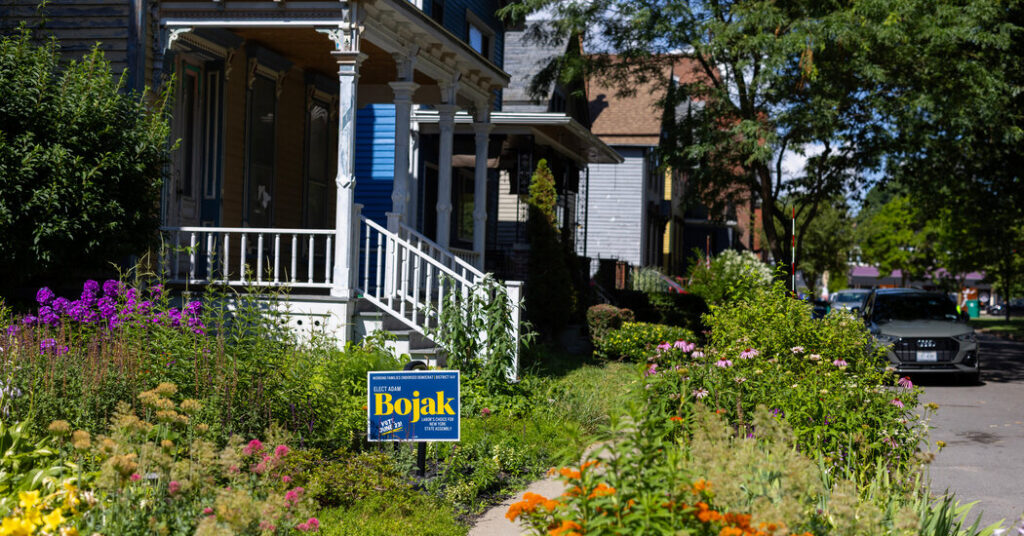
As the national co-chair of the Democratic Socialists of America, Megan Romer has worked for plenty of campaigns and knocked on all sorts of doors across the country.
But for Ms. Romer, there is something special about Buffalo that made it “the best canvassing city in the country,” and it’s not just because she hails from nearby Cayuga County.
“Everybody has got a front porch,” she said. “It is such a nice place to spend a Saturday talking to voters.”
Ms. Romer speaks from recent experience. She was part of a volunteer team that knocked on around 25,000 doors in the western Buffalo area, helping Adam Bojak to a decisive win in last month’s three-way Democratic primary for a State Assembly seat. If Mr. Bojak wins in November, he will become the State Legislature’s first democratic socialist to represent western New York.
Roughly 150 miles to the east in nearby Syracuse, a similar army of fired-up volunteers knocked on thousands of doors in support of Maurice Brown, a democratic socialist. The effort paid off: Mr. Brown narrowly defeated Assemblyman William B. Magnarelli, a 28-year incumbent, by 82 votes in a primary that saw about 6,700 people cast their ballots.
The primaries in New York last month underscored the continued emergence of the left as a political force. Nowhere was that more evident than New York City, where two democratic socialists defeated more established rivals in Democratic House contests, and another leftist candidate took down a House incumbent.
But for national Democrats wrestling with how to channel the enthusiasm for populist outsiders without alienating general-election voters in November, the victories in Buffalo and Syracuse — hundreds of miles from New York City and its democratic socialist mayor, Zohran Mamdani — might also prove instructive.
Candidates and organizers said in interviews that voters seemed to care most about affordability and had a sense that government was in need of generational change.
That thirst for change was evident in Buffalo. Bonnie Bullard, a nanny who lives on Buffalo’s densely populated West Side, where Mr. Bojak received just under 66 percent of the vote, said that she felt compelled to vote for Mr. Bojak after he was endorsed by Senator Bernie Sanders, a democratic socialist from Vermont.
“I am tired of politics as usual, not just with the Republican Party but also the Democratic Party, and I feel democratic socialists are listening to the everyday person,” Ms. Bullard said.
Christine McMullen, a 35-year-old tattoo artist, agreed. “I think sometimes traditional Democrats are more worried about making their donors happy, where socialists are more concerned about what they can do for people,” said Ms. McMullen, who works at Crucible Art Collective on the West Side of Buffalo.
Mr. Bojak and Mr. Brown said they were somewhat surprised that their ties to the D.S.A. did not elicit more skepticism or curiosity. Just five years ago, India Walton, a democratic socialist who had an upset victory in the Democratic primary for mayor in Buffalo, lost in the general election. Her opponent — Byron Brown, the incumbent mayor at the time — ran an aggressive write-in campaign that portrayed her as an extremist.
But the candidates said that the attention given to Mr. Mamdani’s win last year has made voters in western and central New York more comfortable with the democratic socialist brand.
“Bernie Sanders chipped away at that, but then Zohran Mamdani was a huge help,” Mr. Bojak said.
He continued: “Zohran wasn’t successful because he talked about being a socialist. He just said what he was going to do. Our messaging is broadly popular. People want to tax the rich and expand child care. I don’t care what letter is next to their name.”
Maxwell Bollman, who helps lead the D.S.A.’s Buffalo chapter, said that after Mr. Mamdani’s victory last year, the chapter saw its membership grow from around 200 members to about 500. And over time, more voters seemed receptive to the group’s economic platform.
“People are feeling that squeeze even if you’re wealthy and tucked away in the suburbs,” said Mr. Bollman, who also served as Mr. Bojak’s field director.
And while their opponents mostly relied on paid canvassers, Mr. Bollman said that his team of volunteers actually knew Mr. Bojak and believed in his policies — a personal touch and conviction that is sometimes lacking in traditional get-out-the-vote efforts.
“The old Buffalo establishment is getting pushed out,” Mr. Bollman said. “We’re filling that void because we’re the only political project around here that can actually motivate voters.”
Mr. Brown, known to most as Mo, also benefited from D.S.A. volunteers, who fanned out to suburban pockets of their districts, where the group’s policies may not have been received as warmly.
Mr. Bollman said that the parts of the district in Buffalo were easier to canvass because of the city’s density and its more progressive slant. But in the last month before the primary, the campaign began to venture into suburbs like Hamburg to try to lure more mainstream voters — a prelude to what Mr. Bojak and Mr. Brown will need to do for November’s general election.
Mr. Bojak succeeded against his two opponents by garnering about 61 percent of the vote in the more vote-heavy Buffalo, overcoming roughly 33 percent he pulled in Hamburg.
If the two men prevail, they will be part of a cohort of 16 D.S.A.-backed legislators in Albany next year. This would represent the largest number of democratic socialists in the State Capitol ever, and that doesn’t even account for the lawmakers who agree with the group’s platform but are not officially part of the organization.
“The wins point to a good amount of sclerosis in the old line, consultant machine blob, and that the era of simply bombarding people with mailers and television ads is maybe over,” said Ms. Romer, the national D.S.A. co-chair.
In Syracuse, Rachel May, a Democratic state senator, said that there was not much ideological separation between Mr. Brown and Mr. Magnarelli, but Mr. Brown was able to capitalize on voter frustration.
“People here feel that the Democratic Party’s business as usual is not meeting this moment,” said Ms. May, who also represents Syracuse and was one of the few elected officials to back Mr. Brown.
“I think people who are not necessarily of the same ideological spectrum as Mo still want someone who is going to fight in new ways because the old ways have not been working,” she added. “He tapped into some of that.”
Another modern-day concern became an issue in Syracuse and Buffalo: mammoth data centers used to power generative artificial intelligence. A state bill sponsored by a D.S.A. lawmaker that was passed in Albany last month would create a one-year moratorium on new data centers.
Mr. Brown recounted attending a community meeting in the small town of Lysander, where a data center had been proposed. “The room was not big enough to hold everyone who wanted to be there for that meeting,” he said.
“They wanted elected officials to pay attention,” he added. “I had a leg up on my opponent, because I was.”