

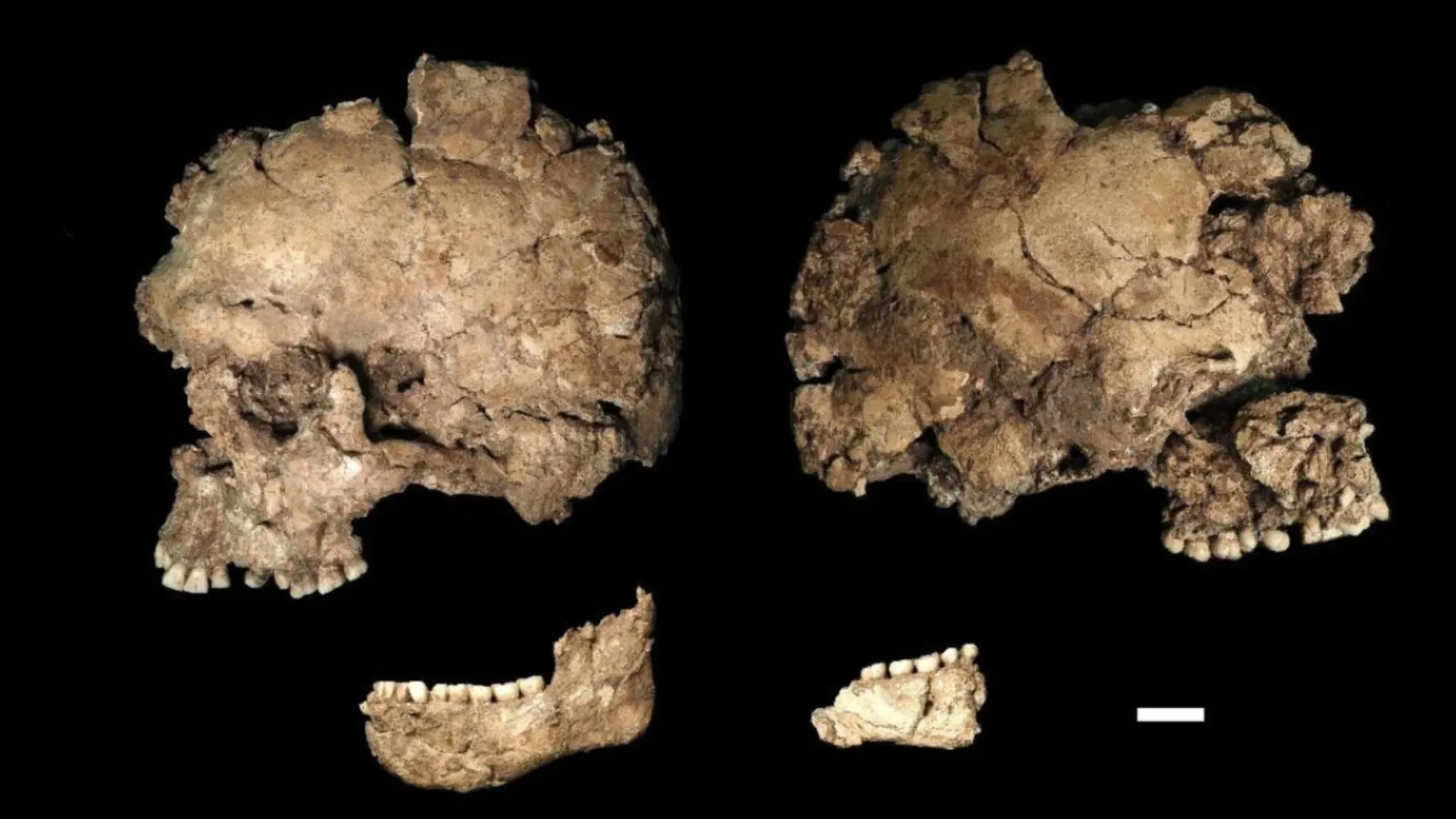
One of the oldest known burial sites ever discovered is also home to what appears to be evidence of horrific violence committed as far back as 145,000 years ago. As it was chronicled in Scientific Reports, one recently reexamined Homo sapiens skull belonged to a person who appears to have been stabbed in the face.
Brutal.
The skull, known as Qafzeh 25, was uncovered decades ago at Qafzeh Cave in present-day Israel, where archaeologists have identified at least 27 deliberate burials dating between 145,000 and 92,000 years ago. The site is one of the earliest known examples of humans intentionally burying their dead, suggesting these ancient people already practiced complex rituals long before civilization was even a concept.
Scientists Found Evidence of a 145,000-Year-Old Face Stabbing
Now, thanks to high-resolution CT scans and microscopic analysis, researchers have identified what may be the oldest known case of sharp-force trauma ever documented. A face stabbing that echoes through the ages.
It’s a deep cut running across the left side of the man’s jaw, damaging both bone and one of his teeth. Forensic science has gotten so good that the researchers figure it was likely done by a sharp stone weapon, maybe during a face-to-face confrontation with a right-handed attacker. They aren’t completely ruling out the incident as the result of an accident; the location and shape of the wound make Homo sapiens-on-Homo sapiens violence the most likely explanation.
The crazy part is that the researchers don’t think that the victim of the face stabbing even died from it.
The bone shows signs of healing, meaning he lived for quite some time after the attack, like a real badass… And like a real medical marvel of his age. Surviving a facial wound like that in the Stone Age would’ve been difficult without some kind of medical care provided by members of the community. So, either this guy was unbelievably lucky that the wound didn’t get infected, or that he didn’t bleed out, or it suggests that he was living among early humans who may have been capable of killing and caregiving.
They also found evidence that the entire Qafzeh population had some gnarly rotting teeth, so it’s not like the stabbed person would have missed the stabbed-out tooth anyway. The stabber was probably doing them a favor.