

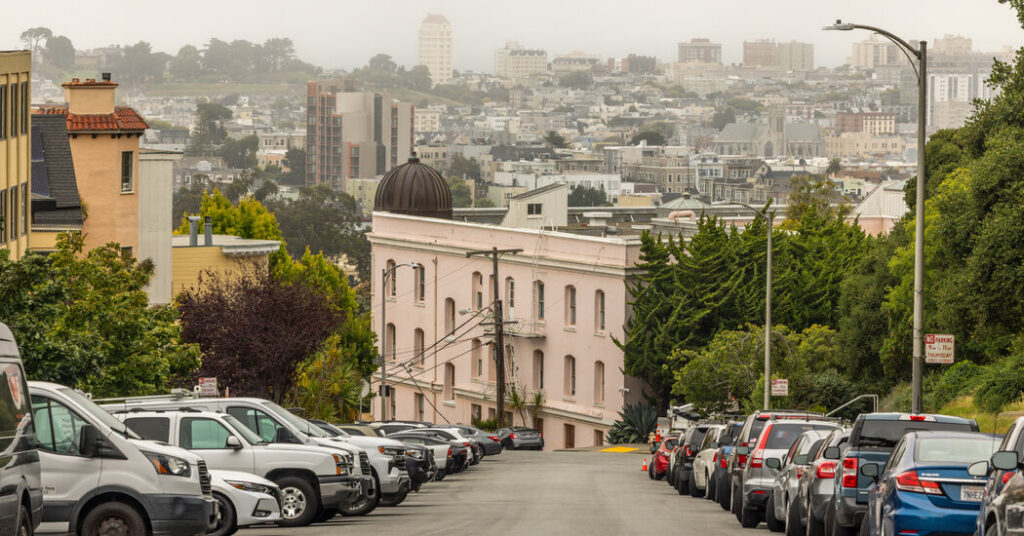
As much of the eastern half of the country withers in sticky heat on the Fourth of July, San Francisco was expected to spend the morning wrapped in fog, with a cooling breeze sweeping in from the ocean in the late afternoon.
In the summer, it’s not unusual for the city to stand out like a peacock in a chicken coop on weather maps that show high temperatures across the rest of the country. That was true again for Saturday, when the city was expected to top out at 66 degrees, compared with 102 in Washington, D.C., and 98 in New York, where the record-breaking heat wave will linger for yet another day.
That makes San Francisco the coolest big city in the contiguous United States (Up north, Anchorage was unlikely to get above 60.)
When it’s 66 outside, the body doesn’t perspire, except when running up one of the city’s steep hills. A light jacket may be needed, while a winter coat is too much. Some might call this temperature comfortable.
“The mid-60s, it’s just perfect,” said Val Lupiz, who spends his days outdoors. He said he had worked as a cable car gripman for 26 years.
Mr. Lupiz said visitors are often surprised by the city’s cool summer weather.
“Some people think of sunny California and they don’t realize Northern California is different,” he said.
Summer in San Francisco is mild because the city is surrounded by chilly ocean waters and fog reliably clings to the coast.
“That’s our natural air-conditioning, with the winds pushing that cool air and fog onshore,” said Scott Rowe, a meteorologist with the National Weather Service office in Monterey, Calif., about 100 miles south of San Francisco.
But the fog that keeps the city cool could also obscure one of the anticipated highlights of its Fourth of July celebrations. For just the third time in the city’s history, fireworks will be set off from the Golden Gate Bridge, at 9:30 on Saturday night. It cwuld be an iconic view of one of the country’s most famous expanses — if anyone can see it.
There’s fog in the forecast, with the clouds mostly clearing in the afternoon but returning later in the day, filtering into the Golden Gate and covering downtown into the night.
San Francisco’s average high temperature in July sits at about 66 degrees, nudges up to 67 in August, and reaches 70 in September and October, which are usually the warmest months of the year, as the winds often shift and push warm inland air toward the coast.
Over the last seven decades, the average afternoon high in San Francisco on July 4 has been 66, compared with 73 in Seattle, 86 in Chicago, 92 in Houston, 84 in New York City and 88 in Washington, D.C., according to data from the National Weather Service.
San Francisco rarely gets as warm as these other cities on Independence Day. With records going back to 1874, the city has only hit 80 or above six times on the holiday. Once, when temperatures soared into the 90s in 1931, the San Francisco Chronicle reported that residents “watched the antics of their thermometers with amazement.”
More commonly, however, locals watch the shenanigans of the fog that the winds spread across the hills and valleys. They appreciate its beauty and cooling abilities but often become frustrated with it on the Fourth of July when it obscures fireworks spectacles.
“It’s summer in San Francisco, and unfortunately that means cloudy nights more often than not,” said Brayden Murdock, a meteorologist with the Weather Service.