

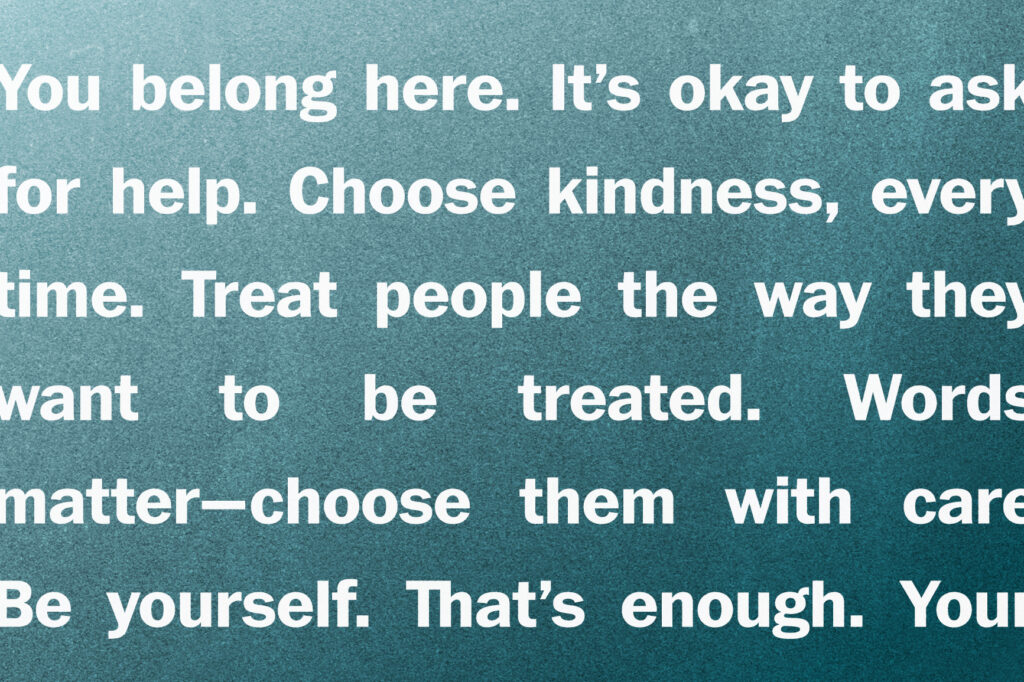
When teachers in a southeastern Michigan school district decorate their classroom walls this fall, they will be limited to 32 preapproved phrases, part of an effort to “keep non-curricular ideologies and partisan politics out of the classroom,” officials said.
Classrooms can display messages including: “Everyone is welcome,” “You matter,” and “Choose kindness,” according to the list of acceptable statements. They must be printed in red or black ink, the school district’s colors, according to an internal memo obtained by The Washington Post.
Anything else must be approved by Romeo Community Schools, a rural, traditionally conservative district of about 5,300 students.
Critics say the policy limits expression and bans phrases associated with supporting the LGBTQ+ community, such as “All are welcome.” Staff said last school year they had to remove posters that promoted inclusion; flags from countries other than the United States; and banners with rainbow letters — which are also a sign of LGBTQ+ affinity.
“I believe that they’re definitely trying to not allow us to have a conversation about diversity,” said Shelley Bjorkstrand, a middle school counselor in Romeo. Last school year, she said, she was ordered to remove a sign that labeled her office a “safe space.”
The policy follows a nationwide trend of increased regulation of what is allowed in public school classrooms — decisions that have traditionally been left to teachers or local districts. Four states have passed laws that require classrooms to display the Ten Commandments. Other states have barred teachers from hanging certain flags.
A Pennsylvania school district banned displays related to gender and sexual orientation, prompting a lawsuit last month accusing officials of discrimination.
But education and free speech advocates said they had not seen other school districts be as prescriptive about signage as Romeo.
“We’re seeing overly prescribed input from boards or states or, increasingly, federal agencies and legislators, around what can and cannot be represented, read, included on a bookshelf, hung on a wall,” said Kasey Meehan, director for Freedom to Read at PEN America, a free-speech nonprofit. “We do see it as suppressing free expression.”
Officials in Romeo Community Schools say the poster policy was created in response to complaints from school staff. The rule was approved in April 2025 and took effect last school year, though staff received the list last month.
“We have had some administrators — and even staff, teachers — express the desire to make sure we’re focusing on curriculum and not people’s personal beliefs,” Rachel Eichhorst, the district’s school board president, said during a meeting at the time. Members approved the rule in a 6-1 vote.
But Bjorkstrand said she’s never heard that from her colleagues, and suspects the complaints came from people in the broader Romeo community.
In October, Bjorkstrand said, she was instructed to take down a sign that read: “This is a safe space to be who you are.” One of her colleagues was ordered to take down a sign that said “Welcome” in rainbow lettering, she said. A teacher who has Polish ancestry had to remove the country’s flag from his classroom.
“As a counselor, I was pretty offended that I had to take that down,” Bjorkstrand said. “Especially in middle school, our students, they need adults that they can trust, and they need to feel that they can be themselves.”
The policy bars school employees from displaying “ideological or political materials as part of the educational program, unless they are relevant to the subject matter and presented in a balanced manner.”
The local teachers union filed a grievance with the school district over how the policy would be implemented, Brad Wenz, president of the Romeo Education Association, said in a statement. The two sides settled the matter by creating the list of acceptable messages, as well as a four-level process that includes legal review for approving new ones.
Teachers received that list on June 8, Mary Anne Brush, a district spokesperson, said in an email.
“In response to some confusion surrounding the policy, the administration, teachers union and legal counsel worked collaboratively to create a list of preapproved poster statements, without the involvement of the Board,” Brush said. “These statements help ensure that the policy is implemented fairly and consistently, reflecting the shared desire to have curriculum-focused classroom environments.”
The list, first posted on a Facebook page that monitors local news and reported by Chalkbeat, has since raised concerns about alienating students, particularly LGBTQ+ children, and restricting teachers.
“This was insane to me. It’s just going too far,” said Cara Lougheed, a former Michigan public school teacher whose sons graduated from Romeo Community Schools in 2023 and 2026. When she taught in the Detroit metro area, Lougheed said, she was free to decorate her classroom as she pleased. She hung a flag in her classroom with the word “human” and different colors for the LGBTQ+ community.
“Some of my students thanked me,” Lougheed said. “They felt like when they walked into the room, there wasn’t going to be bullying allowed.”
Erin Knott, executive director of Equality Michigan, an LGBTQ+ advocacy group, said students may feel excluded if their identities are treated as something that can’t be seen or discussed.
“I understand that school districts are navigating an increasingly difficult political landscape and may feel pressure to avoid becoming the center of controversy,” Knott said in an email. “But policies that restrict educators’ ability to acknowledge or affirm LGBTQ+ students risk sending a very different message than intended.”
Even some people concerned about classroom messages they see as political are skeptical, saying the policy might ban messages that are universally accepted as educational.
“The preapproved list is well-intentioned and aims to keep political propaganda out of the classroom, yet it can also cause unnecessary bureaucracy for nonpolitical messages that aren’t yet on the list,” said Corey DeAngelis, a research fellow at the Heritage Foundation, a conservative think tank.
Attempts in other school districts to restrict the messages teachers display in classrooms have been met with lawsuits.
An Ohio teacher said he was told to remove a poster that said: “Hate has no home here.” He sued his district this spring.
Shortly before Idaho passed a law in 2025 prohibiting flags and banners with “ideological views,” a teacher said she was instructed to take down posters, including one that featured colorful lettering, hands of different skin tones and the words: “Everyone is welcome here.” She also filed a lawsuit.
In an op-ed, Raúl Labrador, Idaho’s attorney general, said the poster promoted “LGBTQ+ ideology” and signaled “adherence to Diversity, Equity and Inclusion.”
“The rainbow colors and progressive symbols accompanying these messages make their political purpose unmistakable,” Labrador wrote.
Christy Seitz, an alum of Romeo High School and mom to an incoming kindergartner, described the district as great with experienced teachers, strong academics and smart students.
She worries the new signage could undermine that.
“It says ‘you belong here,’” she said of one of the approved messages, “if you fit in with us.”