

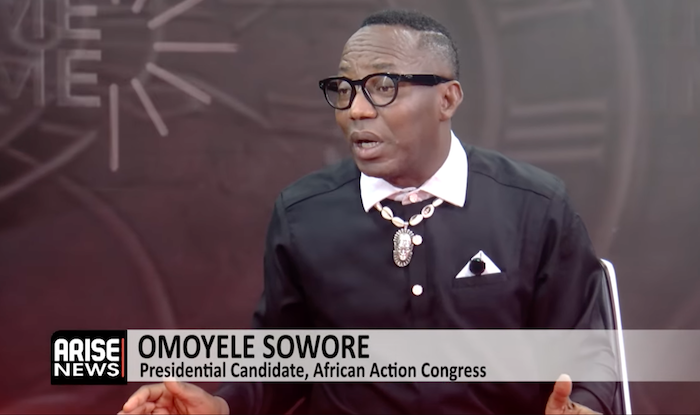
The presidential candidate of the African Action Congress, (AAC), and activist, Omoyele Sowore, has argued that freedom of expression in a democracy cannot be subjected to the whims and caprices of those in authority, insisting that only the rule of law can define the legitimate limits of speech and criticism of government officials.
The remarks come against the backdrop of Sowore’s recent arrest and remand following a bench warrant issued by the Federal High Court in Abuja after he failed to appear for proceedings in his ongoing cybercrime and criminal defamation trial. The charges stem from social media posts in which he allegedly described President Bola Tinubu as a “criminal”. Following his absence in court on June 16, 2026, the presiding judge revoked his bail and ordered his remand at the Kuje Correctional Centre before later granting him fresh bail in the sum of 200 million naira with stringent conditions.
Speaking with ARISE NEWS on Wednesday, Sowore said: “The limitation to freedom of expression cannot be regulated by the whim and caprices of those in power. It has to be according to what the law says. If the law says you can speak truthfully to power, nobody should have the right to prevent you from expressing yourself. That is why it’s called the rule of law,” he argued.
Responding to questions on the Cybercrime Act, Sowore argued that the law should not be used to suppress criticism or punish individuals for expressing unpopular opinions, alleging that authorities were more interested in punishing him than securing a conviction through the courts.
“The cybercrime law, as amended by the Tinubu regime, also made it very clear that an individual cannot use the law to oppress another person simply because the person said something you don’t like. That is what the amendment says. That only in circumstances where your statement has led to the breakdown of law and order, is capable of breaking down law and order, would you then be brought in to explain yourself. But don’t forget that there has to be a trial, you know, and unfettered, fair access to all the evidence you need, and if you are able to present your case and you are seen not to have committed any crime, nobody has the right to take you to jail, keep you in jail, or keep taking you back to jail through technicalities.
“But what has happened in my case since 2019, as you know, is that whenever they charge me with these offenses and I get arrested, they are not interested in a trial. They are interested in convicting, punishing me without conviction,” he alleged.
He further claimed that the prolonged legal battles had devastating consequences for his family, including the death of his brother, whom he described as having been assassinated in Edo State under unresolved circumstances.
“After five years of wasting my time, you know, ruining my entire family, killing my brother and my mom having a stroke, they came and ended the case. My brother was assassinated on his way back from school in Edo State,” he alleged.
On whether his description of President Bola Tinubu as a “criminal” was a political opinion or a factual allegation, Sowore maintained that it was a statement of fact and said he was prepared to defend his position in court, while alleging attempts by authorities to frustrate his defence in the ongoing proceedings.
“It’s a statement of fact. And it says that if anybody has been involved in drug dealing, drug trafficking, there’s no status of limitation. The NDLEA can still try you, even if you are president, when your presidency is over. We can make that point. And in this case, it’s not just that. During End SARS—there was a case that was active at the Federal High Court of embezzlement of billions of tax—taxes that were supposed to be paid by Alpha Beta, that’s linked to this president. He never handled that case. We were told after End SARS that the documents were burnt in the courtroom so that they can cover it up. And we have several of these.
“What I told them is that, why don’t you just calm down? Let’s prove this case in court. But when we were at the point of proving the case the most, our attorney was ripping apart their one single witness—a DSS guy who said he found out that I made this statement. The judge got upset. He said, ‘Stop. If you don’t stop, come and kneel down here.’ It’s never happened before. Trying to ask my lead attorney, Marshal Abubakar, to kneel down before a judge because they didn’t want us to present our evidence,” he said.
Speaking on the state of democracy in Nigeria, Sowore argued that Nigeria transitioned to civil rule rather than democracy in 1999 and accused the current administration of undermining democratic principles.
“Nigeria had a transition to civil rule; it never had become a democratic nation. That is one reality, and it’s a hard fact that we must all accept. The fact that we accepted in 1999 that the military should leave abandoned us with a constitution that we knew nothing about, how it was written, printed, or processed. And asking people to run for election and some people to oversee the election did not mean that we had democratic rule. That is why I have restated time and time again that what we had was a morocratic rule. Morons hijacked the democratic process in this country.
“That is what I see the Tinubu regime and these other guys who are operating your democratic structure as—they hate the idea of democracy. They hate the idea of openness. They hate elections, and they hate the fact that you are striving to get a better country because they don’t want that. They want you to live in a country where you are perpetually frying something, whether it’s akara, kuli-kuli, or whatever they call it,” he said.
Reflecting on his years in activism and politics, the activist said he remained committed to his campaign for social and political change, insisting that he could not claim success while Nigeria continued to grapple with poverty, insecurity and weak institutions.
“I have been effective at what I do, and that’s why I don’t allow people to demand of me ‘experience.’ I have done very well, as far as my conscience is concerned, regarding what I want my country to be like. But will I sit down here and start claiming victory when we are still being subjugated, when we haven’t achieved what we want to achieve, when we’re still one of the poorest nations in the world, we don’t have a military that can defeat ragtag militants, you know, kidnappers and bandits, or terrorists as you call them? If you don’t have a country where people have prosperity, in the midst of plenty we are in the midst of lack. So, I can’t stand here, sit here and declare victory. Nobody in my position should do that,” he insisted.
Speaking on his electoral performance, Sowore argued that it was impossible to accurately gauge public support for his ideas without free and fair elections, insisting that credible polls require open campaigns and transparent electoral processes.
“I think that’s something we keep repeating here across this table all the time—that we cannot calculate whether my policies or my personality or my ideas are admirable to the Nigerian people until we start having free and fair elections. So, let’s get to a point where we can have free and fair elections.”
Addressing the limited turnout at some of his protests, he attributed it to fears of repression and violence by security agencies, arguing that many Nigerians are reluctant to participate in demonstrations because of the risks involved.
“When we call out people to go for, protest, we are calling on the critical mass. But don’t forget that when you’re calling on people to come out and protest, you’re also calling on them to come out and confront your police and the army and the DSS who kill people during End SARS. And don’t forget I was one of the people who mobilized people for End SARS. In fact, I was the first to go to the police headquarters there in Abuja to start End SARS. So, when consistently people get killed when they’re engaging in peaceful protest, people get jailed when they make Facebook posts about their public officials, you do not expect to find a huge number of people who are willing to take all this risk from time to time. So, you’re left with a few very critical mass who are willing to take all the risk,” he explained.
Despite the risks, Sowore said he would continue mobilising Nigerians and speaking out against injustice, insisting that his activism was driven by conscience rather than a desire for personal recognition or political gain.
“I will keep doing it. But I’m not dying for Nigerians, I’m dying for what I believe is right by my conscience. And I would have done it if I was in the US or I was a Palestinian or I found myself in South Africa. But I would have done the same thing,” he insisted.
Ruling out alliances with mainstream opposition figures, Sowore said he would not compromise his principles by joining forces with politicians he believes are responsible for Nigeria’s problems.
“I cannot, in good conscience, wake up one day and compromise with a politician who engage in genocide that I know, have covered and have condemned in the past, when we have not punished them for the genocide they committed. I cannot wake up in this country and join a political party of a guy who stole all the money that could have trained children to become graduates and become successful in life, or the people who took money that were meant for roads, in which you and I have lost private relatives, whether at distance or close. I can’t sit down with them when they have not changed their ways, and I know they’re not going to change their ways. So, I look at the people of Nigeria, and that is what I call the coalition of the oppressed, and say let’s celebrate our liberation by fighting these other people,” he urged.
Sharing the personal cost of his activism, the activist said his experiences with arrests, detention and prosecution had not weakened his resolve, insisting that the pursuit of justice and systemic change often requires sacrifice.
“What I’m trying to tell you is that if you have a penchant for justice, social justice, political justice, economic justice, that’s all you need to offend the system. And as long as you’re not compromised and you’re not compromising and you’re not willing to compromise, that’s all you need to offend the system your entire life. So, it doesn’t matter.
“But in our own case, we have to take the hard route because it is necessary. Don’t forget, even though we’re discussing democracy here, my own attitude towards democracy is revolutionary democracy, where the people step out all at once and change the system because the system must fall.
“There’s no way this system can sustain your development, your progress, your prosperity. The system is set to devour you, and you have a duty to take down the system. That’s the revolution that I preach. And that requires that we use the appropriate language, adjective, adverbs, nouns to describe people who are destroying the country, whether they’re the ones there now or the ones that are coming, because we need a country that belongs to us and we don’t have to mince words about it,” he concluded.
Favour Odima
Follow us on: