

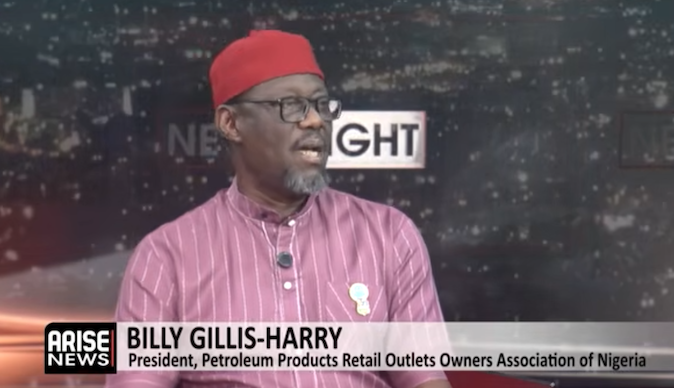
The president of the Petroleum Products Retail Outlets Owners Association of Nigeria, (PETROAN), Billy Gillis-Harry, has defended the slow pace of reductions in petrol pump prices across Nigeria, following declines in international oil prices, arguing that marketers must first sell off existing stock purchased at higher costs before reflecting lower prices at filling stations.
“When prices go up, it takes us a very arduous task to get funds to pay for it. And when the prices come down, those same costs that have been incurred with the attendant charges still remain with us. So it’s not conducive, even for you as a consumer, that we should divest ourselves of very much-needed financial blood in our system to be able to keep our stations wet. That is the reality. If we had bought, say, for ₦1,210 for instance, it’s difficult for us to restock our product if we attempt to sell at ₦1,209,” he explained.
Gillis-Harry also dismissed suggestions that marketers were exploiting consumers or engaging in cartel practices to keep prices high, describing such claims as assumptions that overlook the realities of the downstream sector.
“Both are assumptions. Because it’s not good for anybody at all, whether it’s government or just citizens, to sit down, do an armchair projection, and then assume certain values. That is not correct. For us in PETROAN, our covenant with Nigerian citizens is to ensure that our stations are wet, we give appropriate weights and measures, and we give top quality as we receive it, as approved by NMDPRA,” he stated.
He maintained that fuel retailers operate on thin margins and must generate enough profit to cover operating costs while ensuring products remain available at filling stations across the country.
“Now, while we have taken the decision to make that, we must be in business. Yes, we will not make the profit we project at all times, but we must still make some profit to be able to pay the cost of doing business,” he said.
Addressing criticism that the inventory argument appears to favour marketers only when prices fall, Gillis-Harry argued that rising prices also create financial strain for retailers, who must secure additional funds to replace stock at higher costs.
“I will not point any accusing fingers at anybody because I represent over 8,000 retail outlets in the country, and we do know the size of influence we have. And so we are cautious and careful to make sure that we keep the temperature down at all times. And so we take quite a lot of flak. Things that we do and we accept that you would not even understand, that we go home crying sometimes in the night.
“If I bought products, say, 1,100, and suddenly the price jumped to 1,300, I have to look for 200 Naira to, first of all, make up that price. And 200 Naira has a cost from the financial institutions. And it’s not easy to find any and every financial institution there to give us funds,” he lamented.
According to him, the challenge is compounded by limited access to affordable financing, renewing PETROAN’s call for the establishment of a dedicated Nigerian energy bank to provide single-digit interest loans for downstream operators.
“Which is why, in this same table, we had asked that the Federal Government should discuss with us the dynamics of how to set up an energy bank for domestic values for Nigeria—not an energy bank for Africa, an energy bank for Nigeria—that will be able to look at the dynamics of providing funds for downstream operations. That would have helped us to have single-digit interest rates and will help in ensuring that we will not have these difficulties in raising capital to be able to meet up our finished products,” he noted.
Speaking on domestic refining, Gillis-Harry praised the contribution of the Dangote Refinery to Nigeria’s fuel supply but stressed that greater competition among refiners would be needed to drive down prices.
“We have a domestic refinery that has done us well, and personally, I’m proud of that refinery—the Dangote Refinery. But at the end of the day, if we have just only one giant in the house, of course, very soon all the lilliputians will be smashed down,” he said.
He added that marketers purchase products based on availability and cost considerations rather than whether they are imported or locally refined.
“I have never bought any product across the border, but I buy imported products. I also buy refined products in Nigeria. And a lot of my members have access to doing this. Whatever the dynamics that play, don’t forget that for us retail outlet owners, we can only buy from where it is available.”
Favour Odima
Follow us on: