

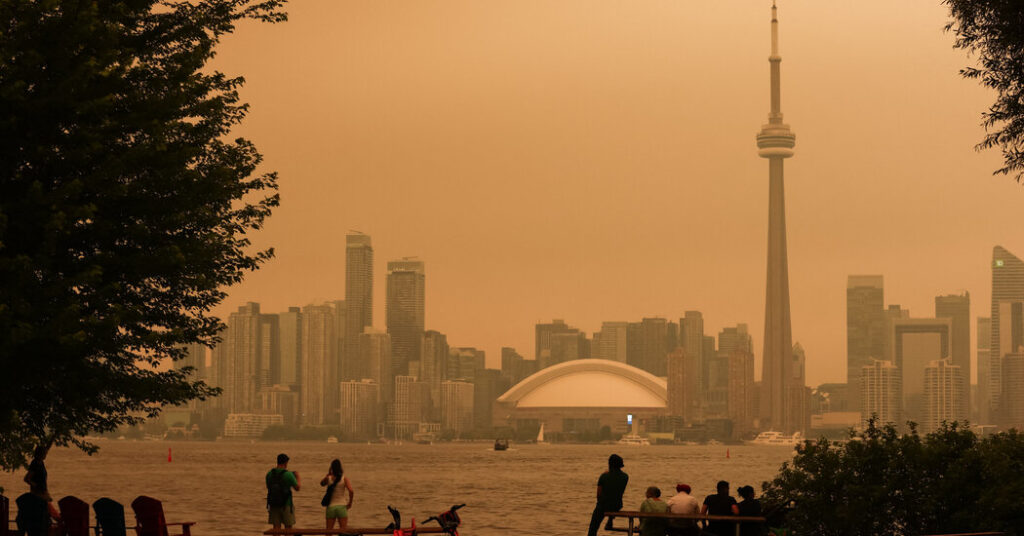
The strip of dense wildfire smoke can be seen on satellites stretching from the Upper Midwest and Canada, across the Great Lakes, through southern Ontario and New England and down to New York City. Some is even traveling out over the Atlantic Ocean and back up to the far eastern coastline of Canada.
Weather forecasters expect the smoke to darken skies again on Thursday across North America and send air quality readings surging to dangerous levels in many places.
Three big questions about the wildfire smoke:
Where will the smoke go on Thursday? The day is likely to unfold very much as Wednesday did, forecasters said: The densest smoke will move south throughout the day, and it may even dip as far as Maryland this time. Around New York, expect the worst conditions in the afternoon and evening.
When will it end? The smoke is spreading so widely this week because the same heat dome that has led to brutally high temperatures in the Midwest and the Northeast has trapped the smoke close to the ground. By the weekend, as another weather system pushes the hottest air away, both the heat and the smoke are expected to ease in the Northeast, forecasters said. But closer to the fires, the smoke is likely to linger longer.
Where is the air quality the worst? The worst air quality is in Minnesota, Wisconsin and Ontario, where the wildfires are actively burning. But as far away as Toronto and New York, the air quality index was still likely to reach unhealthy levels through the day on Thursday.
The E.P.A. estimated that many places that were affected by smoke on Wednesday would experience similar conditions on Thursday — or even a little worse.
Air quality readings of 100 or higher are a warning to people who have respiratory conditions to take precautions. Above 150, the air is considered “unhealthy” for people who are not in sensitive groups. Above 200, the air is “very unhealthy.” Above 300, the air is ”hazardous.”
The scale, which runs from 0 to 500, was designed by the E.P.A. and measures the density of five different pollutants in the air: ground-level ozone, particulates, carbon monoxide, nitrogen dioxide and sulfur dioxide.
Several spots in northeastern Minnesota, closest to the fires recorded had A.Q.I. readings well into the “hazardous” range on Wednesday.
Toronto’s A.Q.I. was briefly among the worst in the world on Wednesday, and by the evening every U.S. state from Minnesota to Connecticut had some location where the air quality index had reached unhealthy levels. At 10 p.m. on Wednesday night, as some of the thickest plumes of smoke moved well south of the international border, Minneapolis was at 287, Detroit was at 196, New York City was at 192 and Scranton, Pa., was at 157, according to AirNow, run by the E.P.A.
What else to know about the smoke:
As climate change drives up global temperatures past record levels, the frequency of days when it is both hot and polluted has also been increasing. Claire Brown and Christina Kelso of The Times’s Climate team wrote about several factors that are converging to amplify health risks during sweltering days. Read more here ›
Wildfires can generate unhealthy levels of smoke. Dani Blum of Well wrote about what you can do to protect yourself, even far from the fires. Read more here ›
When the air is smoky, it’s important to consider whether it’s safe to exercise outdoors — and how to protect yourself if you choose to head out. Melinda Wenner Moyer of Well wrote about what athletes should know. Read more here ›