

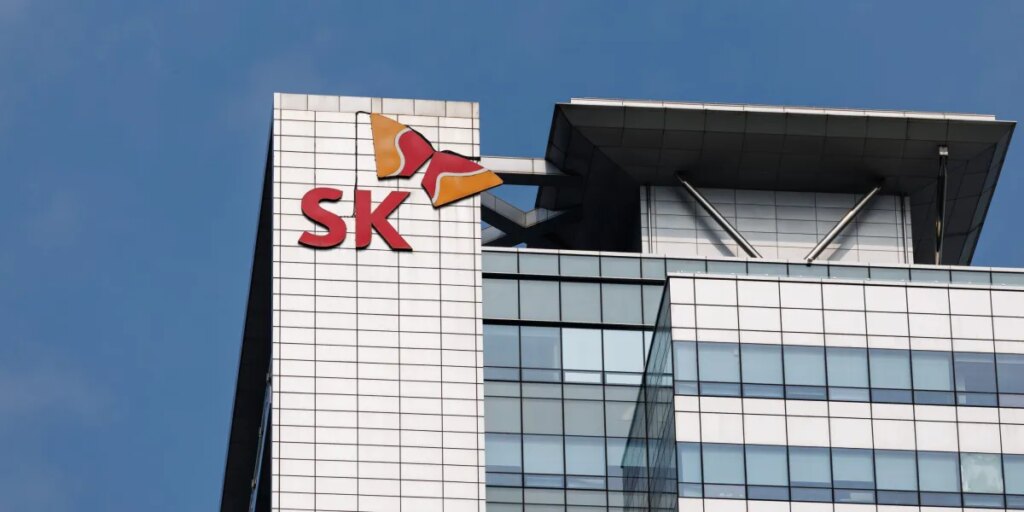
This week’s $29 billion US stock-market listing for SK Hynix Inc. may be the biggest-ever first-time share sale by a foreign company, but it isn’t just about raising cash. It’s also about competing in the hottest corner of the global stock market — memory chips used in AI computing.
For years, the South Korea-based semiconductor manufacturer has traded at a discount to its chief US-based rival, Micron Technology Inc. Tapping into the world’s deepest equity market and its frenzy for all things related to artificial intelligence could help change that at a time when the companies that make memory chips and other equipment used in AI data centers are driving the performance of the S&P 500 Index.
“We are in a time of extreme enthusiasm about chip stocks,” said Daniel Morgan, senior portfolio manager at Synovus Trust Co., which owns Micron shares. “It’s a good time to go and get the US involved in your shares.”
Betting on SK Hynix has been difficult, if not impossible, for the majority of American investors. Like Micron, the second-best performer in the S&P 500 this year with a scorching 242% gain, the company is benefiting from soaring demand for high-bandwidth memory chips. But owning SK Hynix’s South Korea-listed shares outright means off-hours trading in the US. The other alternative is buying unsponsored American depositary receipts, or ADRs, over the counter. Not only are the unsponsored ADRs performing worse than SK Hynix’s South Korea shares, but liquidity is also severely limited, making trading them a challenge.
SK Hynix’s Nasdaq listing, which is expected on July 10, should change that and improve the company’s lagging valuation. The South Korean firm trades at 6.2 times estimated earnings over the next 12 months. Micron is currently at 7 times after the shares tumbled 14% last week, their worst performance since March, but it was over 11 times as recently as June 22.
“The offering targets investors who currently lack access to the Korean equity market,” said Di Zhou, portfolio manager at Thornburg Investment Management, which owns SK Hynix shares. “SK Hynix’s Nasdaq listing provides direct, frictionless exposure to one of the most compelling pure-plays on the AI memory cycle.”
Over the past 12 months, SK Hynix’s Korea-listed shares and Micron’s stock have gained about 700%, pushing both companies’ market capitalizations above $1 trillion. The rallies are hardly unique among memory and storage companies. Sandisk Corp. is leading the S&P 500 in that time, soaring 3,676%, while Western Digital Corp. is up 719% and Seagate Technology Holdings Plc has jumped 449%. Overall, the Philadelphia Stock Exchange Semiconductor Index has gained 125% in the past 12 months and is coming off its best quarter ever.
Good Times Roll
But investors are increasingly nervous about how much longer the good times can last. The tech giants driving the bulk of the memory demand, including Alphabet Inc. and Microsoft Corp., are increasingly turning to debt and equity markets to fund spending that until recently was coming from their cash piles. Those capital expenditures have sent memory chipmakers’ profits through the roof. But if the spigot gets turned off, the whole dynamic will change.
“Investors run the risk of stepping into something that’s potentially a speculative bubble,” said Ed O’Gorman, chief executive officer at River Wealth Advisors. “You have to be very careful investing in anything that’s up the way these stocks have climbed.”
In the meantime, SK Hynix’s ADRs will undoubtedly appeal to many US investors seeking more ways to bet on the biggest beneficiaries of AI spending.
“There are a lot of people who don’t own anything in this space, so it coming to market could draw people who have not bought in yet,” said Kim Forrest, chief investment officer and founder at Bokeh Capital Partners, which owns Micron shares. She plans to sit out the offering due to some of the discrepancies surrounding governance of ADR listings, but she expects plenty of her peers to line up for a piece.
SK Hynix is projected to deliver 221 trillion won ($144 billion) in net income in 2026 on sales of 355 trillion won ($231 billion), up 415% and 265%, respectively, from 2025. Micron is expected to post an 876% surge in net income to about $83 billion in its current fiscal year, which ends Aug. 31, on a 247% leap in sales to $130 billion.
Read More: SK Hynix ADR Seen Driving 30% Upside as Micron Gap Narrows
In an effort to keep up with demand, SK Hynix is planning to spend hundreds of billions of dollars to build two production plants in South Korea, as is rival Samsung Electronics Co. SK Hynix’s offering will help fund those commitments. But adding capacity also raises the specter of a potential supply glut down the road if demand cools off.
The memory industry is notorious for its boom and bust cycles. Just three years ago, Micron and SK Hynix lost money after a demand slump caused prices for memory chips to tumble.
One clear benefit from the offering is it will provide SK Hynix with access to US equity indexes, which would result in buying from passively managed exchange-traded funds that track the benchmarks. For example, the Invesco QQQ Trust Series, better known by its ticker QQQ, tracks the technology-heavy Nasdaq 100 Index and has $482 billion in assets.
Arbitrage Opportunity
Wall Street bulls point to the deeper pool of capital, the ability to trade the shares during regular market hours and an eventual addition to the Nasdaq 100 as reasons to be optimistic about the ADRs. What’s more, the US listing will attract trading from hedge funds seeking to capitalize on arbitrage opportunities between valuation differences in the Nasdaq-listed ADRs and the Seoul-listed shares — a playbook used in previous offerings by Alibaba Group Holding Ltd. and Taiwan Semiconductor Manufacturing Co.
“Because of the cross-market structure, there will be potentially premiums and discounts between the pair,” said Brendan Ahern, chief investment officer of KraneShares, which owns Micron stock. “That will bring in arbitrage players and enhance the stocks’ liquidity.”
It’s unclear if investors can freely exchange the SK Hynix ADRs for the Korean shares, a feature that could determine whether the price differences persist and how arbs will set up their trades. Full convertibility would allow investors to exchange the two securities and keep prices closely aligned, while restrictions could leave the US listing at a sustained premium. This dynamic is playing out with Taiwan Semiconductor, where the average premium of the ADRs over the local price is more than 21% in the last year and currently around 13%, according to data compiled by Bloomberg.
Perhaps most importantly, investors will be focused on SK Hynix’s ability to close its valuation gap with Micron. The offering may be attractive to US investors ranging from long-only portfolio managers seeking to increase exposure to the booming share prices of memory stocks as well as hedge funds that focus on IPOs and other types of equity issuance.
Synovus Trust’s Morgan, who holds a small amount of SK Hynix through over-the-counter depositary shares, is curious about the new ADRs but is taking a wait-and-see approach when it comes to any purchases.
“It’s going to be a very hot issue,” he said. “We’re going to have to let it hit the tape and go from that.”