

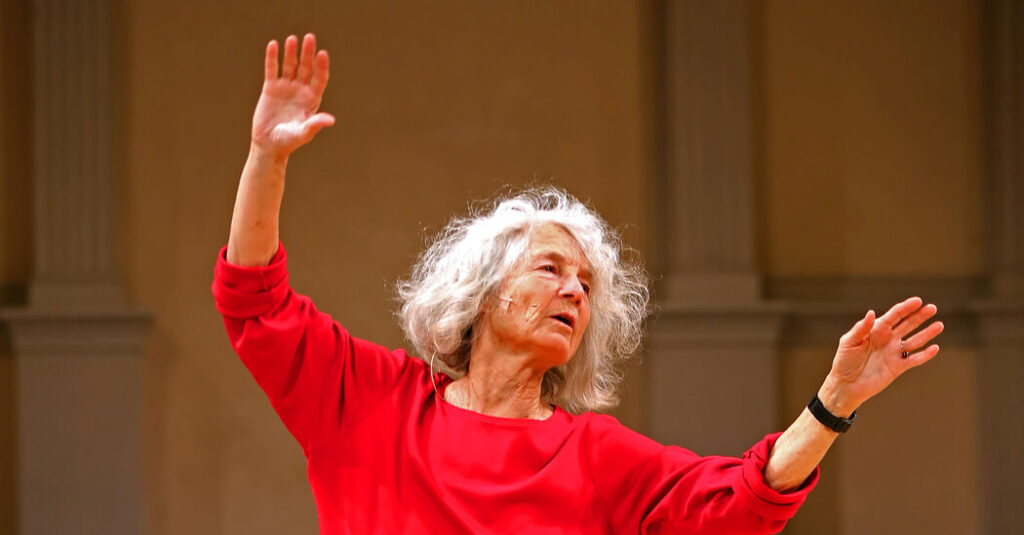
Simone Forti, the postmodern choreographer, writer, painter and self-described movement artist who took inspiration from everyday objects, children’s play, animals, Minimalism and LSD trips, and whose most influential works, which she called Dance Constructions, borrowed from both sculpture and performance, employed simple instructions and materials like plywood and rope, and are now part of the collection of the Museum of Modern Art, has died in Los Angeles. She was 91.
The Raffaella Cortese Gallery of Milan, which represented her, announced the death on social media but provided no further details. Ms. Forti had lived with Parkinson’s disease for several years, but continued to perform and teach into her late 80s.
Premiered at Yoko Ono’s Lower Manhattan loft in 1961, Ms. Forti’s groundbreaking Five Dance Constructions and Some Other Things was a suite of short pieces based on playground structures, improvisation and random chance. (The idea had been planted in her by the pioneering recent performances of Japan’s Gutai Art Association, whose artists crashed through paper panels and hurled fistfuls of mud.)
Prompted rather than choreographed, Ms. Forti’s works unfolded in the moment, their outcomes determined as much by physics as by the performers’ intentions.
In one of the five Dance Constructions, “Slant Board,” dancers scaled a tilted plywood panel strung with knotted ropes. In another, “Hangers,” they held onto ropes strung from the ceiling that swayed as other dancers walked between them. In “Huddle,” the members of a small ensemble climbed over each other to create changing forms, while in “Platforms,” two performers hid under boxes and whistled for 15 minutes. In “Accompaniment for La Monte’s ‘2 Sounds,’” set to a dissonant score by La Monte Young, one dancer spun on a suspended rope that another wound and unfurled.
The “other things” were originally shown at a 1960 “Happening” staged by the artists Claes Oldenburg and Jim Dine. One was “Rollers” (now called “Roller Boxes”), in which dancers pushed and pulled wheeled boxes that had other dancers inside them, and the other was “See Saw,” in which two performers executed mundane actions while riding the object of the title.
The 1961 premiere of the full program was “a watershed moment when the relationship between bodies and objects, movement and sculpture, was being fundamentally rethought,” Stuart Comer, the chief curator of media and performance at MoMA, said in a news release after the museum acquired the work in 2015.
The Dance Constructions had a profound effect on early postmodern choreographers like Steve Paxton, Lucinda Childs and Yvonne Rainer, who founded the avant-garde collective Judson Dance Theater, which broadly expanded the notion of what dance could be. (Despite her influence on its ethos, Ms. Forti was not a member of the group, which disbanded after a few years in 1964.)
In her memoir, “Feelings Are Facts,” Ms. Rainer recalled rehearsing “See Saw” with the Minimalist artist Robert Morris, Ms. Forti’s husband at the time. Ms. Forti threw a jacket on the floor and ordered Ms. Rainer to “perform that!” In response, Ms. Rainer “had a screaming fit on my end of the seesaw (don’t ask why), while Bob read an art magazine to himself at his end.”
In a 2019 tribute, Ms. Rainer said: “I am indebted to Simone for my awakening as a dancer. I can honestly say that my creative life began when I met her.”
Simonetta Forti was born on March 25, 1935, in Florence, Italy, to Mario Forti, who managed a clothing factory, and Milka (Greunstein) Forti. The Fortis were Jewish, and in the late 1930s the family, which included Simonetta’s older sister, Anna, escaped through Switzerland to the United States. They settled in Los Angeles, where Ms. Forti attended public schools and took informal dance lessons.
She and Mr. Morris met as students at Reed College in Oregon, where she studied humanities for two years before the couple dropped out, moved to San Francisco and married in 1955. Mr. Morris spurred Ms. Forti’s interest in painting, and after they moved to New York City in 1959, she earned a bachelor’s degree in fine arts from Hunter College. They divorced in 1962; her marriages to the theater artist Robert Whitman and the composer Peter Van Riper also ended in divorce. Ms. Forti had no children, and leaves no immediate survivors.
While living in San Francisco, Ms. Forti enrolled in Anna (then Ann) Halprin’s nature-based improvisation workshops in Marin County — Ms. Rainer was a fellow student — and performed with Ms. Halprin for four years.
“The main thing she taught me was how to learn from my own body intelligence,” Ms. Forti wrote in “Handbook in Motion,” a collection of memories and sketches published in 1974, and to “not discriminate against any movement we could experience.”
Her early aesthetic coalesced in New York, where she taught nursery school and took — and disliked — classes in the modern techniques of Martha Graham and Merce Cunningham. “I’m not an instrumentalist, I’m a composer,” she said years later. She felt at home in Robert Dunn’s composition-based classes, where she began to merge Ms. Halprin’s sensory approach with concepts, some about using chance procedures, espoused by composers like John Cage and artists like Robert Rauschenberg.
Her combination of emotion and intellect set Ms. Forti apart from some postmodernists of her era, whose work could tend cerebral and theoretical. In contrast, Ms. Forti regarded almost all movement, even falling leaves and the growth of cabbages, as a form of dance. She based another signature work, “Zoo Mantras” (1968), on the repetitive movements of zoo animals.
“I just recognized them as fellow dancers,” she said in a 2003 interview, “and it seemed that they’d found a way to bring a little richness into the poverty of their lives.”
New York also introduced her to LSD, which she tried at Woodstock in 1969 and took frequently while living in a commune for the next year. “On acid you really see things differently,” she said, crediting her psychedelic experiences with further expanding her artistic palette.
She studied tai chi, collaborated with the video artist Nam June Paik and other members of the Fluxus collective, and, in the mid-1970s, translated selected works into holograms that have been shown at the Los Angeles County Museum of Art and the Whitney Museum of American Art in New York.
Her improvisational News Animations, which premiered in 1987 and evolved over decades of new iterations, entailed newspapers and spoken word, referring to current events and alluding to her childhood. “I sometimes worry that I’ll die and be reborn in a place of war,” she recited in a 2012 performance at Danspace Project in New York.
Language was an essential creative outlet for Ms. Forti. Poetry and spontaneous monologues figured frequently in her work, and she contributed essays to Artforum and Movement Research magazines and developed a word-based improvisation practice she called Logomotion. A sought-after teacher, she also led workshops around the world and taught at schools including the University of California, Los Angeles.
In February 2023, the Venice Biennale presented her with its prestigious Golden Lion for lifetime achievement in dance. The Biennale’s director of dance, the British choreographer Wayne McGregor, described Ms. Forti as a “true arts genius” and said she had moved “freely and seamlessly between creative worlds, wildly mixing disciplines, and, in doing so, championed the primacy of body, or rather ‘thinking with the body,’ as a force for experimentation, play and (re)invention.”
Ms. Forti took the recognition in typical stride. “I didn’t know what the Golden Lion was,” she told The Times in 2023, when she also had a retrospective exhibition at the Museum of Contemporary Art in Los Angeles.
She added, “If someone has to take the role this year and stand there holding it, I am honored to be the one to do it for the community.”
When MoMA acquired the Dance Constructions, Mr. Comer said, “We’re particularly interested in the idea of body-to-body transmission, so we’ve been developing a new model of workshops with the organization Danspace Project to ensure that this work continues to inhabit the dance community and the new generations who will carry it forward.”
That workshop model informed performances of the works as part of the exhibition “Judson Dance Theater: The Work Is Never Done” in 2018, and a recent casting call from the museum sought performers for another iteration next February.
Ms. Forti said in 2015 that the museum, in acquiring the works, was really acquiring “the ability to have these pieces continue their life past when I do mine.”