

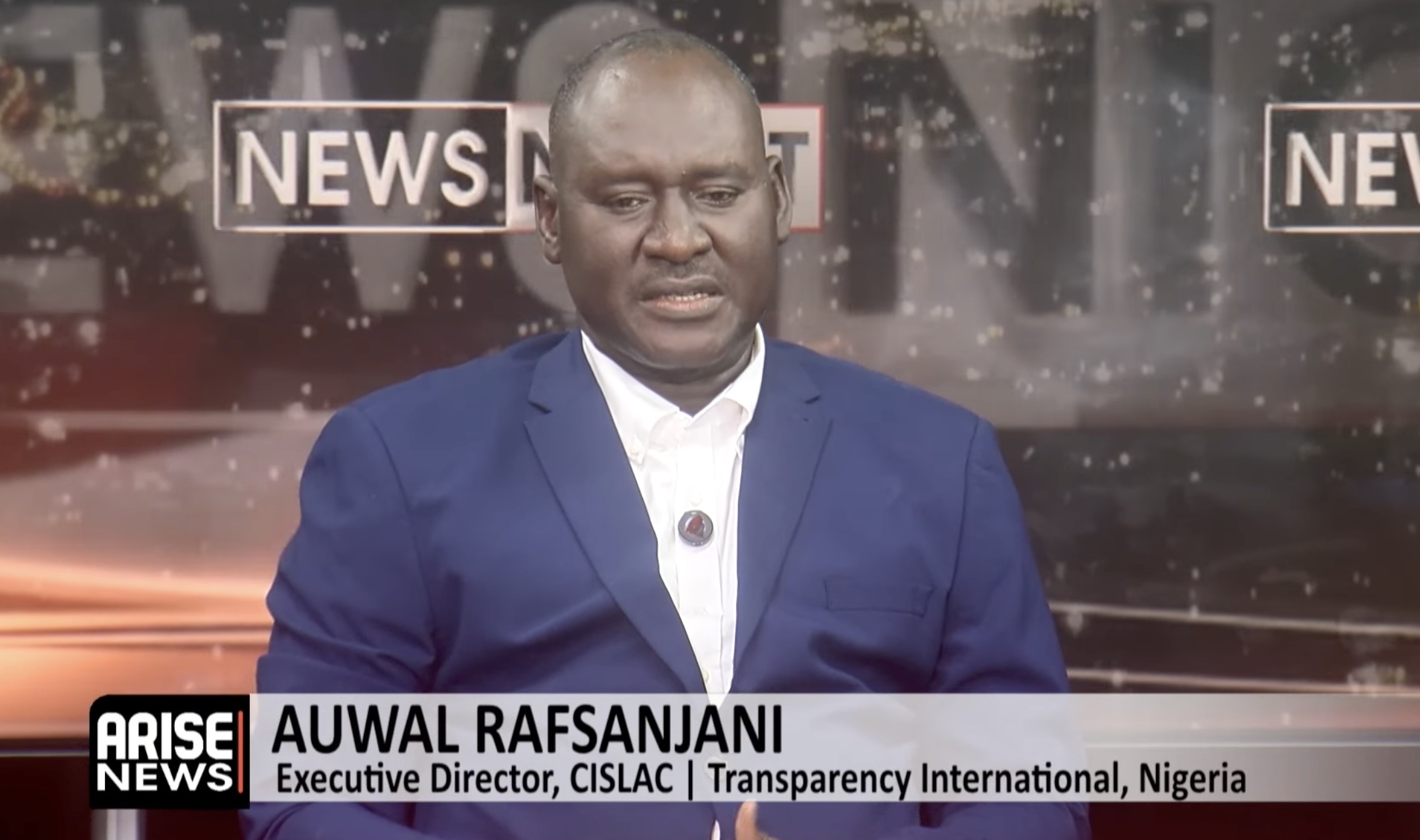
The Executive Director, Civil Society Legislative Advocacy Centre, (CISLAC), and Transparency International, Nigeria, Auwal Rafsanjani, has described the Presidential Foreign Investment Promotion Council, now being referred to by critics as a “phantom agency,” as a reflection of deep institutional failure.
Speaking with ARISE NEWS on Tuesday in an interview, Rafsanjani argued that an agency that allegedly does not legally exist could only have operated through the connivance of individuals within public institutions, and called for an independent investigation to uncover those responsible and ensure accountability.
Recall that the Presidential Foreign Investment Promotion Council came under scrutiny after questions were raised over its legal status, operations, and inclusion in the national budget, with critics referring to it as a “phantom agency.”
“First and foremost, this is really a very embarrassing situation to our country, and it further exposes the institutional failure in our country. It also shows that this kind of fraudulent agency exists only with the connivance and collaboration of many persons and some institutions. Otherwise, you ask yourself: how come an agency that does not exist is having an office space in the Federal Secretariat, and at the Secretariat of the Federation office?
“Our own opinion on this is that there must be an independent body that will be able to do this investigation, and the findings of it must be public. The persons involved, if found guilty, must be punished for us to redeem our reputation, because this has serious reputational damage for our institutions,” he stressed.
Rafsanjani further warned that the controversy risks deepening public distrust in government institutions, arguing that allegations of appointments being obtained through unofficial means must be addressed to restore confidence.
“Let us say the truth. We will always say the truth. A lot of Nigerians are making allegations that appointments are for sale in this country. That’s the allegation that many people are making. That means that people can purchase any appointment, and they don’t care about institutional integrity, they don’t care about the reputation of the country, they will just do whatever they will do to make the profit and recover their money. So, they don’t keep the country in their heart because they did not come through merit; they more or less bought the position.”
He also stressed the need for stronger oversight, including audits of presidential council agencies, to ensure public funds are properly accounted for and that institutions maintain credibility both domestically and internationally.
“Ideally, government should have audited all the presidential council agencies, because as it is now, there are a lot of agencies that are collecting budget, and the citizens don’t know what they are doing,” he said.
Recommending a comprehensive audit of government agencies, the CISLAC Executive director said authorities must verify their legal status, mandates, and leadership structures.
“In our opinion, I think first and foremost, we need to do an audit of the agencies and the establishments that we have in this country. Establish their status; establish who is actually their host personnel or who appointed the person.”
He added: “Number two, we need to review our administrative process and procedure in this country. We need to also ensure that all the agencies actually coordinate very well, because I believe that if there’s effective inter-agency coordination, you would not have seen this without being detected. I think we need to do something to ensure that we correct that impression.”
Questioning the credibility of ongoing investigations into the alleged phantom agency scandal, Rafsanjani argued that public confidence had been weakened by what he described as a premature position from the Presidency. He called for an independent, open, and transparent process to ensure all those involved are properly scrutinised and held accountable.
“First and foremost, there appears to be no confidence in this process because already the Presidency had made up its mind that the Chief of Staff is exonerated and is not involved. So even to call an ICPC investigation, it was Nigerian pressure that led to this. If Nigerians did not talk about it, they had already concluded that he was not involved.
“Why can’t you allow an independent, open, transparent process to checkmate all this? Now, if you remember, the Accountant General and the CBN were in denial before, but look at what happened at the public hearing. That is why it is so pity, so sad that the Senate decided not to even do anything on this matter. Senators are now saying that maybe, perhaps, they may have also been involved in one way or the other regarding this, because they are supposed to have exposed this during the budget defense, and they didn’t do that. Now, look at Nigerian citizens and say, ‘We are not going to investigate.’ This is part of the reason why the National Assembly exists, and some people who are in leadership positions in the National Assembly are mortgaging and destroying the reputation of this country.
“We will not let that happen. We will continue to say the truth; we will continue to let the Nigerian people know that what they are doing is anti-Nigeria and anti-our laws. They are not helping Tinubu. If they think that they are doing this thing to help Tinubu, they are actually embarrassing Tinubu,” he maintained.
Favour Odima
Follow us on: